
Uveitis isn’t just a red eye. It’s inflammation deep inside your eye - in the uvea, the middle layer that feeds the retina and iris. Left untreated, it can silently damage your vision, sometimes leading to permanent blindness. It’s the third leading cause of vision loss worldwide, yet most people don’t know the signs until it’s too late. If you’re experiencing sudden eye redness, pain when reading, light sensitivity, or floaters that won’t go away, this isn’t just tired eyes. It could be uveitis.
What Exactly Is the Uvea?
The uvea is made up of three parts: the iris (the colored part of your eye), the ciliary body (which helps focus your lens), and the choroid (a layer full of blood vessels that nourishes the retina). When inflammation hits any of these, it’s called uveitis. This isn’t surface-level irritation. It’s internal swelling that can crush the delicate structures inside your eye.
Think of it like a leaky pipe inside your home. You might not see the water at first, but over time, it rots the walls, warps the floors, and ruins the foundation. Uveitis works the same way - damage builds quietly until your vision starts to blur or fade.
Four Types of Uveitis - And Why It Matters
Not all uveitis is the same. Where the inflammation happens determines your symptoms, treatment, and risk level.
- Anterior uveitis (iritis) affects the front - the iris and ciliary body. This is the most common type, making up 75% to 90% of cases. Symptoms hit fast: intense redness, sharp pain, sensitivity to light, and blurry vision. It often affects just one eye and responds well to treatment if caught early.
- Intermediate uveitis (pars planitis) targets the vitreous - the jelly-like fluid in the middle of your eye. You won’t feel much pain, but you’ll notice floaters - dark spots or squiggles floating across your vision - and blurred sight. This type loves to stick around, turning chronic and flaring up for months or even years.
- Posterior uveitis hits the back of the eye: the retina and choroid. It’s the most dangerous. Vision loss can creep in slowly, often without pain. Many people don’t realize they have it until a routine eye exam reveals damage. It usually affects both eyes and carries the highest risk of permanent vision loss.
- Panuveitis means inflammation across all layers. It’s the most severe form. Symptoms combine everything: redness, pain, floaters, blurred vision, and rapid vision decline. It’s often linked to serious autoimmune or infectious diseases.
What Causes Uveitis? The Real Story
Doctors can find a clear cause in only about two-thirds of cases. The rest? Idiopathic - meaning no obvious trigger shows up on tests. That doesn’t mean it’s random. It means your immune system is attacking your eye for reasons we don’t fully understand yet.
When there is a cause, it usually falls into three buckets:
- Autoimmune diseases: Conditions like ankylosing spondylitis, multiple sclerosis, sarcoidosis, or rheumatoid arthritis can turn your immune system against your own eye tissue.
- Infections: Viruses like herpes simplex, herpes zoster (shingles), or cytomegalovirus (CMV) can trigger inflammation. Bacterial infections like syphilis or toxoplasmosis (from undercooked meat or cat litter) are also culprits.
- Trauma or surgery: A blow to the eye, a scratch, or even eye surgery can spark inflammation as your body tries to heal.
Here’s the catch: even if you have an autoimmune disease, uveitis doesn’t always happen. And if you have uveitis, you might never develop the full-blown disease. It’s not a guarantee - just a warning sign your body’s defenses are misfiring.
Why Steroids Are the First Line of Defense
Corticosteroids - powerful anti-inflammatory drugs - are the go-to treatment for almost every type of uveitis. They work fast. They reduce swelling. They stop tissue damage before it becomes permanent.
But how you get them depends on where the inflammation lives:
- Anterior uveitis: Steroid eye drops - like prednisolone acetate 1% - are the standard. You’ll start with drops every hour or two, then taper down over weeks as the swelling fades. Most people recover fully with this approach.
- Intermediate uveitis: Eye drops don’t reach deep enough. You’ll likely need a steroid injection around the eye (periocular) or an implant that slowly releases medication inside the eye (intravitreal).
- Posterior uveitis and panuveitis: Oral steroids like prednisone are often needed. Sometimes, you’ll get a combination of injections and pills. The goal is to get enough drug into the back of the eye to calm the inflammation.
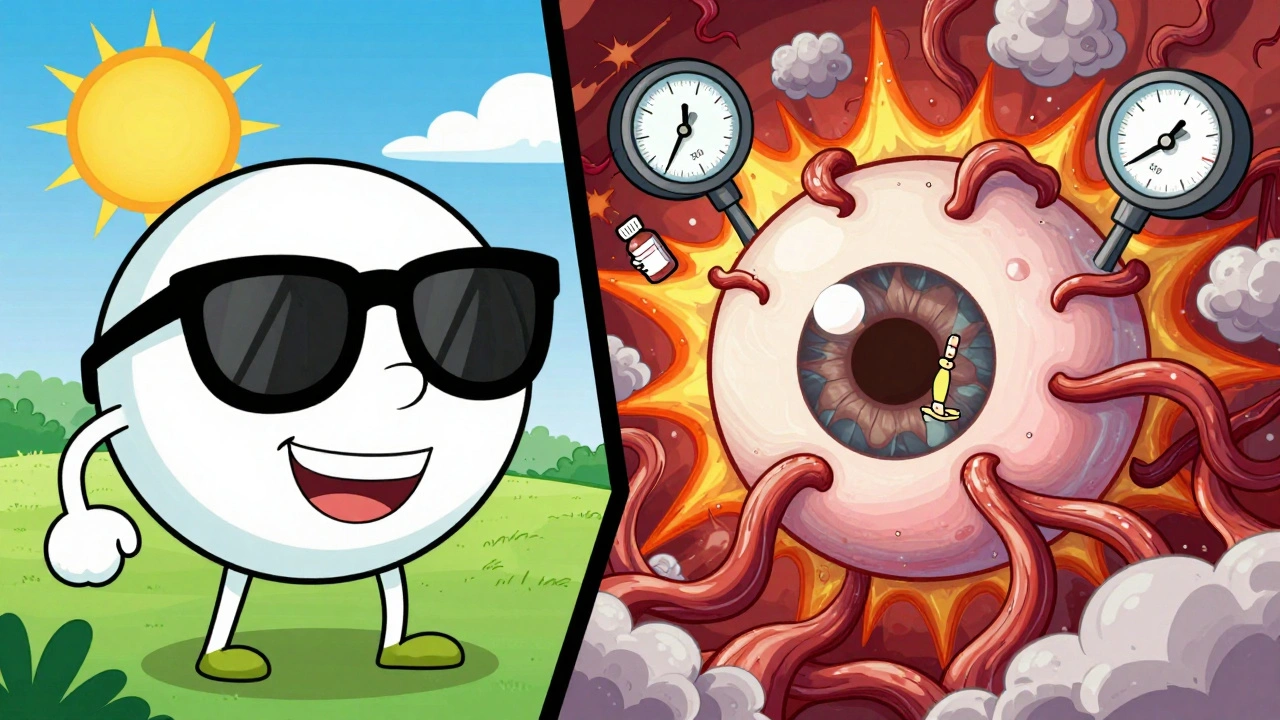
Timing is everything. The sooner you start steroids, the less likely you are to develop complications like macular edema (swelling in the central vision zone), synechiae (iris sticking to the lens), or glaucoma from increased eye pressure.
The Hidden Risk: Steroid Side Effects
Steroids save your vision - but they can hurt it too, if used too long.
Long-term steroid use raises your risk of:
- Cataracts: Clouding of the eye’s natural lens. Up to 40% of people on long-term steroids develop them.
- Steroid-induced glaucoma: Pressure builds inside the eye, damaging the optic nerve. This can happen even without symptoms.
- Increased infection risk: Steroids suppress your immune system. A simple eye scratch can turn serious.
That’s why doctors don’t just prescribe steroids and walk away. They monitor you closely - checking eye pressure, scanning for cataracts, and adjusting doses. For chronic cases, they often switch to steroid-sparing drugs like methotrexate or mycophenolate. These slow your immune system down without the same side effects.
When to See a Doctor - Right Now
Uveitis doesn’t wait. It doesn’t care if it’s Monday or you’re busy. If you notice any of these, get to an eye specialist within 24 hours:
- Redness that doesn’t go away after a day or two
- Pain that gets worse when you read or focus
- Sudden floaters or flashes of light
- Blurry vision that doesn’t clear up with glasses
- Extreme sensitivity to light - even indoor lighting hurts
Don’t wait for it to get worse. Don’t assume it’s allergies or dry eyes. If your eye feels off, especially with pain or vision changes, treat it like an emergency. Early treatment can mean the difference between seeing clearly and losing sight.
What Happens If You Ignore It?
Uveitis can scar your iris, stick your pupil to your lens, swell your retina, or destroy your optic nerve. Once that damage is done, it’s often permanent. You might not go completely blind - but you could lose your central vision, your color perception, or your ability to read or drive.
Chronic cases - especially intermediate and posterior uveitis - can flare again and again. Each flare adds more damage. That’s why long-term management isn’t optional. It’s survival.
Living With Uveitis: Beyond Steroids
Once the inflammation is under control, you’re not done. You need follow-ups - every few weeks at first, then every few months. Your doctor will check your eye pressure, take images of your retina, and watch for signs of recurrence.
If you have an underlying autoimmune disease, you’ll likely work with a rheumatologist. Controlling your whole-body inflammation helps keep your eyes safe.
Wear sunglasses outdoors. Bright light can irritate inflamed eyes. Avoid smoking - it worsens inflammation. And never skip your eye drops, even if your eye looks fine. Stopping too soon can trigger a flare.
Uveitis isn’t something you cure and forget. It’s a condition you manage. But with the right care, most people keep their vision for life.
Can uveitis go away on its own?
Sometimes, especially in mild anterior uveitis, symptoms may improve without treatment. But that doesn’t mean the inflammation is gone. Left untreated, it can cause permanent damage like synechiae, glaucoma, or macular edema. Even if your eye looks better, you still need an eye doctor’s evaluation to prevent long-term vision loss.
Are steroid eye drops safe for long-term use?
No. Long-term use of steroid eye drops increases your risk of cataracts and steroid-induced glaucoma. That’s why doctors prescribe them for the shortest time possible and monitor eye pressure closely. For chronic uveitis, steroid-sparing medications are added to reduce or replace steroid use over time.
Can uveitis affect both eyes?
Yes. While anterior uveitis often starts in one eye, intermediate, posterior, and panuveitis frequently affect both eyes. Even if only one eye shows symptoms now, the other could be inflamed without obvious signs. That’s why regular eye exams are critical - even for the "good" eye.
Is uveitis contagious?
No. Uveitis itself isn’t contagious. But if it’s caused by an infection like herpes or toxoplasmosis, the underlying germ can be spread - though not the eye inflammation itself. You can’t catch uveitis from someone else’s red eye.
How long does steroid treatment last for uveitis?
It varies. Anterior uveitis may need drops for 2 to 6 weeks. Intermediate or posterior uveitis often requires months of treatment - sometimes longer. The goal is to use the lowest dose for the shortest time to control inflammation. Tapering too fast can cause a flare-up. Your doctor will adjust based on your response and eye scans.
Can children get uveitis?
Yes. Juvenile idiopathic arthritis is a common cause in children. Kids often don’t complain of pain or redness - they might just squint, avoid bright light, or have trouble focusing. Routine eye screenings are essential for children with autoimmune conditions, even if they show no eye symptoms.
Comments
Deborah Jacobs
December 5, 2025 AT 00:42This hit me hard. My sister had uveitis after her autoimmune flare-up-she thought it was just allergies until she couldn’t read her own name. The way you compared it to a leaky pipe? Perfect. I didn’t realize how silently it eats away at vision. Thank you for making this so clear.
She’s doing okay now-steroid drops for three months, then switched to methotrexate. Still gets checked every six weeks. Eyes are stable. But man, if I hadn’t pushed her to see a specialist, she’d have lost central vision for sure.
James Moore
December 5, 2025 AT 08:53Let me tell you something-this whole medical-industrial complex is exploiting people’s fear of blindness to push steroid regimes that are barely better than placebo with a side of cataracts! You think this is science? It’s corporate profit wrapped in Latin terms! The uvea? Who even cares? What matters is that Big Pharma knows you’ll do anything to avoid going blind-so they sell you a slow poison disguised as salvation!
Have you ever heard of herbal remedies? Turmeric? Omega-3s? Cold laser therapy? No? Because they’re not patentable, that’s why! Your doctor won’t tell you because he’s on their payroll! I’ve seen patients reverse uveitis with diet and meditation-no steroids, no injections, no eye pressure nightmares. The system doesn’t want you to know this.
And don’t get me started on the ‘rheumatologist’ hustle-another cog in the machine! Wake up, people! Your body can heal itself-if you stop letting them pump you full of poison!
Also-why are we even using ‘steroids’? That word alone should trigger alarm bells. Steroids? Like the ones bodybuilders use? Are we turning people into steroid zombies now?!
Chris Brown
December 6, 2025 AT 10:08It is, of course, regrettable that the medical community continues to rely on such blunt instruments as corticosteroids when more precise, targeted therapies have been available for decades. The fact that patients are still being subjected to the indiscriminate suppression of their immune systems-thereby increasing their vulnerability to opportunistic infections and long-term ocular damage-is not merely a clinical oversight; it is a moral failure.
One cannot help but wonder whether the persistence of this paradigm is rooted in institutional inertia, or whether there is a deeper, more troubling reluctance to acknowledge the limits of pharmaceutical intervention in complex autoimmune conditions. The evidence is clear: long-term steroid use correlates directly with cataractogenesis and glaucomatous optic neuropathy. Yet, we persist.
Perhaps the answer lies not in more drugs, but in more humility.
And yes, I am aware that my tone may come across as… severe. But when vision is at stake, severity is warranted.
Mark Curry
December 8, 2025 AT 01:56Yeah, this is super important. I had a friend who ignored his red eye for weeks because he thought it was pink eye. By the time he went in, it was posterior uveitis. Lost 30% of his vision in one eye.
He’s on methotrexate now. Doesn’t have to use steroids anymore. Still gets checked every few months. He says the hardest part isn’t the meds-it’s remembering to wear sunglasses. Even on cloudy days.
Just… don’t wait. If your eye feels weird, go. It’s not a big deal until it is.
🙏
Manish Shankar
December 8, 2025 AT 10:16Thank you for this meticulously detailed and clinically accurate exposition on uveitis. As a medical professional from India, I have encountered numerous cases where delayed diagnosis led to irreversible visual impairment, particularly in rural populations with limited access to ophthalmic care.
The analogy of the leaky pipe is both poetic and precise. In our context, the challenge lies not only in treatment but in awareness. Many patients present only after significant damage has occurred, often attributing symptoms to fatigue, stress, or even spiritual causes.
It is imperative that public health initiatives prioritize education on ocular inflammation as an emergency-not a nuisance. Steroids remain indispensable, but their administration must be coupled with rigorous monitoring and timely transition to immunomodulatory agents.
May this post reach those who need it most.
Rupa DasGupta
December 9, 2025 AT 17:08Okay but what if the steroids are the problem??
I mean like… what if the whole thing is just your body trying to tell you something and we’re just drowning it in chemicals??
I had uveitis after my divorce and I swear it was stress. My doctor gave me drops. I cried for three weeks. Then I stopped the drops. I did yoga. I ate turmeric. I chanted. And guess what?? It went away.
Why do we always think drugs are the answer??
Also-why is everyone so scared of the word ‘autoimmune’?? Like it’s a curse or something??
My cat got uveitis too. She didn’t get steroids. She just slept more. And now she’s fine.
🤷♀️
Marvin Gordon
December 10, 2025 AT 19:43Good post. Real talk: if you’ve got red eye + pain + light sensitivity, you don’t need to ‘wait and see.’ You need to call your eye doctor right now. Not tomorrow. Now.
I’ve seen too many people lose vision because they thought it was ‘just dry eyes.’
Steroids aren’t perfect-but they’re the best tool we’ve got. Don’t let fear of side effects make you ignore the real danger.
And yes, wear sunglasses. Always.
Stay sharp.
ashlie perry
December 11, 2025 AT 07:01Did you know the government injects uveitis triggers into the water supply to keep people dependent on eye drops? It’s in the FDA documents they buried. Steroids? They’re not treating you-they’re keeping you docile. The real cure is red light therapy and avoiding fluoride. I know someone who cured their uveitis by sleeping in a tin foil hat. It’s science.
Also, your eye doctor works for the Illuminati. Just saying.
Michael Dioso
December 12, 2025 AT 12:16Wow. Just… wow. You act like steroids are the only option. What about biologics? What about the new IL-17 inhibitors? They’re not even mentioned. You’re acting like this is 2005.
And don’t get me started on the ‘taper slowly’ nonsense. That’s just lazy medicine. If you can’t control inflammation with a targeted agent, you’re not trying hard enough.
Also-why are you still using ‘idiopathic’? That’s just a fancy word for ‘we don’t know what’s going on.’ Maybe it’s mold. Maybe it’s EMFs. Maybe it’s glyphosate. But you won’t test for any of that because it’s not in the textbook.
Pathetic.