

The first thing to understand is that not every skin reaction is a true allergy. There is a big difference between an irritant reaction and an allergic one. An irritant reaction is like a chemical burn; the substance simply damages your skin barrier. An allergic reaction, however, is a delayed type IV hypersensitivity. This means your immune system has "remembered" the substance from a previous encounter and is now launching a full-scale attack. It is common for people to mistake one for the other, and about 15-20% of suspected allergies are actually just irritation.
The Most Common Culprits in Your Medicine Cabinet
You might be surprised by what triggers these reactions. While we often think of "harsh" chemicals, some of the most common allergens are medications designed to help us heal. Antibiotics are the biggest offenders. Neomycin is a frequent trigger, appearing in nearly 10% of positive patch tests, followed closely by Bacitracin and Gentamicin. If you have a "triple antibiotic" ointment and your skin is reacting, one of these is likely the cause.
Then there are the painkillers and numbing agents. Benzocaine, often found in over-the-counter teething gels or throat lozenges, can cause a reaction in about 2% of tested patients. Similarly, nonsteroidal anti-inflammatory drugs (NSAIDs) like Ketoprofen used in topical gels can trigger dermatitis. Perhaps most frustrating is the allergy to Corticosteroids themselves. About 0.5% to 2.2% of people are actually allergic to the very steroids used to treat rashes, leading to a cycle where the medicine makes the condition worse.
How Doctors Pinpoint the Exact Allergen
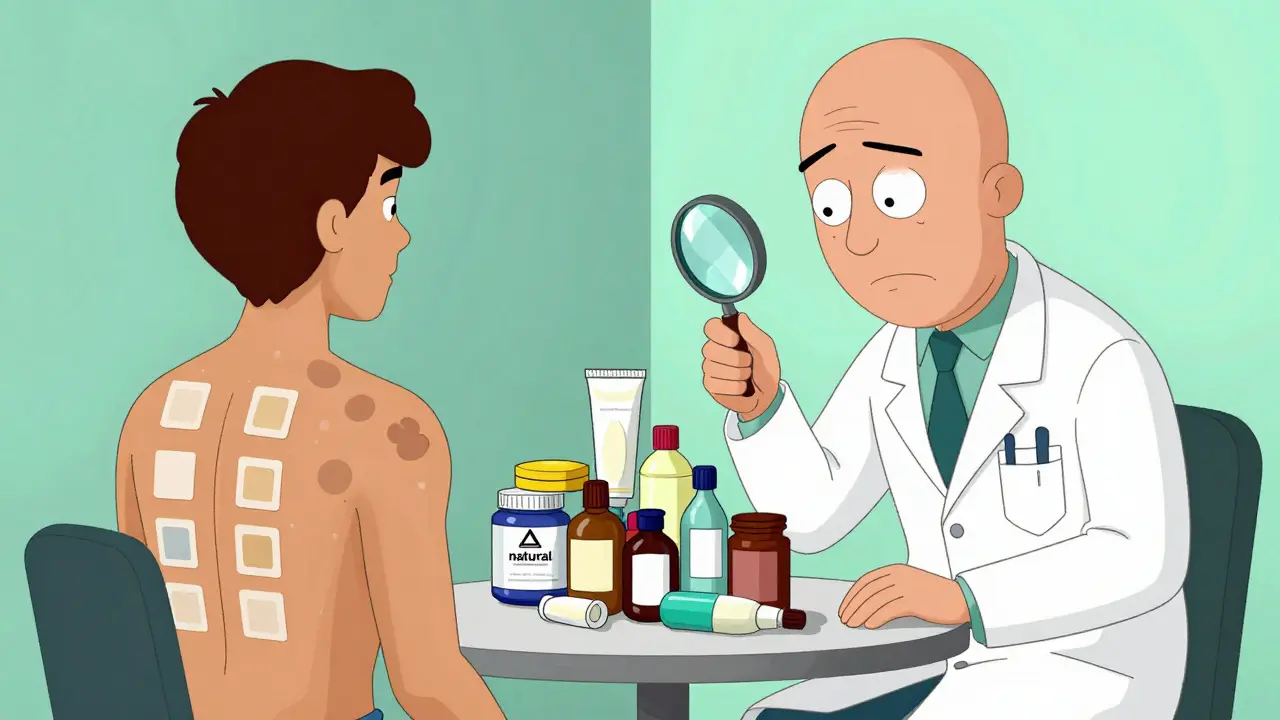
You can't guess your way out of a medication allergy; you need a systematic approach. The gold standard for diagnosis is patch testing, a process where suspected allergens are applied to the skin under adhesive patches for 48 hours. A doctor reads the results at 48 hours and again at 96 hours. This timeline is crucial because allergic contact dermatitis is a "delayed" reaction-it doesn't happen instantly like a bee sting; it takes a few days for the immune system to react.
This method is remarkably effective, identifying the cause in roughly 70% of suspected cases. A pro tip if you are heading to a dermatologist: bring every single tube, bottle, and cream you use. About 30% of the time, the trigger isn't the active medication but an inactive ingredient in a "natural" or non-prescription product that you wouldn't even think to mention.
| Medication Class | Common Example | Estimated Patch Test Positivity | Typical Use Case |
|---|---|---|---|
| Antibiotics | Neomycin | 9.9% | Cuts, scrapes, skin infections |
| Antibiotics | Bacitracin | 7.5% | Preventing wound infection |
| Anesthetics | Benzocaine | 2.1% | Local numbing, sore throats |
| NSAIDs | Ketoprofen | 1.8% | Joint pain, muscle inflammation |
| Corticosteroids | Hydrocortisone | 0.5% - 2.2% | Eczema, itching, inflammation |
Treatment Strategies: From Mild to Severe
Once you stop using the offending drug, the priority is to calm the skin down. For mild cases, a low-dose over-the-counter hydrocortisone cream often does the trick. However, if the reaction is more intense, doctors move to mid- or high-potency steroids like Triamcinolone or Clobetasol. But here is where you have to be careful: using high-potency steroids on "thin skin" areas-like your eyelids, face, or groin-can lead to skin atrophy (thinning) in up to 35% of patients if used for more than two weeks.
For those sensitive areas, dermatologists prefer Topical Calcineurin Inhibitors, non-steroidal creams that modulate the immune response without thinning the skin. Tacrolimus (Protopic) and Pimecrolimus (Elidel) are the go-to options here. While they can cause a burning sensation initially, they are often more effective for medication-induced dermatitis than standard steroids.
In extreme cases, where the rash covers more than 20% of your body, topical creams aren't enough. You may need systemic treatment, such as a course of Prednisone. When taken as a tapered dose over a few weeks, this can provide relief to 85% of severe cases within the first 24 hours.

Navigating Cross-Reactivity and Long-Term Care
If you are allergic to one steroid, does that mean you can't use any? Not necessarily. Steroids are divided into groups (A through F) based on their chemical structure. For example, if you react to a Group A steroid like hydrocortisone, you can often safely use a Group B steroid like triamcinolone. Understanding these groups can reduce your treatment limitations by 65%, meaning you still have plenty of options for managing your skin.
The real key to long-term success is total avoidance. Research shows that 89% of chronic cases resolve completely within four weeks once the trigger is removed. Compare that to only 32% resolution when patients use medications to treat the symptoms without ever finding and removing the cause. It’s the difference between putting out a fire and just spraying perfume on the smoke.
For those who struggle to identify hidden ingredients, some people now use specialized databases or apps that cross-reference product ingredients with known allergens. With the FDA now requiring complete ingredient lists on prescription topicals, it's becoming much easier to scan a label and spot a danger zone before the cream ever touches your skin.
How do I know if my cream is causing an allergy or just irritating my skin?
An irritant reaction usually happens quickly and feels like a sting or burn immediately after application. An allergic reaction is typically delayed; you might not notice anything for 48 to 72 hours, after which the area becomes intensely itchy, red, and possibly blistered. A patch test performed by a dermatologist is the only way to know for sure.
Can I use a different brand of the same medication?
It depends. If you are allergic to the active ingredient (like Neomycin), no brand of that drug will be safe. However, if you are allergic to a preservative or a fragrance used by one specific manufacturer, a different brand might be perfectly fine. This is why ingredient analysis during a doctor's visit is so important.
Why does my doctor suggest Tacrolimus instead of a steroid for my face?
The skin on your face is much thinner than the skin on your elbows or knees. High-potency steroids can cause permanent skin thinning (atrophy) or visible blood vessels if used on the face for too long. Tacrolimus is a "steroid-sparing" agent that manages inflammation without changing the skin's structure.
How long does it take for the rash to go away after stopping the medication?
Once you stop the allergen, itching usually decreases within 48 to 72 hours. However, complete resolution of the skin lesions typically takes 2 to 4 weeks. If the rash doesn't improve after a month of strict avoidance, you may have an undiagnosed secondary trigger.
Are there any "natural" alternatives that are safer?
"Natural" doesn't always mean "safe." Many botanical extracts are potent allergens. Instead of switching to unverified natural products, focus on microbiome-friendly barrier creams that protect the skin surface. Always patch-test any new product on a small area of your forearm for 48 hours before applying it to a larger affected area.
Comments
Jay Vernon
April 5, 2026 AT 08:47This is super helpful! I never knew some creams could make things worse 😮👍
jack hunter
April 6, 2026 AT 08:47imagine believing a doctor can just patch test your way to happines lol its all just a cycle of big pharma making you think your skin is broken when its actually just the world being toxic and we are the ones paying for the cure that causes the illness ironic isnt it
Danielle Kelley
April 8, 2026 AT 07:24Exactly! They want you addicted to those steroids! Once you start the cycle of "thinning skin" and "replacement creams," you're just a customer for life in their twisted game. Don't trust the FDA labels, they leave out the real toxins that trigger the immune response on purpose!
Srikanth Makineni
April 8, 2026 AT 22:36Neomycin is a nightmare. Switch to plain petroleum jelly for small cuts
Toby Sirois
April 9, 2026 AT 19:43Actually, using petroleum jelly is a rookie mistake if you have an actual infection. You need to understand that the skin barrier is complex. Most people just don't have the discipline to follow a real regimen. If you can't handle a bit of itching while you figure out the allergen, you're just weak. I've seen this a thousand times and it's always a lack of basic knowledge about biology.
Jitesh Mohun
April 10, 2026 AT 19:23stop talking about weakness and look at the facts just get the patch test and stop guessing people
Nikhil Bhatia
April 10, 2026 AT 22:46Too much text for a basic skin rash
Brady Davis
April 11, 2026 AT 07:16Oh no, a cream made my skin red! Truly a tragedy for the ages! I'm simply devastated that I have to read a label before applying something to my body! Someone call the paramedics immediately!
shelley wales
April 12, 2026 AT 07:49It can be so overwhelming to deal with these reactions, but it's great that there are different groups of steroids to try. Just take it one step at a time and be patient with your healing process!
Dhriti Chhabra
April 13, 2026 AT 10:36I find the distinction between an irritant reaction and a hypersensitivity response to be most enlightening. It is truly prudent to maintain a comprehensive list of all topical applications when consulting a medical professional.
Timothy Burroughs
April 14, 2026 AT 03:08Only in America do people need a manual to put on a cream!! In a real country we just use common sense and don't whine about "burning sensations" while using medicine. You people are so soft its embarrassing to watch the decline of the west through a skin care post
Alexander Idle
April 15, 2026 AT 04:32I must say, the sheer audacity of the pharmaceutical industry to sell us the poison and the antidote in the same aisle is simply exquisite theater! I'm absolutely floored by the irony of it all! Truly, the comedy is in the chemistry!
Ruth Swansburg
April 15, 2026 AT 13:31Stay strong everyone. You can find the cause. Keep going!
Sarabjeet Singh
April 16, 2026 AT 23:36Just keep at it. The right treatment is out there for everyone.
charles mcbride
April 17, 2026 AT 20:59The point about the 48-to-96 hour window for patch tests is incredibly important. Many of us just assume that if it doesn't itch immediately, it's safe, but the delayed response is where the real danger lies. It's essentially a slow-burn reaction that catches you off guard. I've had a few experiences where I thought a product was fine for the first two days, only to wake up on day three looking like I'd been attacked by a swarm of bees. This is exactly why the systematic approach mentioned here is the only way to go. Trying to guess is just a gamble with your skin health. If you're dealing with chronic issues, please just go to the derm and bring your whole cabinet of creams. It saves so much time in the long run and prevents you from accidentally reapplying the trigger. Plus, understanding the chemical groups of steroids can be a total game-changer for those of us who react to the common stuff. It’s not about giving up on medicine, it’s about finding the specific one that doesn’t fight your body. Just be patient with the process because the resolution takes a few weeks, not a few hours. Stick with the avoidance strategy and you'll likely see that 89% success rate. It's all about the long game here.