

When you're on levothyroxine for hypothyroidism, the time you take your pill matters more than you might think. It’s not just about remembering to take it - it’s about when you take it. A single cup of coffee, a bowl of oatmeal, or even a calcium supplement can cut your medication’s effectiveness by up to 40%. And if your TSH levels keep creeping up despite taking your pill every day, the problem might not be your dose - it’s your timing.
Why Timing Matters for Levothyroxine
Levothyroxine is a synthetic version of the thyroid hormone T4. Your body needs it to regulate metabolism, energy, temperature, and brain function. But this medication doesn’t work well if your stomach is full. Studies show that only 60% to 80% of the dose gets absorbed when taken with food - compared to nearly 90% when taken on an empty stomach. That’s a huge difference.The reason? Levothyroxine needs an acidic environment to dissolve and be absorbed. Food, especially high-fiber meals, soy, coffee, and dairy, raises stomach pH and blocks absorption. Even a light snack can reduce effectiveness by 15-20%. And it’s not just food - calcium, iron, antacids, and proton pump inhibitors (like omeprazole) can interfere too.
When absorption drops, your body doesn’t get enough hormone. Your TSH (thyroid-stimulating hormone) rises. That’s when you start feeling tired again, gain weight, or struggle with brain fog - even though you’re taking your pill. In fact, 15-30% of people on levothyroxine need dose adjustments each year simply because their timing is off.
The Gold Standard: Morning Fasting
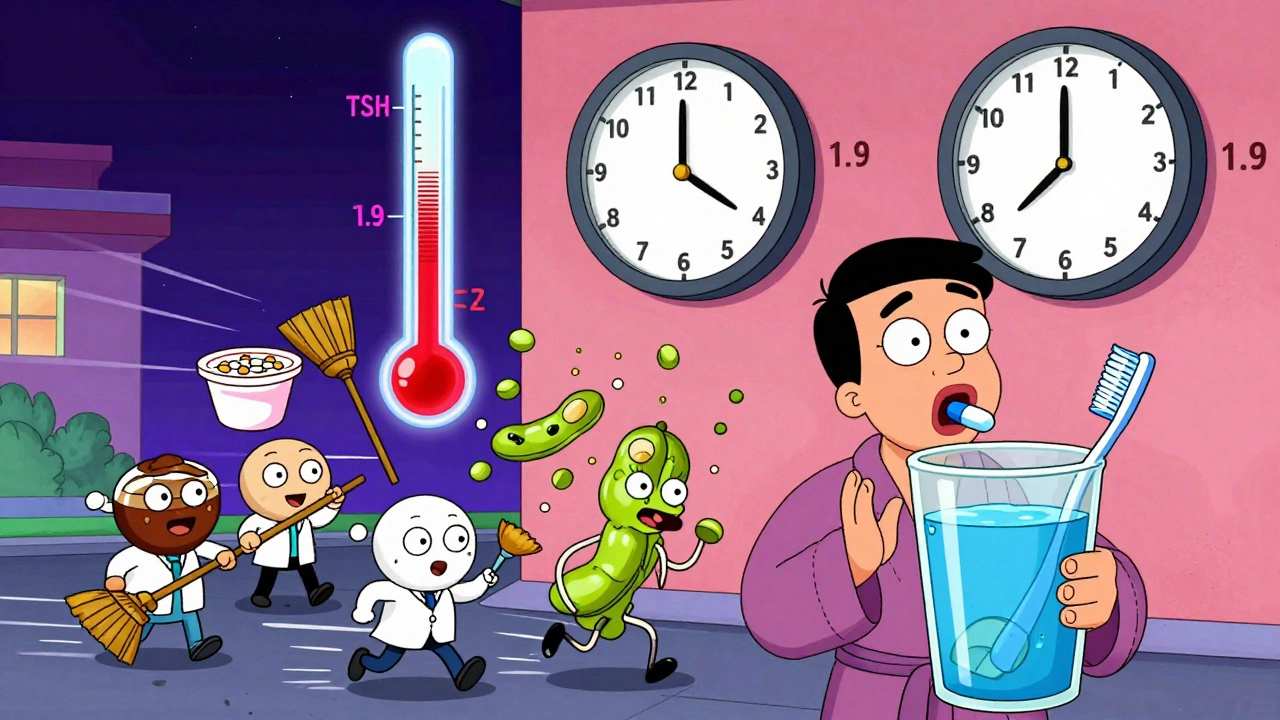
The most recommended method is taking levothyroxine 30 to 60 minutes before breakfast. This is backed by the American Thyroid Association, the FDA, and most endocrinologists. Why? Because your stomach is empty, your acid levels are low, and there’s no food or drink to interfere.Studies show this method gives the most stable TSH levels. In one trial with 45 patients, those who took their pill before breakfast had average TSH levels of 1.9 mIU/L. Those who took it with food jumped to 2.9 mIU/L - still in the normal range, but far from optimal. For people with thyroid cancer or those needing tight TSH control (0.1-0.5 mIU/L), this gap can be dangerous.
Here’s how to do it right:
- Take your pill first thing in the morning, right after waking up.
- Drink a full glass of water - this helps the tablet dissolve and move through your system.
- Wait at least 30 minutes (preferably 60) before eating or drinking anything else.
- Avoid coffee, juice, milk, or even tea during that time.
Many people find it helps to keep the pill bottle next to their toothbrush. That way, brushing your teeth becomes the cue to take your medication - no thinking required.
Bedtime Dosing: A Viable Alternative?
Some patients struggle with the morning routine. Maybe they’re rushed, have kids to feed, or get stomach upset from taking it on an empty stomach. That’s where bedtime dosing comes in.Research on this is mixed. One 2010 study found patients taking levothyroxine at bedtime had 27% higher absorption and lower TSH levels than those taking it in the morning. But another study in 2011 showed the opposite. A 2022 trial with 150 patients found no difference in TSH control between morning and evening dosing - as long as both were done on an empty stomach.
The key phrase here is on an empty stomach. For bedtime dosing to work, you need to wait at least 3-4 hours after your last meal. That means no late-night snacks, no bedtime yogurt, no milk before sleep.
Here’s what patients say:
- "Switching to bedtime dosing stabilized my TSH after 3 years of fluctuations. My endocrinologist was skeptical - but my labs proved it worked." - Reddit user ThyroidWarrior42
- "I finally stopped feeling tired. I take it at 10 PM, and I don’t have to rush in the morning." - Drugs.com review
Adherence is also better with bedtime dosing. One survey found 79% of patients stuck with evening dosing, compared to 63% with morning dosing. If you can’t stick to the morning routine, bedtime might be your best shot.
What You Must Avoid
Some things are absolute no-gos within 4 hours of taking levothyroxine:- Calcium supplements - reduce absorption by 27-36%
- Iron supplements - cut absorption by 39-59%
- Coffee - drops absorption by 9-14%
- Soy products - reduce uptake by 20-30%
- High-fiber meals - cut absorption by 15-25%
- Proton pump inhibitors (like Nexium, Prilosec) - reduce absorption by 15-22%
If you take calcium or iron, take them at least 4 hours after your thyroid pill. Same with antacids. If you’re on a PPI for acid reflux, talk to your doctor - you may need a higher levothyroxine dose.
And yes - even decaf coffee can interfere. The issue isn’t caffeine. It’s the compounds in coffee that bind to the hormone. Same goes for green tea or black tea. Stick to water.
What About Other Forms of Levothyroxine?
Most people take levothyroxine as a tablet. But there are other options:- Soft gel capsules (Tirosint) - less affected by food. Studies show only 8-12% absorption drop with food, compared to 20-30% for tablets.
- Oral solution - dissolves quickly, may be easier for people with stomach issues.
These are more expensive - $30-$50 a month vs. $10 for generics. But if you’ve tried everything and still can’t get your TSH stable, they might be worth considering. The FDA has approved these formulations specifically for patients with absorption problems.
Real-Life Challenges and How to Solve Them
Let’s be honest - sticking to a strict routine is hard.- "I forget to wait 30 minutes." - Set two alarms: one for taking the pill, one for breakfast. Use a pill organizer labeled "NO FOOD FOR 60 MIN."
- "I take my pill with my coffee because I need it to wake up." - Swap coffee for water in the morning. You’ll feel better without the crash later.
- "I get stomach pain taking it on an empty stomach." - Try bedtime dosing. Or switch to Tirosint. Some patients report less discomfort with liquid forms.
- "I travel a lot." - Pack extra pills. Stick to your routine even in different time zones. If you can’t wait 30 minutes, take it 4 hours after your last meal.
Apps like MyThyroidMedication help track doses and TSH trends. One study showed a 34% improvement in adherence with app use.
What If Your TSH Is Still High?
If you’ve followed all the rules - morning fasting, no coffee, no calcium, no soy - and your TSH is still above 3.0 mIU/L, talk to your doctor. Possible reasons:- You’re on a generic brand that varies in absorption between batches.
- You’re taking another medication that interferes (like antacids or cholesterol drugs).
- You have celiac disease, H. pylori, or another gut condition affecting absorption.
- Your dose is simply too low.
Don’t adjust your dose yourself. TSH levels take 6-8 weeks to stabilize after a change. Keep a log of your timing, meals, and symptoms. Bring it to your next appointment.
The Bottom Line
Levothyroxine works best when you treat it like a precise tool - not just another pill. The goal isn’t just to take it. It’s to take it right.Best option? 30-60 minutes before breakfast, with water, no food or drink for an hour.
Can’t do that? Bedtime, 3-4 hours after dinner, is your next best choice.
Whatever you choose - stick to it. Consistency matters more than perfection. Your TSH levels will thank you.
Comments
nikki yamashita
December 12, 2025 AT 02:25OMG YES I switched to bedtime dosing last year and my brain fog literally vanished. No more 2pm crashes either. Water only, no snacks after 7pm, and boom - TSH stable for 14 months. 🙌
wendy b
December 13, 2025 AT 19:50Actually, the real issue is that most docs dont even know this stuff. I had to read 12 papers to convince mine that coffee was wrecking my absorption. The FDA guidelines? Barely taught in med school. Sad.
Audrey Crothers
December 14, 2025 AT 07:23THIS. I was taking it with my morning smoothie for YEARS. Felt like a zombie. Switched to water + 60 min wait and now I have energy to run 5Ks. Thank you for this post!! 💪
Adam Everitt
December 16, 2025 AT 02:20One might argue that the body’s circadian rhythm governs not only cortisol but also thyroxine receptor sensitivity - and that timing is less about stomach pH and more about hormonal synergy. The fasting window? A crude proxy for a deeper physiological alignment.
Lawrence Armstrong
December 17, 2025 AT 00:49Just started Tirosint last month. Expensive? Yeah. Worth it? Absolutely. My TSH dropped from 4.8 to 1.6 in 8 weeks. No more guessing. No more coffee guilt. 🎯
Laura Weemering
December 17, 2025 AT 09:54Did you know the pharmaceutical industry funds most of the 'morning dosing' studies? They want you to take it with your $10 generic - not the $50 softgel. The real agenda? Profit, not your health.
Reshma Sinha
December 19, 2025 AT 01:50Been on levo for 7 years. Bedtime works for me - but only if I avoid soy sauce. Yes, even that tiny splash in stir fry ruined my labs. TSH spiked. Lesson learned.
Donna Anderson
December 20, 2025 AT 20:22i took mine w my coffee for 3 yrs… then one day i just tried it right when i woke up… like 2 weeks later i felt like a new person. why did no one tell me this sooner???
Stacy Foster
December 21, 2025 AT 22:13They’re lying about calcium interference. My endo said it’s fine if I take it 2 hours apart. Then my TSH went to 8.0. I found out later he doesn’t even read labs. Big Pharma’s puppet.
Rob Purvis
December 23, 2025 AT 04:23Important note: if you’re on a generic brand and your TSH keeps fluctuating, try switching manufacturers - batch variability is real. I went from Amneal to Teva and my levels stabilized overnight. Document your pill’s imprint code and stick with one.
sandeep sanigarapu
December 23, 2025 AT 09:25Consistency is key. I take mine at 10:30 PM every night, no exceptions. Even on weekends. Even when traveling. My TSH is perfect. Simple. No drama.
Robert Webb
December 24, 2025 AT 15:49For anyone struggling with morning routines - consider setting a phone reminder labeled 'THYROID TIME' that plays a chime. Pair it with a visual cue like leaving your water glass on the counter overnight. Behavioral psychology shows that environmental triggers reduce cognitive load by 40%. Small systems > willpower.
Levi Cooper
December 24, 2025 AT 16:31Why do Americans always need a 2000-word guide for one pill? In my country, we just take it with breakfast. We’re not fragile. Stop overcomplicating medicine.
Nathan Fatal
December 26, 2025 AT 07:49The real tragedy isn't the coffee or the calcium - it's that millions of people are told their symptoms are 'in their head' because their TSH is 'in range.' But range doesn't equal optimal. Optimal is personal. And that requires patience, tracking, and refusing to settle for 'good enough.'
Ashley Skipp
December 28, 2025 AT 07:42Just take it when you remember. Who cares if it’s 2 hours after food? You’re not dying. Chill.