
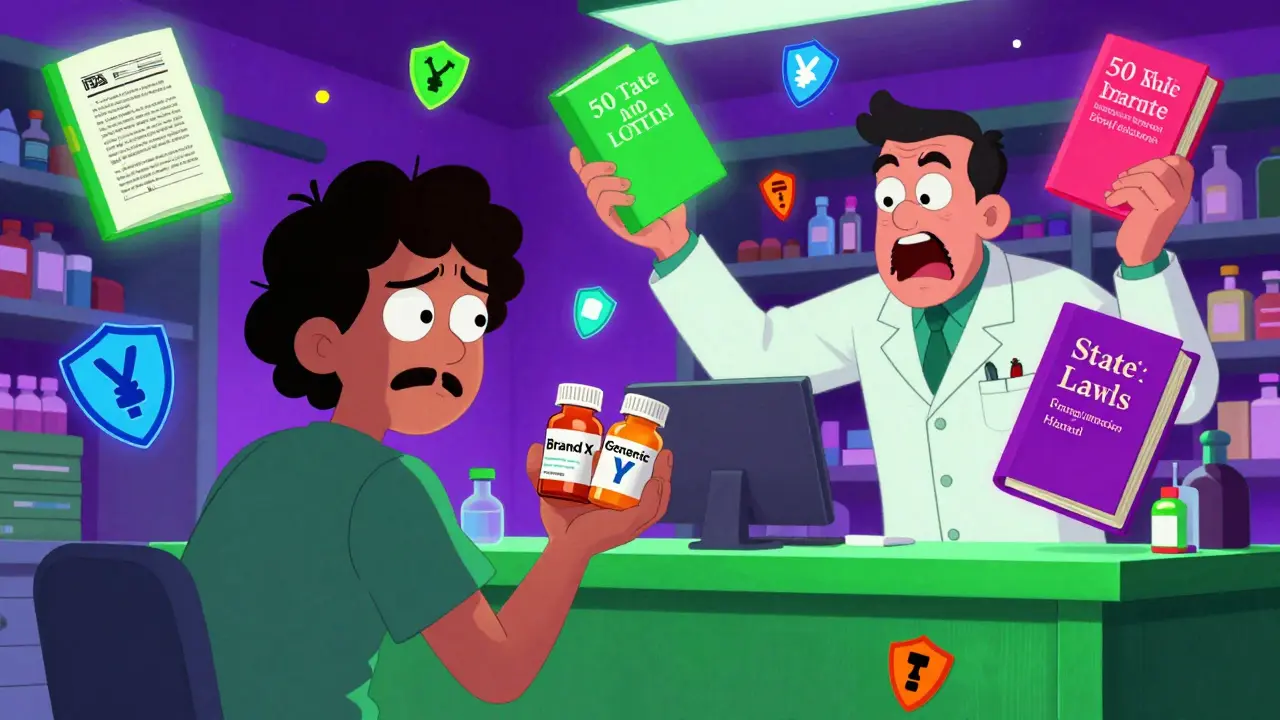
When you pick up a prescription, you might not think about whether the pill in your bottle is the brand name or a generic version. But behind the scenes, a complex web of state laws decides what the pharmacist can swap - and what they can’t. These rules aren’t the same across the U.S. In fact, they vary so much that a pharmacist in New York can legally substitute a generic without asking, while one in Oklahoma needs written permission from the doctor just to switch brands. This isn’t just bureaucracy. It affects your out-of-pocket costs, your safety, and even whether you get the right medication at all.
How Generic Substitution Works - And Why It Matters
Generic drugs are chemically identical to their brand-name counterparts. They work the same way, have the same side effects, and are held to the same FDA standards. But they cost 80% to 85% less. That’s why the U.S. government pushed for generic substitution starting in the 1980s. Since then, generics have saved the healthcare system over $1.6 trillion in a decade. But savings only happen if pharmacists are allowed - and sometimes required - to swap them in.
The federal government sets the rules for what counts as a generic through the FDA Orange Book. It lists drugs and their therapeutic equivalence ratings - A-rated generics can be substituted freely. But once the drug leaves the FDA’s hands and enters the pharmacy, state law takes over. And that’s where things get messy.
19 States Force Substitution - The Rest Don’t
Nineteen states have mandatory substitution laws. That means if a prescription is written for a brand-name drug and an FDA-approved generic exists, the pharmacist must dispense the generic unless the doctor says “dispense as written.” These states include California, Florida, Illinois, and New York. The goal? Cut costs fast. In these states, generic use is 8.7% higher than in permissive states.
The other 31 states - plus Washington, D.C. - operate under permissive substitution. Pharmacists can swap generics, but they don’t have to. They might do it because it’s cheaper for the patient, or because the pharmacy’s system auto-selects it. But they could also skip it if they’re unsure, or if the patient seems hesitant. This creates inconsistency. One pharmacy fills your prescription with a generic. The next one gives you the brand. No one’s breaking the law. But you’re left confused.
Patient Consent: Only 7 States Plus D.C. Require It
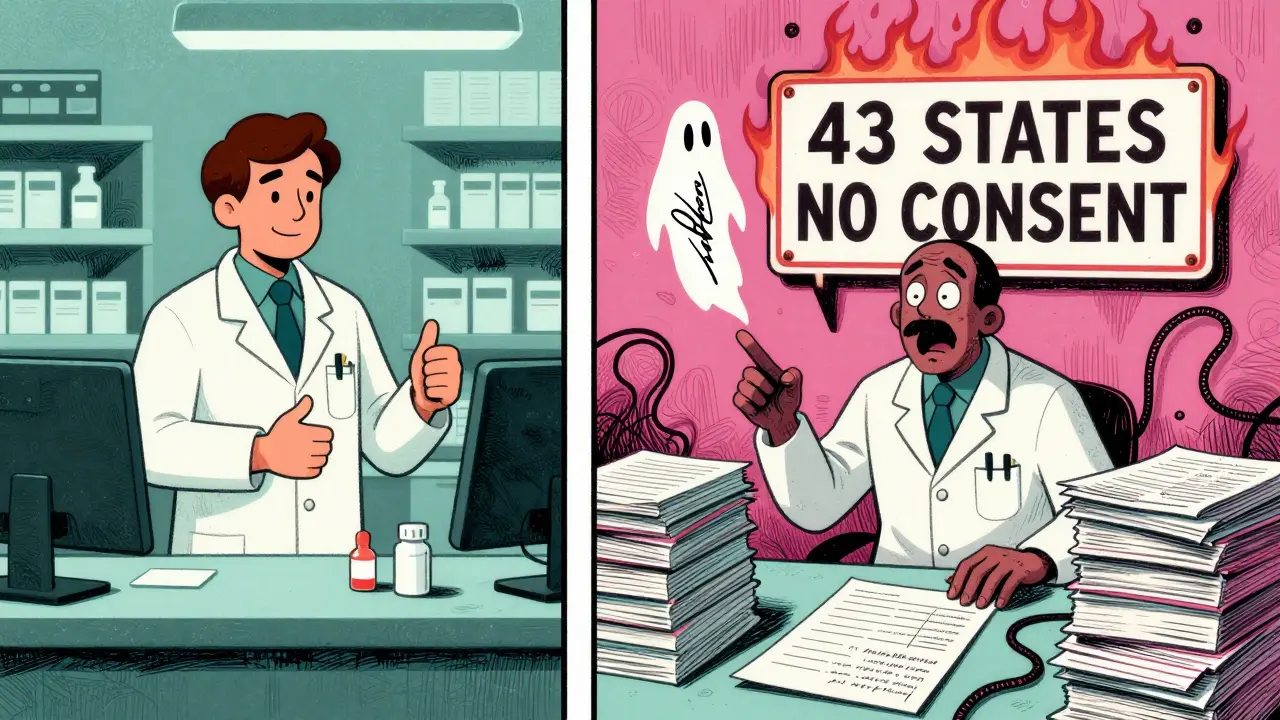
Should you be asked before your medicine changes? In most places, no. Only seven states and D.C. require pharmacists to get your explicit consent before substituting a generic. That means in 43 states, you could be handed a different pill - with no warning at all.
Patients in states with consent rules report feeling more informed. A 2023 University of Michigan poll found 68% of patients in consent states understood what happened. In states without consent, only 42% did. That gap isn’t just about transparency - it’s about trust. If you don’t know your meds changed, you might blame yourself when side effects appear.
Notification Rules Are a Wild West
Even if you don’t get asked, should your doctor know? Thirty-one states and D.C. require pharmacists to notify the prescriber when a generic is swapped. But how? By phone? By fax? Through an electronic record? The rules vary wildly.
California demands an electronic entry in the prescriber’s system within five days. Other states accept a printed note in the chart. Some don’t require notification at all. This matters because doctors need to track your response to medication. If you switch from a brand to a generic and your blood pressure spikes, your doctor won’t know why - unless the pharmacist told them.
Biologics Are a Different Ballgame
Not all generics are created equal. Small-molecule drugs like metformin or lisinopril are straightforward to copy. But biologics - drugs made from living cells like Humira or Enbrel - are incredibly complex. Their copies are called biosimilars, and they’re not exact duplicates. That’s why 45 states have stricter rules for them.
In most of those states, the pharmacist must notify the doctor within a specific time frame - often 5 to 10 days. Thirty-eight states require patient notification too. But here’s the kicker: none of the 56 U.S. jurisdictions (including D.C. and Puerto Rico) treat biosimilars the same way. One state might let a pharmacist substitute without telling anyone. Another might require the doctor to pre-approve every switch. That confusion is why biosimilars make up only 14.3% of eligible prescriptions - even though over 30 have been approved by the FDA.
Liability: Are Pharmacists Protected?
Pharmacists are on the front lines. If a substituted drug causes harm, who’s responsible? Twenty-four states offer no explicit legal protection. That means a pharmacist could be sued even if they followed the law - if the patient had an unexpected reaction.
Connecticut pharmacist Sarah Jennings told Pharmacy Times she refuses to substitute warfarin - a blood thinner - even when it’s safe, because she doesn’t want to risk liability. That’s not rare. In states without protection, pharmacists play it safe. They leave you with the brand-name drug - even if it costs $500 instead of $20.
Formularies: Positive vs. Negative Lists
Some states use a “positive formulary.” That means they list which generics are approved for substitution. If it’s not on the list, you get the brand. Others use a “negative formulary.” They list the drugs that can’t be swapped - everything else is fair game.
New York uses a negative list. California uses the FDA’s Orange Book as its only guide. Oklahoma requires written permission from the prescriber or payer for any substitution - making it one of the most restrictive states. This isn’t just paperwork. It changes how fast you get your meds. In states with complex lists, pharmacists spend hours checking databases before filling a single script.
Technology Can Help - But Only in Some States
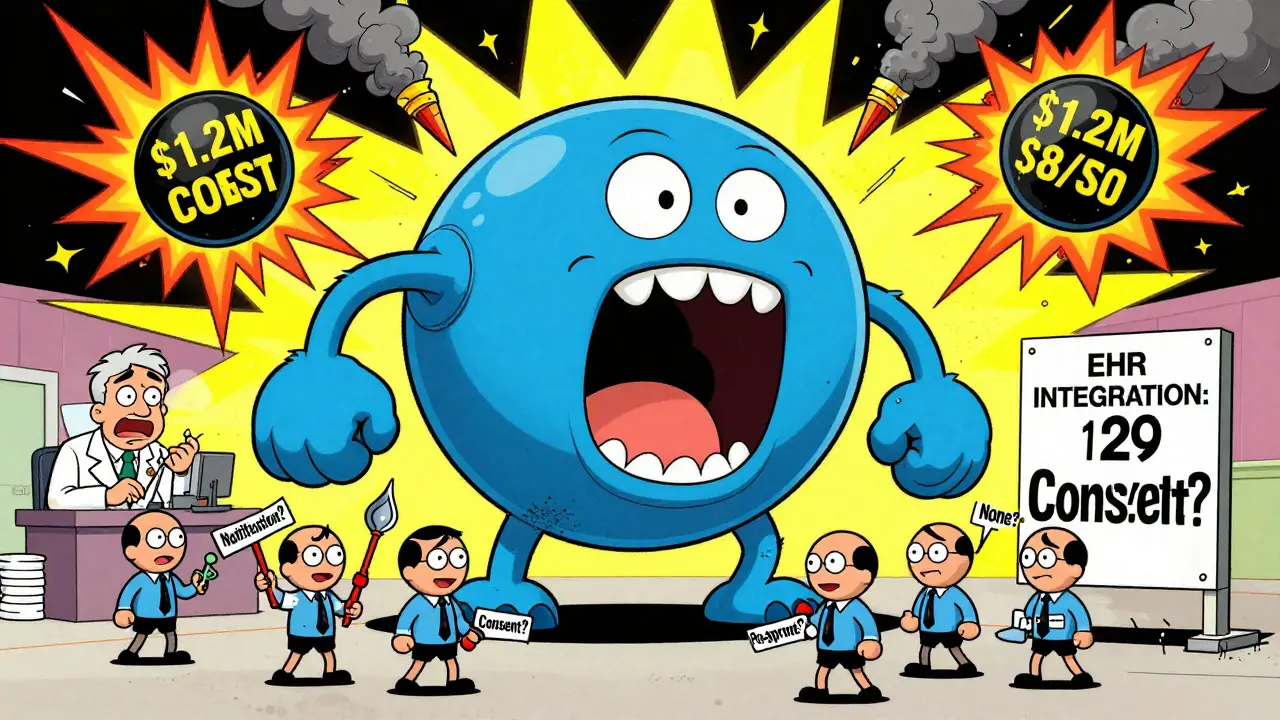
Electronic health records (EHRs) like Epic and Cerner are supposed to make this easier. But only 28 states have fully integrated substitution rules into their systems. That means in 23 states, pharmacists still manually check state laws, print out forms, or call prescribers.
One study found that in states without integration, pharmacists take 17% longer to fill prescriptions involving substitution. That’s not just inconvenient - it delays care. A 2024 trial with the ScriptPro SP 200 system showed a 37% drop in substitution errors when the software auto-updated state rules in real time. But most independent pharmacies can’t afford that tech.
What This Means for You
Here’s the reality: your state’s rules determine how much you pay, how safe your meds are, and whether your doctor knows what you’re taking. If you live in a mandatory substitution state, you’ll likely get generics unless you ask otherwise. In permissive states, you might get the brand - even if it’s not necessary.
Ask your pharmacist: “Do you automatically substitute generics here?” If they say no, ask why. If they say yes, ask if your doctor gets notified. If you’re on a high-risk drug like warfarin, insulin, or seizure meds - don’t assume anything. Confirm the name, dose, and manufacturer every time.
And if you’re switching pharmacies or moving states? Don’t assume the rules follow you. A system that auto-substitutes in Texas might block it in Georgia. Your medication history doesn’t change - but the law does.
The Push for Change
The fragmentation is costing billions. Pharmacy chains spend an average of $1.2 million per state just to stay compliant. Independent pharmacies, with fewer resources, make more errors. The National Association of Boards of Pharmacy is trying to fix this. Their 2024 project aims to cut 51 different state rules down to just three regional models by 2026-2027.
The FDA and Congressional Budget Office both say harmonizing these laws could save $14 billion over ten years. But political resistance is strong. States guard their control over pharmacy practice. Until that changes, you’ll keep living in a patchwork of rules - each one a little different, each one a little harder to navigate.
Can a pharmacist substitute a generic drug without telling me?
Yes - in 43 states and D.C., pharmacists are not required to notify you before swapping a brand-name drug for a generic. Only seven states and D.C. require explicit patient consent. Even in states where notification isn’t required, pharmacists may still inform you as a courtesy. Always check the label and ask if you’re unsure.
Do I need to ask for a generic to save money?
Not always. In 19 states, pharmacists are legally required to substitute generics unless the doctor says "dispense as written." In those states, you’ll automatically get the cheaper version. In other states, substitution is optional - so you might need to ask. But even then, many pharmacies default to generics because they’re cheaper for the insurer and the patient. Always confirm what you’re getting.
Why are biosimilar substitution rules so different from regular generics?
Biosimilars are copies of complex biologic drugs made from living cells, like Humira or Enbrel. Unlike small-molecule generics, they aren’t exact duplicates - small differences can affect safety or effectiveness. Because of this, 45 states impose stricter rules: mandatory doctor notification, patient consent, or even prescriber approval. None of the 56 U.S. jurisdictions treat biosimilars the same way, which is why adoption remains low despite FDA approvals.
What happens if I have a bad reaction after a generic substitution?
Liability depends on your state. In 24 states, pharmacists have no legal protection - meaning they could be sued even if they followed the law. In states with liability protection, the pharmacist is shielded as long as they acted according to state rules. If you have a reaction, report it to your doctor and pharmacist immediately. Keep your medication records and ask whether substitution occurred. In states without notification rules, this information may be missing from your chart.
How can I find out my state’s substitution rules?
The National Association of Boards of Pharmacy (NABP) offers a free, updated online tool that maps all 50 state and D.C. substitution laws. However, many pharmacists say it lacks detail for complex cases like biosimilars. Your best bet is to ask your pharmacist directly - or check your state’s board of pharmacy website. If you’re on high-risk medication, always verify substitution rules before filling a prescription.
Comments
Alex Danner
January 7, 2026 AT 02:23Man, I had no idea this was such a mess. I got switched from my brand-name blood pressure med to a generic last month and didn’t even notice until I checked the bottle. Then I panicked thinking I got the wrong stuff. Turns out my pharmacist in Ohio just swapped it automatically. No warning, no paperwork. I’m lucky I didn’t have a reaction.
But now I’m paranoid every time I pick up a script. I always check the label, the color, the little imprint code. If you’re on anything that affects your brain or heart, don’t trust the system. Ask every damn time.
And why the hell do 24 states leave pharmacists open to lawsuits? That’s insane. They’re just following the law. If the state says ‘swap it,’ then the state should back them up. Instead, pharmacists play it safe and charge you $500 for a pill that should cost $20. It’s backwards.
I’ve started printing out my state’s pharmacy board rules and carrying them in my wallet. It’s ridiculous I have to do that just to get my meds without getting screwed.
Aparna karwande
January 7, 2026 AT 03:32India doesn’t have this chaos. We have one national drug policy. If it’s bioequivalent, it’s approved. No 50 different rulebooks. No pharmacists terrified of lawsuits. No patients confused because the pill looks different every time.
And yet Americans act like this is normal? You have the technology, the science, the resources - but you can’t standardize a damn pill swap? This isn’t freedom. This is bureaucratic clownery. Your ‘state rights’ are killing people slowly with confusion and cost.
Stop romanticizing fragmentation. It’s not diversity. It’s negligence dressed up as patriotism.
Jessie Ann Lambrecht
January 8, 2026 AT 14:48This is one of those posts that makes you feel less alone in your frustration. I’ve been on warfarin for 8 years and I’ve had to switch pharmacies three times because each one had different rules - and none of them told me until I was holding the bottle.
Now I keep a little card in my wallet that says: ‘I’m on warfarin. Please confirm if generic substitution occurred and notify my doctor.’ I hand it to every pharmacist. Some roll their eyes. One even cried and said, ‘I wish everyone did this.’
Don’t wait for the system to fix itself. Be your own advocate. Ask. Write it down. Tell your doctor. And if you’re lucky enough to have a pharmacist who actually explains it? Thank them. They’re the unsung heroes in this mess.
Ayodeji Williams
January 8, 2026 AT 18:46Kamlesh Chauhan
January 9, 2026 AT 03:50Elen Pihlap
January 9, 2026 AT 11:25Sai Ganesh
January 11, 2026 AT 11:15As someone who works in global health logistics, I’ve seen how fragmented regulation slows down access everywhere. The U.S. system is not unique - but it’s uniquely inefficient.
What’s interesting is that even countries with universal healthcare have state-level variations in drug substitution - but they resolve them through centralized clinical guidelines, not legal chaos.
The solution isn’t federal overreach. It’s better coordination: a national minimum standard, with room for state-level enhancements based on local needs. Not 50 different rulebooks written by lobbyists.
And yes - biosimilars need special handling. But that doesn’t mean each state should invent its own version of ‘special’.
Paul Mason
January 12, 2026 AT 05:22Look, I get it. People are scared of generics. I used to be. But here’s the truth: 98% of the time, they’re fine. The FDA doesn’t approve junk. If it’s A-rated, it’s good.
But the real problem isn’t the substitution - it’s the lack of communication. If your pharmacist doesn’t tell you, and your doctor doesn’t know, then yes, things go wrong.
Simple fix: every pharmacy should have a printed one-pager on substitution rules, and every script should come with a tiny label: ‘Generic substituted.’ Done. No forms. No calls. No drama.
Stop making it harder than it needs to be. The tech exists. The will doesn’t.
Andrew N
January 13, 2026 AT 19:56Let’s be honest: the real issue isn’t the laws. It’s the liability culture. Pharmacists aren’t lazy. They’re terrified. They’re not trained to be clinicians. They’re trained to count pills and follow rules. When you put them in a position where a single substitution could bankrupt them, they’re going to avoid risk - even if it costs the patient more.
And the formularies? They’re a joke. Negative lists are easier to manage than positive ones. But nobody wants to admit that. So we get 17 different databases, all outdated, all conflicting.
The real solution? Remove pharmacist liability for FDA-approved substitutions. Period. Then let the market and clinical guidelines sort out the rest. But no one wants to touch that because it’s too simple.
LALITA KUDIYA
January 14, 2026 AT 18:10