
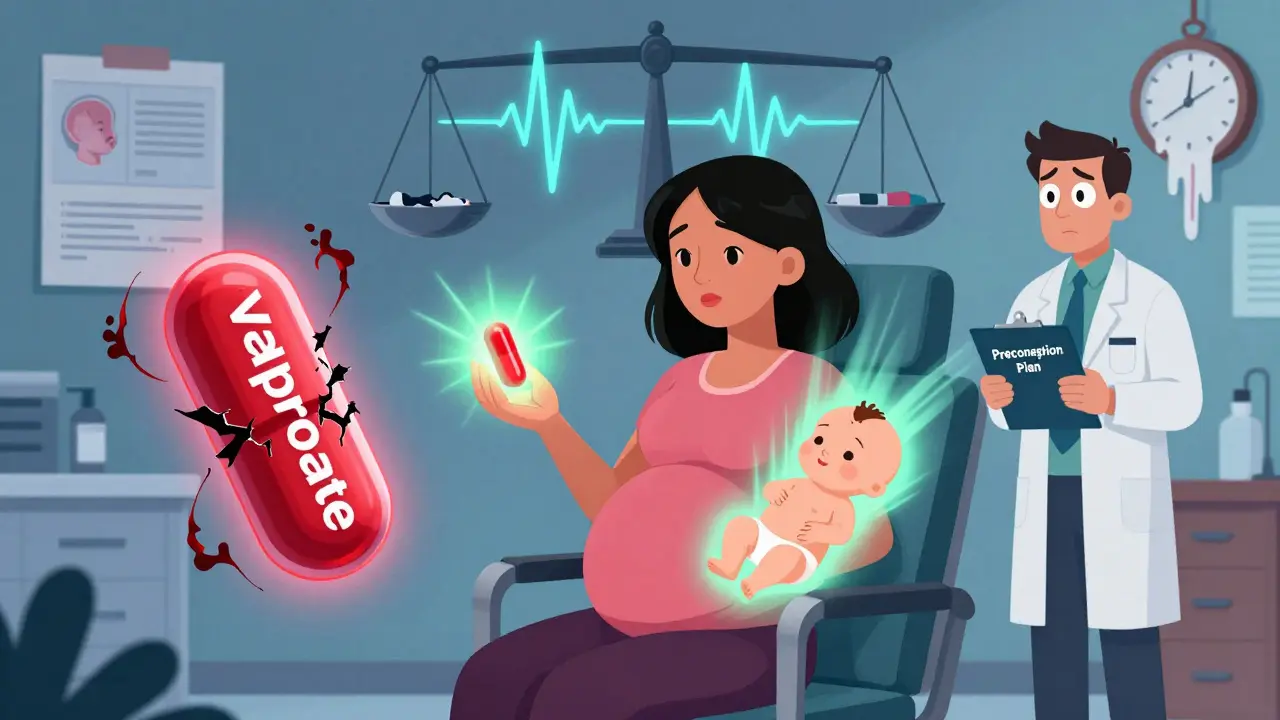
When a woman with epilepsy becomes pregnant, she faces a difficult choice: keep taking her seizure medication to prevent dangerous seizures, or stop it to protect her baby - but risk losing control of her seizures. This isn’t just a medical dilemma. It’s a life-altering decision made every day by women who want to start a family but are caught between two serious risks.
Some Seizure Medications Carry High Risks During Pregnancy
Not all seizure medications are the same when it comes to pregnancy. Some are far more dangerous than others. The biggest red flag is valproate - also known as sodium valproate or valproic acid. Studies show that about 10% of babies exposed to valproate during pregnancy develop major physical birth defects. That’s five times higher than the general population risk of 2-3%. These defects can include heart problems, cleft lip or palate, spinal cord issues, and microcephaly - where the baby’s head is smaller than normal.
Valproate doesn’t just affect physical development. Children exposed to it in the womb are more than twice as likely to be diagnosed with autism spectrum disorder (ASD) and nearly twice as likely to have attention deficit hyperactivity disorder (ADHD), according to research from Indiana University published in Neurology in 2020. Because of this, health agencies like the UK’s MHRA and the American Epilepsy Society now strongly advise against using valproate in women of childbearing age unless there’s absolutely no other option.
Other high-risk medications include carbamazepine (Tegretol), phenytoin (Epanutin), phenobarbital, and topiramate (Topamax). These drugs also increase the chance of physical birth abnormalities, though not as severely as valproate. The risk rises with higher doses - especially for carbamazepine, phenobarbital, and valproate. For example, women taking more than 1,000 mg of valproate daily have nearly double the risk of birth defects compared to those on lower doses.
Safer Alternatives Exist - And They Work
The good news? Not all seizure medications are risky. Two drugs - lamotrigine (Lamictal) and levetiracetam (Keppra) - have been consistently shown to be much safer during pregnancy. A 2023 review by the UK’s Medicines and Healthcare products Regulatory Agency (MHRA) found no significant increase in birth defects linked to these two medications. They’re now considered first-choice options for women planning pregnancy.
A major Stanford University study published in JAMA Neurology in 2021 followed 298 children whose mothers took lamotrigine or levetiracetam during pregnancy. At age two, these children showed normal verbal development - no different from children whose mothers didn’t take any seizure medication. While there was a slight increase in minor developmental delays at the highest exposure levels, the overall picture is reassuring.
Since the 1990s, the rate of major birth defects linked to seizure medications has dropped by 39%, according to data from JAMA Neurology in 2024. That’s not because the drugs changed - it’s because doctors are prescribing safer ones more often. More women are getting preconception counseling. More are switching from valproate to lamotrigine or levetiracetam before they even get pregnant.
Drug Interactions Can Undermine Both Birth Control and Seizure Control
Here’s something many women don’t realize: seizure medications can interfere with birth control - and birth control can interfere with seizure medications. It’s a two-way street.
Drugs like carbamazepine, phenytoin, phenobarbital, and high doses of topiramate and oxcarbazepine speed up how fast your body breaks down hormones. That means birth control pills, patches, or rings may not work as well. Women on these medications have a higher chance of unintended pregnancy - even if they take their pill every day.
On the flip side, hormonal birth control can lower the levels of certain seizure medications in your blood. That’s especially true for lamotrigine, valproate, zonisamide, and rufinamide. If your lamotrigine level drops too low, you could start having seizures again. That’s dangerous - not just for you, but for your baby.
That’s why women on seizure meds need to talk to their doctor about birth control options. Intrauterine devices (IUDs), implants, or progestin-only injections are often better choices than pills. If you’re on lamotrigine and need hormonal birth control, your doctor may need to adjust your dose - and monitor your blood levels closely.
Uncontrolled Seizures Are More Dangerous Than Medication
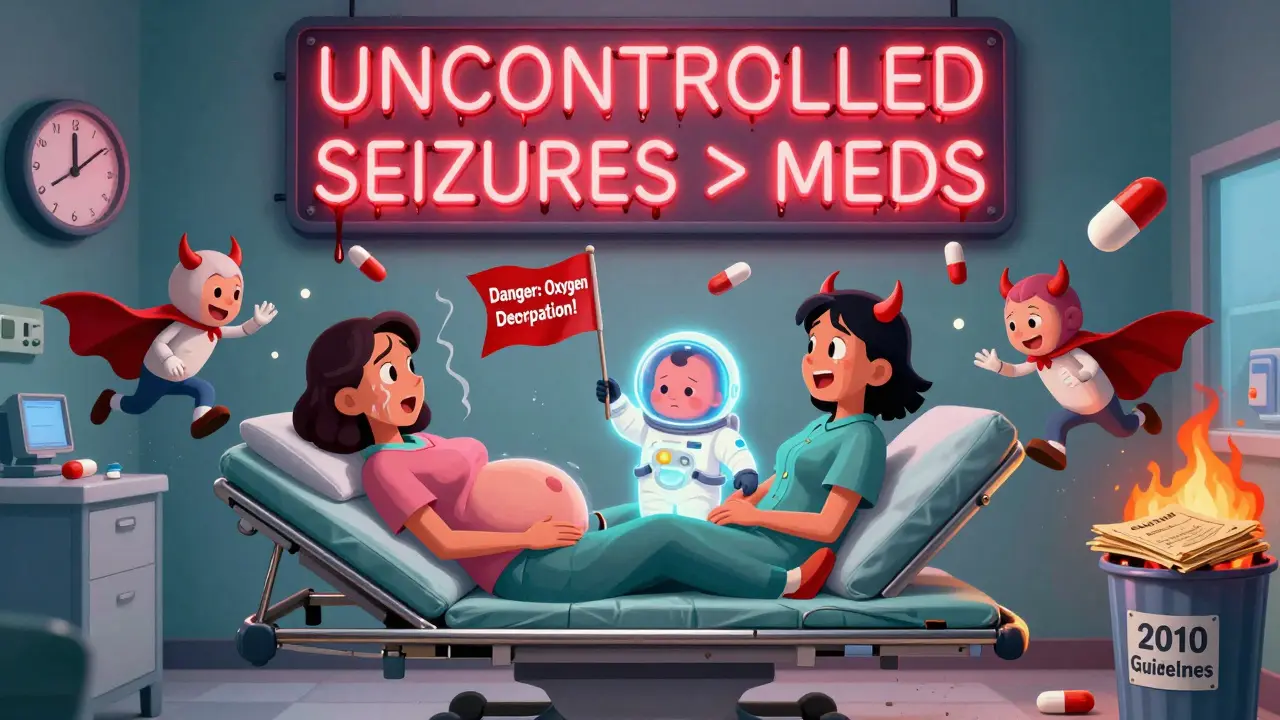
It’s easy to think, “If the medicine is risky, maybe I should just stop it.” But that’s not safe. Uncontrolled seizures - especially tonic-clonic (grand mal) seizures - can cause miscarriage, premature birth, injury to the mother, or even fetal death. The physical trauma from a fall during a seizure can harm the baby. Oxygen deprivation during a long seizure can damage the fetal brain.
As neurologist Kelsey Wiggs from Indiana University put it, women with epilepsy face an “excruciating double bind.” They need medication to stay safe - but the safest medication for them might not be the safest for their baby.
Experts agree: no seizure medication is as dangerous as uncontrolled seizures. The American Epilepsy Society says the goal isn’t to stop all meds - it’s to use the lowest effective dose of the safest possible drug. Stopping medication without medical guidance is one of the most common mistakes women make before or during pregnancy.
Who’s Still at Risk? And Why
Even though safer options exist, not everyone gets them. A 2023 French study found that women with lower income, less education, or limited access to specialists were more likely to be prescribed high-risk drugs like valproate during pregnancy. This isn’t because doctors are careless - it’s often because they don’t have time, resources, or training to manage complex cases.
Women in rural areas, those without insurance, or those who see multiple doctors without coordination are at higher risk. They may not get preconception counseling at all. Some don’t even know their medication could affect their baby. A 2023 survey from AESNET found that two-thirds of women of childbearing age with epilepsy answered basic questions about medication safety and birth control interactions incorrectly.
That’s why preconception planning matters so much. If you’re thinking about getting pregnant - even if it’s years away - talk to your neurologist now. Don’t wait until you’re already pregnant. Switching medications takes time. Doses need to be adjusted slowly. Blood levels need to be monitored. You need a plan.
What You Should Do Right Now
If you’re a woman with epilepsy and you’re sexually active:
- Ask your doctor which medication you’re on and whether it’s considered high-risk for pregnancy.
- If you’re on valproate, carbamazepine, phenytoin, phenobarbital, or high-dose topiramate, ask about switching to lamotrigine or levetiracetam - even if you’re not planning to get pregnant yet.
- Use reliable birth control. Avoid pills, patches, or rings if you’re on enzyme-inducing medications. Ask about IUDs or implants.
- If you’re trying to get pregnant, schedule a preconception visit with your neurologist and OB-GYN. Bring your full medication list.
- Don’t stop or change your meds without medical advice. Seizures are a real and immediate danger.
If you’re already pregnant and taking seizure medication: do not stop. Call your doctor immediately. They may need to adjust your dose, check your blood levels, or switch you to a safer drug - but only under supervision.
Hope Is Real - But Planning Is Essential
Today, women with epilepsy have more options than ever before. The risk of birth defects has dropped significantly. More doctors know how to manage epilepsy in pregnancy. Safer drugs work just as well as older ones. Many women go on to have healthy babies without any complications.
But this doesn’t happen by accident. It happens because women plan ahead. Because they ask questions. Because they get the right care before conception - not after.
Having epilepsy doesn’t mean you can’t have a child. It means you need to be smarter about how you manage it. The goal isn’t to avoid medication - it’s to choose the right one, at the right dose, at the right time.
Is it safe to take seizure medication while pregnant?
Yes - but only the right ones. Medications like lamotrigine and levetiracetam are considered low-risk and are often recommended during pregnancy. Avoid valproate, phenobarbital, phenytoin, and high-dose topiramate if possible. Never stop your medication without talking to your doctor - uncontrolled seizures are more dangerous to both you and your baby than these medications.
Can seizure meds cause autism or ADHD in babies?
Yes, valproate is strongly linked to higher rates of autism spectrum disorder (ASD) and attention deficit hyperactivity disorder (ADHD) in children exposed during pregnancy. Studies show the risk is more than double compared to other seizure medications. Other drugs like carbamazepine and phenytoin may carry smaller risks, but valproate is the most concerning. Switching to lamotrigine or levetiracetam before pregnancy can significantly reduce this risk.
Do birth control pills work with seizure meds?
Not always. Medications like carbamazepine, phenytoin, phenobarbital, topiramate (at high doses), and oxcarbazepine can make hormonal birth control - pills, patches, rings - much less effective. This increases the chance of unintended pregnancy. For women on these drugs, non-hormonal options like IUDs or implants are safer. If you’re on lamotrigine, birth control can lower its effectiveness, so your dose may need to be adjusted.
What’s the safest seizure medication for pregnancy?
Lamotrigine (Lamictal) and levetiracetam (Keppra) are currently considered the safest options for pregnant women with epilepsy. Large studies show no significant increase in birth defects with these drugs, and children exposed to them in the womb develop normally. They’re now the first-line choices for women planning pregnancy - as long as they effectively control seizures.
Should I stop my seizure meds if I’m pregnant?
No. Stopping seizure medication without medical supervision can lead to uncontrolled seizures, which pose serious risks including miscarriage, injury, and oxygen deprivation to the baby. The goal is to use the lowest effective dose of the safest medication. Talk to your neurologist immediately if you’re pregnant or planning to be - don’t make changes on your own.
Can I breastfeed while taking seizure meds?
Yes, most seizure medications are safe during breastfeeding. Lamotrigine and levetiracetam pass into breast milk in very small amounts and are not linked to harmful effects in babies. Valproate and phenobarbital are present in higher levels, so they require more caution. Always talk to your doctor - but don’t avoid breastfeeding out of fear. The benefits usually outweigh the risks.
Comments
Angel Molano
January 14, 2026 AT 02:15Stop taking valproate. Period. If your doctor still prescribes it, find a new one.
lucy cooke
January 15, 2026 AT 04:11Oh, so now we're medical dictators? How quaint. The real tragedy isn't the drugs-it's the reductionist mindset that sees pregnancy as a chemical equation to be optimized. Where's the poetry in being a mother? The chaos? The raw, unregulated biological rebellion against corporate-approved pharmacology?
They'll tell you lamotrigine is 'safe'-but safety is a marketing term invented by Big Pharma to sell you peace of mind you didn't know you were missing. My cousin took Keppra, had a beautiful child, and still woke up screaming at 3 a.m. because the world felt too heavy. Was that the drug? Or was it just... being alive?
We treat women like fragile vials of serum, not humans with souls and histories and dreams that don't fit neatly into clinical guidelines. I'm not anti-medication. I'm anti-paternalism.
Kimberly Mitchell
January 16, 2026 AT 21:31The data is unequivocal: valproate carries a 10% teratogenic risk. Carbamazepine and phenytoin are Class D. Lamotrigine and levetiracetam are Class C with negligible teratogenic burden. The MHRA and AES guidelines are clear. Any deviation constitutes negligence. If clinicians are still prescribing high-risk ASMs to women of childbearing potential without documented informed consent, that’s not a gray area-it’s malpractice.
Furthermore, the interaction profile between enzyme-inducing ASMs and hormonal contraceptives is pharmacokinetically well-characterized. CYP3A4 induction reduces ethinyl estradiol and progestin AUC by up to 50%. Non-hormonal IUDs are not merely preferable-they are standard of care. Failure to counsel accordingly is a breach of duty.
James Castner
January 18, 2026 AT 01:51Let me tell you something that no study will ever fully capture: the weight of silence in a neurologist’s office when you ask, 'Will my child be okay?' You don’t get a statistic. You get a pause. A sigh. A chart full of numbers that don’t include the nights you cried because you didn’t know if you were protecting your future or poisoning it.
I was on valproate for twelve years. I didn’t know it was dangerous until I was 31, engaged, and trying to conceive. My neurologist said, 'It’s working, so why change?' But it wasn’t working-it was just suppressing. And I was suppressing myself, too.
Switching to lamotrigine took nine months. Blood draws every two weeks. Dose adjustments. Seizures creeping back during the transition. My husband held my hand through three grand mal episodes. We almost lost the baby at 16 weeks-not from the drug, but from the stress of the switch.
My daughter is two now. She’s laughing, crawling, babbling. No autism. No microcephaly. No developmental delays. But I’ll never forget the fear. The guilt. The way I stared at her sleeping face, wondering if I’d made the right choice.
So yes, the data says lamotrigine is safer. But the real takeaway? Women deserve to know before they’re pregnant. Not after. Not when it’s too late. Not when they’re already holding a baby and wondering if the meds did something they can’t undo.
If you’re reading this and you’re on valproate? Please. Talk to someone. Even if you’re not planning to have kids. Even if you think you’re not fertile. Because life doesn’t wait for consent.
Diana Campos Ortiz
January 18, 2026 AT 18:48i just wanted to say thank you for this post. as a woman with epilepsy who’s been on keppra for 7 years, i never knew how much safer it was compared to other meds. i thought all seizure drugs were basically the same. i’m so glad i read this before even thinking about pregnancy. i’m going to my doc next week to get my levels checked. you’re right-planning matters.
Adam Rivera
January 20, 2026 AT 12:23As someone who grew up in rural Texas with zero access to neurologists until I was 25, I just want to say this: most women don’t have the luxury of ‘preconception counseling.’ Some of us didn’t even know we had epilepsy until we had our first seizure at 18. And if you’re poor, or undocumented, or don’t speak English, you’re not getting a Stanford study cited to you-you’re getting a pill bottle and a ‘take this, don’t have babies.’
So yeah, lamotrigine is great. But if you don’t have a pharmacy within 60 miles, or insurance that covers it, or a doctor who won’t judge you for being ‘noncompliant,’ none of this matters. We need systemic change, not just better guidelines.
mike swinchoski
January 20, 2026 AT 15:18Women are too emotional to make these decisions. They panic and stop meds. That’s why we need doctors to decide for them. If the science says valproate is bad, then ban it. No exceptions. No ‘personal choice.’ Save the babies.
Vinaypriy Wane
January 22, 2026 AT 05:19I am from India, and here, many women are prescribed valproate because it is cheap-and because doctors are overworked, underpaid, and rarely trained in epilepsy and pregnancy. I have seen mothers cry because their child has microcephaly, and they didn’t know the drug was dangerous. I have seen husbands blame their wives for ‘not taking care.’
This post is a lifeline. I will translate it into Hindi and share it in every epilepsy support group I can find. Knowledge is not a privilege. It is a right.
Thank you for writing this. Truly.
laura Drever
January 23, 2026 AT 16:45lamotrigine is fine until you realize it makes you feel like a zombie and your seizures get worse so now you're just depressed and having seizures what a win
Randall Little
January 24, 2026 AT 01:06So let me get this straight: we’ve spent decades pathologizing women’s bodies, then suddenly we’re all experts on teratogenicity? The same people who told us to take birth control to ‘regulate’ our cycles now want us to swap one pill for another because ‘science says so’? What’s next? Mandatory prenatal EEGs?
And don’t even get me started on ‘preconception counseling.’ Who has time for that? The woman working two jobs, paying $800 a month for insulin, and sleeping 4 hours a night? You want her to schedule a neurology consult before she even knows she’s pregnant? That’s not healthcare. That’s performance art for the privileged.
Acacia Hendrix
January 25, 2026 AT 10:00The literature is unequivocal: lamotrigine demonstrates a teratogenic risk profile comparable to background population rates, with a pooled OR of 1.02 (95% CI: 0.87–1.20) in meta-analyses of prospective cohorts. Levetiracetam is similarly benign, with no significant elevation in major congenital malformations. The reduction in birth defect rates since 1990 is attributable to pharmacokinetic optimization and guideline adherence-not luck.
Conversely, valproate exposure yields a dose-dependent OR of 4.86 (95% CI: 3.12–7.58) for neural tube defects. This is not a ‘risk’-it is a preventable public health catastrophe.
Therefore, the failure to implement preconception planning protocols constitutes a systemic failure of medical ethics.
Rosalee Vanness
January 26, 2026 AT 12:59I want to tell you something real: I had a seizure during my first trimester. I was scared to death-not because of the meds, but because I didn’t know if I’d survive it, or if my baby would. I was on lamotrigine, but my dose had been lowered because I thought ‘less is better.’ Turns out, less is dangerous.
My neurologist didn’t scare me. She sat with me. She said, ‘You’re not failing. You’re fighting.’ And then she helped me adjust my dose, checked my levels weekly, and even called my OB to make sure we were on the same page.
My son is six now. He loves dinosaurs, hates broccoli, and has the biggest laugh you’ve ever heard. He doesn’t know his mom had epilepsy. But I do. And I’m so proud of how we did this-together.
If you’re reading this and you’re scared? You’re not alone. Talk to someone. Find a specialist. Bring a friend to your appointment. Write down your questions. You don’t have to do this perfectly. You just have to do it.
And if you’re a doctor? Don’t just hand out prescriptions. Hold space. Listen. Because sometimes, the most powerful medicine isn’t in the bottle-it’s in the words you say after the chart is closed.