
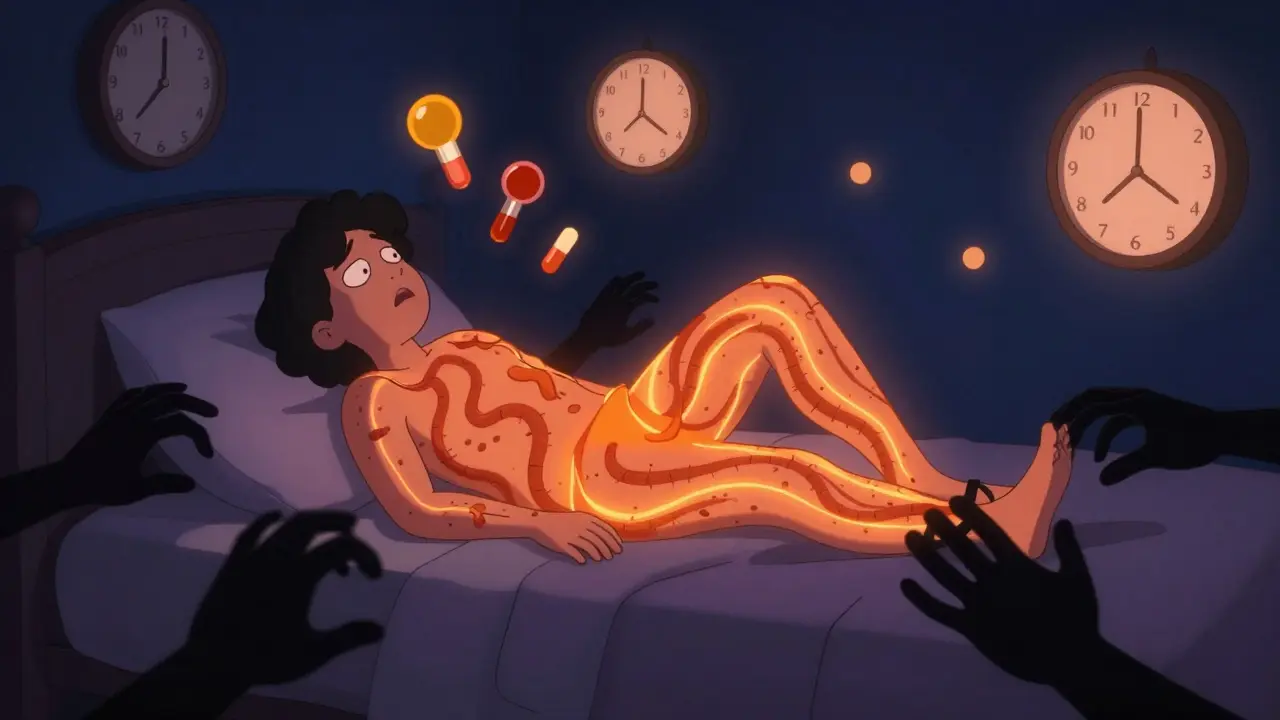
What Restless Legs Syndrome Really Feels Like
You’re lying in bed, trying to relax after a long day. Your legs feel like they’re crawling under your skin-tingling, aching, pulling. You can’t ignore it. You get up, pace the floor, stretch, shake them out. For a moment, it’s better. Then you lie down again, and it comes back, worse than before. This isn’t just restlessness. It’s restless legs syndrome (RLS), a neurological disorder that steals sleep, drains energy, and quietly ruins lives.
One in ten adults in the U.S. has RLS. That’s about 12 million people. Many don’t even know what’s happening. They think they’re just anxious, or stressed, or have bad circulation. But it’s not stress. It’s your brain. Specifically, your dopamine system. And it’s broken in a way that turns nighttime into a battle.
The Science Behind the Urge to Move
RLS isn’t just a nuisance. It’s a measurable brain disorder. Brain scans show people with RLS have 20-30% fewer dopamine transporters in the striatum-the part of the brain that controls movement and reward. Iron levels in the substantia nigra, another key area, are also low in most patients. Iron helps make dopamine. No iron? Less dopamine. Less dopamine? Your legs scream for movement.
There’s a reason symptoms hit hardest at night. Your body’s dopamine levels naturally dip after sunset. For someone with RLS, that drop triggers an overwhelming urge to move. Studies show symptoms spike 300-400% between 8 p.m. and midnight. It’s not coincidence. It’s biology.
And it doesn’t stop at the legs. About 80-90% of people with RLS also have periodic limb movement disorder (PLMD)-involuntary leg jerks every 20-40 seconds while asleep. These movements wake you up, often without you even realizing it. You might think you slept fine, but your brain was fighting all night.
How RLS Steals Your Sleep
Polysomnography studies-the gold standard for sleep analysis-show RLS patients lose 30-50% of their total sleep time. They spend 25-40% more time in light sleep (N1 and N2) and far less in deep, restorative sleep. Falling asleep takes 45-60 minutes, compared to 15-20 for people without RLS. They wake up 6-10 times a night. Sleep efficiency? Drops to 70-80%, while healthy sleepers stay above 85%.
The fallout is brutal. Daytime sleepiness scores (Epworth Scale) average 12-14 for RLS patients-way above the normal 5-7. Memory and focus drop by 20-30%. Driving becomes dangerous. A 2022 meta-analysis found RLS patients are 2.3 times more likely to be in a car accident. That’s not just fatigue. That’s neurological impairment.
Dopaminergic Therapy: The First-Line Fix
For decades, the only real treatment has been dopamine-boosting drugs. Three are FDA-approved: ropinirole (Requip), pramipexole (Mirapex), and rotigotine (Neupro). They all target D3 dopamine receptors, helping calm the overactive urge to move.
They work fast. Most people feel relief within 1-2 hours. In clinical trials, ropinirole reduced symptoms by 47% at 4 mg daily-nearly double the placebo effect. Pramipexole and rotigotine show similar results. For someone who’s spent years lying awake, this feels like a miracle.
But here’s the catch: these drugs don’t fix the problem. They mask it. And over time, they make it worse.
The Hidden Danger: Augmentation
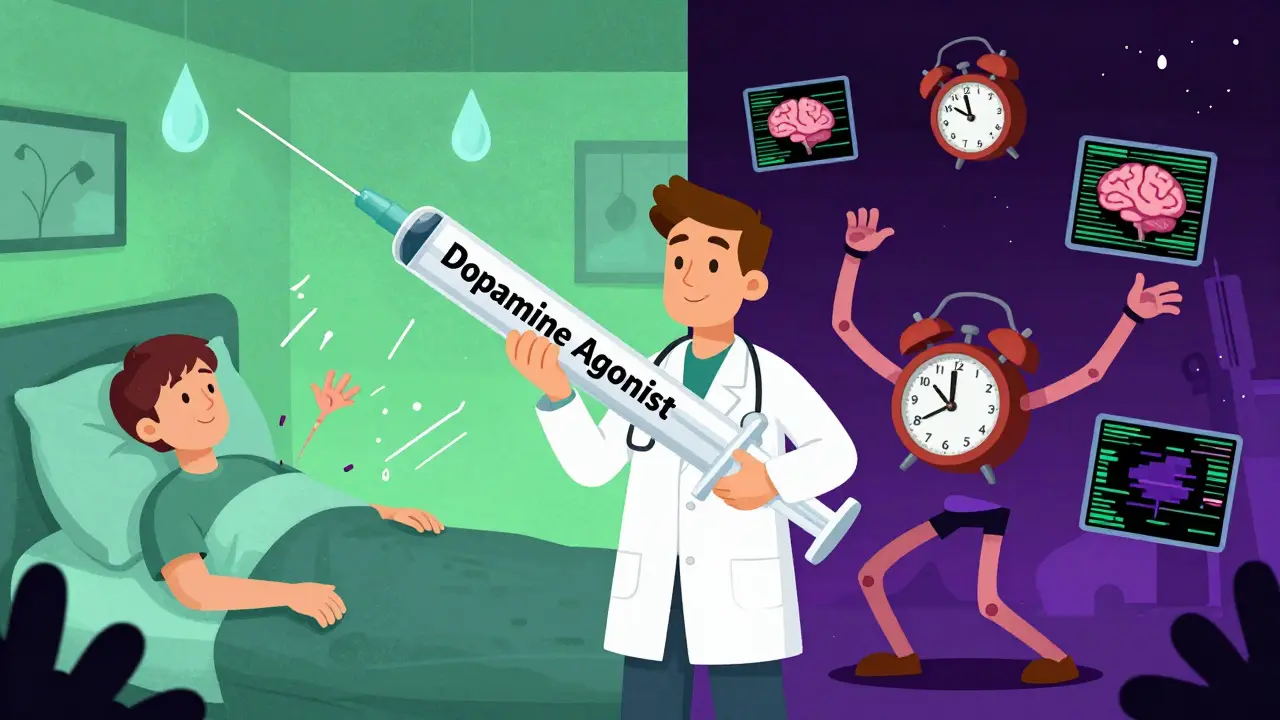
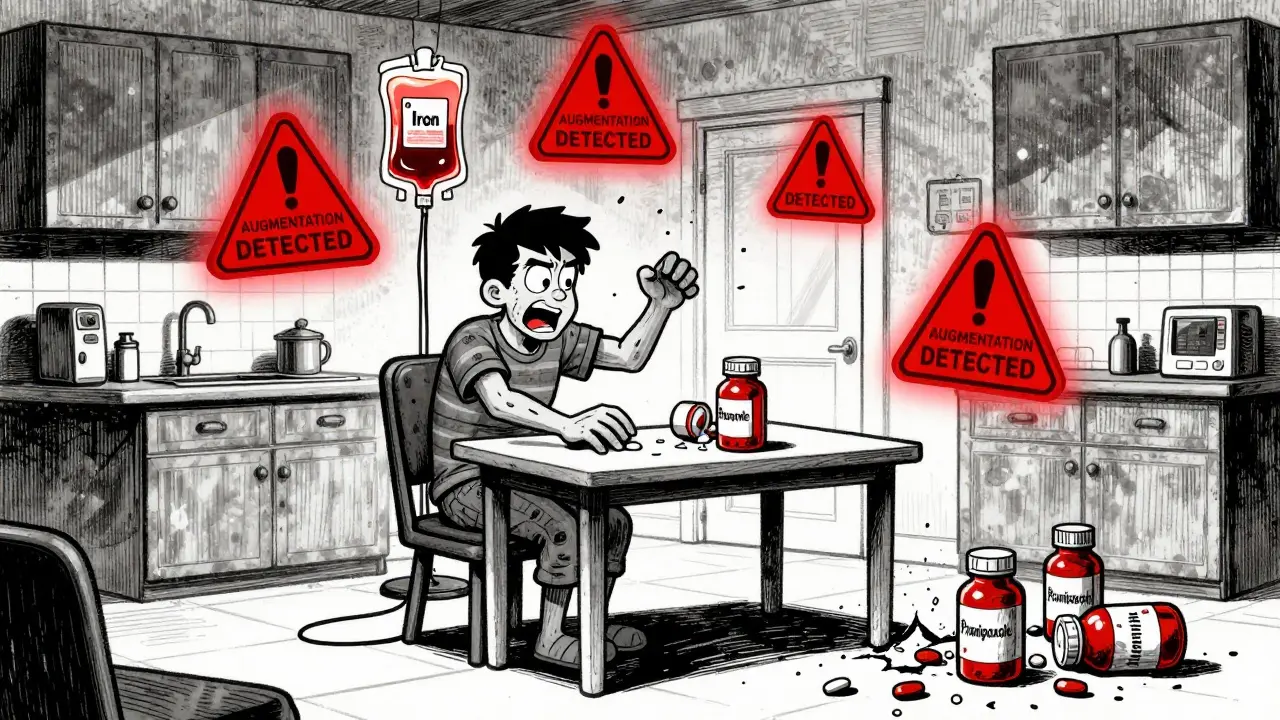
Augmentation is the silent killer of long-term RLS treatment. It’s when the medication stops helping and starts hurting. Symptoms begin earlier in the day-maybe at noon instead of midnight. They spread to your arms or torso. They get stronger. You need higher doses. And then you need them even more.
After one year on dopamine agonists, 20-70% of patients develop augmentation. Pramipexole? Up to 66% after three years. Rotigotine, the patch, is better-only 26%. That’s why many doctors now recommend it first for chronic cases.
Why does this happen? The brain adapts. It reduces its own dopamine production in response to the drugs. You’re not just treating RLS-you’re training your brain to depend on it. And when you try to stop? Symptoms crash back harder than ever.
The Alternative: Alpha-2-Delta Ligands
There’s another option: gabapentin enacarbil and pregabalin. These drugs don’t touch dopamine. They calm overactive nerves in the spinal cord. They take longer-2 to 4 weeks to kick in-but they don’t cause augmentation.
A 2021 head-to-head trial in JAMA Neurology found pregabalin (300 mg nightly) worked just as well as pramipexole (0.5 mg) for reducing RLS symptoms. But augmentation? Only 8% with pregabalin versus 32% with pramipexole after six months.
For people with daily RLS, these are now the first-line choice in most guidelines. The International Restless Legs Syndrome Study Group says: use dopamine drugs only for occasional symptoms. If you need something every night, start with gabapentin or pregabalin.
Iron Therapy: The Forgotten Key
Here’s something most people don’t know: if your serum ferritin (iron storage) is below 75 ng/mL, iron therapy can cut RLS symptoms by 30-40%. That’s not a small boost. That’s life-changing.
But oral iron? Usually useless. Your gut doesn’t absorb it well. The answer is intravenous ferric carboxymaltose. One infusion, and your levels climb. It takes 3-6 months to see full results, but for those who respond, it’s the closest thing to a cure.
Doctors should test ferritin in every RLS patient. If it’s low, treat it. No dopamine needed. No augmentation risk. Just simple, effective biology.
Real People, Real Struggles
Online forums are full of stories. One woman on Reddit described her symptoms spreading to her arms after eight months on pramipexole. “I used to sleep. Now I’m awake at 3 p.m. and my legs are on fire.”
Another man, 58, said the rotigotine patch let him sleep through the night for the first time in 15 years. “I didn’t know what peace felt like until I got this patch.”
But then there’s the dark side. Twelve percent of negative reviews mention impulse control disorders-gambling, shopping sprees, binge eating. One woman racked up $20,000 in debt from compulsive online buying after starting pramipexole. The FDA requires black box warnings for this. Yet many patients aren’t warned.
How to Use Dopaminergic Therapy Safely
If you’re on dopamine agonists, here’s how to avoid disaster:
- Start low: Ropinirole 0.25 mg, pramipexole 0.125 mg. Never go higher than 4 mg or 0.5 mg unless absolutely necessary.
- Take it 1-3 hours before symptoms usually start-not right before bed.
- Track your symptoms weekly. Note when they start, how bad they are (0-10 scale), and if they’ve spread.
- Check ferritin levels every 6 months. If low, get IV iron.
- Never increase the dose without talking to your doctor. More isn’t better-it’s riskier.
Patients who use symptom diaries are 83% more likely to catch augmentation early. That’s the difference between adjusting your treatment-and losing your sleep forever.
The Future: What’s Coming Next
There’s new hope. In 2023, an extended-release version of ropinirole (Requip XL) got approved. It keeps drug levels steady, cutting augmentation risk to 18%-down from 31% with the old version.
Other drugs in trials include fipamezole (an alpha-2 blocker) and intranasal apomorphine (fast-acting, no systemic exposure). Genetic testing is also advancing. Variants in the BTBD9 and MEIS1 genes can predict who’s likely to respond to pramipexole-or who’s at high risk for augmentation.
By 2027, the global RLS drug market is expected to hit $1.8 billion. But the goal isn’t more dopamine drugs. It’s better ones. Ones that don’t break your brain while fixing your legs.
What to Do Right Now
If you have RLS:
- Get your ferritin checked. If it’s under 75 ng/mL, ask about IV iron.
- If you need nightly treatment, ask for pregabalin or gabapentin enacarbil first.
- If you’re on a dopamine agonist, track your symptoms. Are they starting earlier? Spreading? Getting worse? Tell your doctor now.
- Don’t assume more medication = better sleep. Sometimes, less is more.
RLS is not a lifestyle problem. It’s a neurological one. And the right treatment can give you back your nights. But only if you know the risks-and how to avoid them.
Comments
Tiffany Adjei - Opong
January 7, 2026 AT 04:34Ryan Barr
January 8, 2026 AT 12:12Cam Jane
January 8, 2026 AT 23:37Tom Swinton
January 9, 2026 AT 10:53Harshit Kansal
January 10, 2026 AT 00:31Vinayak Naik
January 10, 2026 AT 17:24Saylor Frye
January 12, 2026 AT 01:13Kiran Plaha
January 12, 2026 AT 12:29Matt Beck
January 12, 2026 AT 13:45Molly McLane
January 13, 2026 AT 09:26Katie Schoen
January 14, 2026 AT 09:51Beth Templeton
January 15, 2026 AT 15:11Stuart Shield
January 17, 2026 AT 05:17Indra Triawan
January 17, 2026 AT 17:23Gabrielle Panchev
January 18, 2026 AT 12:18