
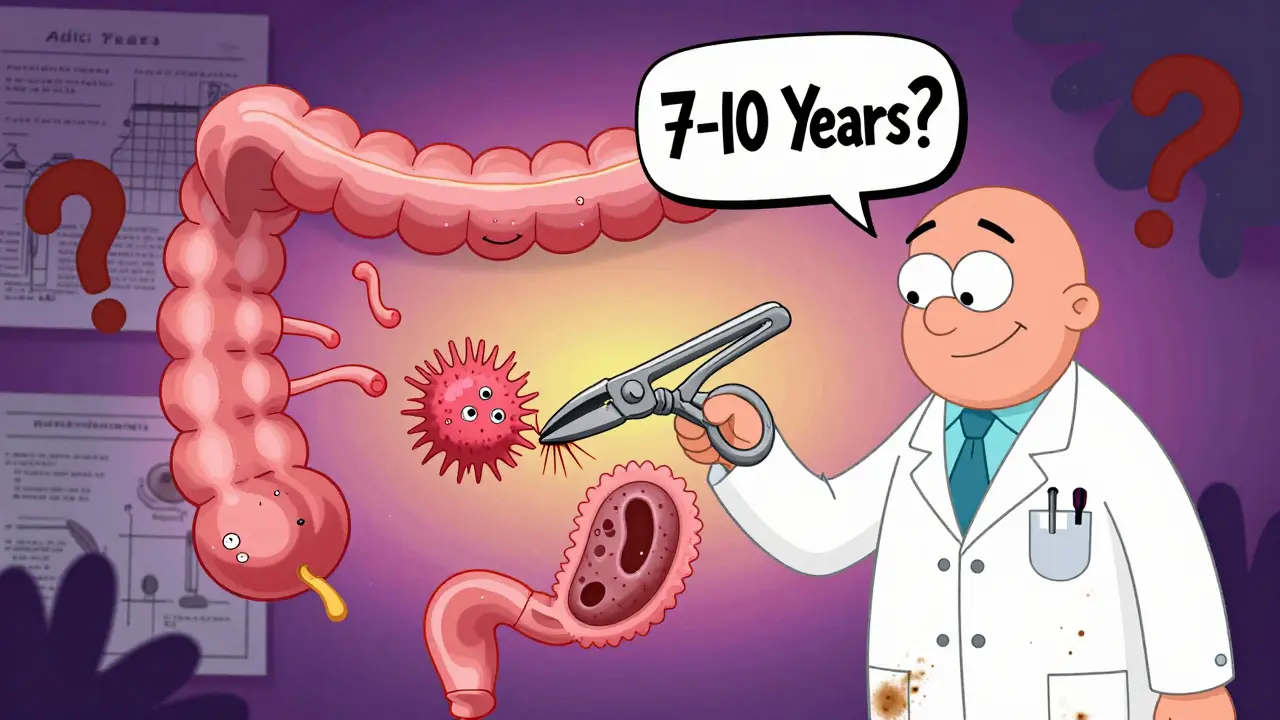
After a colonoscopy finds and removes polyps, the big question isn’t just whether you need another one-it’s when. Getting a repeat colonoscopy too soon means unnecessary stress, cost, and risk. Too late, and you could miss the chance to catch cancer early. The good news? Science now gives us clear, evidence-backed timelines based on what was found during your first procedure.
Not All Polyps Are the Same
Polyps aren’t one-size-fits-all. Their type, size, number, and even how they look under the microscope change your follow-up plan completely. The two main types you’ll hear about are adenomas and serrated polyps. Adenomas are the most common and have the clearest path to becoming cancer if left alone. Serrated polyps-especially sessile serrated lesions (SSLs)-are trickier. They grow slowly, look flat and fuzzy, and can turn cancerous without ever becoming a classic polyp shape. Then there are hyperplastic polyps, which are usually harmless… unless they’re large or in the wrong spot.Low-Risk Adenomas: You Might Wait 7 to 10 Years
If your colonoscopy found just one or two small adenomas-under 10 mm-you’re in the lowest-risk group. Ten years ago, you’d have been told to come back in five. But that changed in 2020. New data showed people with 1-2 small adenomas have nearly the same cancer risk as people with perfectly clean colonoscopies. So now, guidelines from the US Multi-Society Task Force say you can wait 7 to 10 years for your next one. That doesn’t mean everyone waits that long. If your bowel prep was poor, or the polyps weren’t fully removed, your doctor might still suggest 3 to 5 years. But if everything looked clean and complete, 10 years is safe. Studies show over 99% of people in this group stay cancer-free for a decade.More Polyps? Shorter Wait Times
If you had three or four small adenomas (under 10 mm), the clock resets faster. You’ll need your next colonoscopy in 3 to 5 years. Why? More polyps mean your colon is more likely to keep making them. It’s not that each one is dangerous-it’s that the environment in your colon seems primed for growth. Five or more polyps of any size? That’s a red flag. You’ll need a repeat colonoscopy in 3 years. This isn’t about fear-it’s about control. The goal is to catch new polyps before they grow too big or change in type.Big Polyps and High-Risk Features
Size matters. Any adenoma 10 mm or larger pushes you into the high-risk category. So does villous histology (a spiky, finger-like shape), high-grade dysplasia (cells looking very abnormal), or if it was a traditional serrated adenoma. All of these mean your next colonoscopy should be in 3 years. Even scarier: if a polyp was bigger than 20 mm and had to be removed in pieces (called piecemeal resection), your risk of leftover tissue is real. The US guidelines say come back in 6 months. That’s not a mistake-it’s a safety net. At that 6-month check, your doctor looks for any bits left behind that could grow into cancer.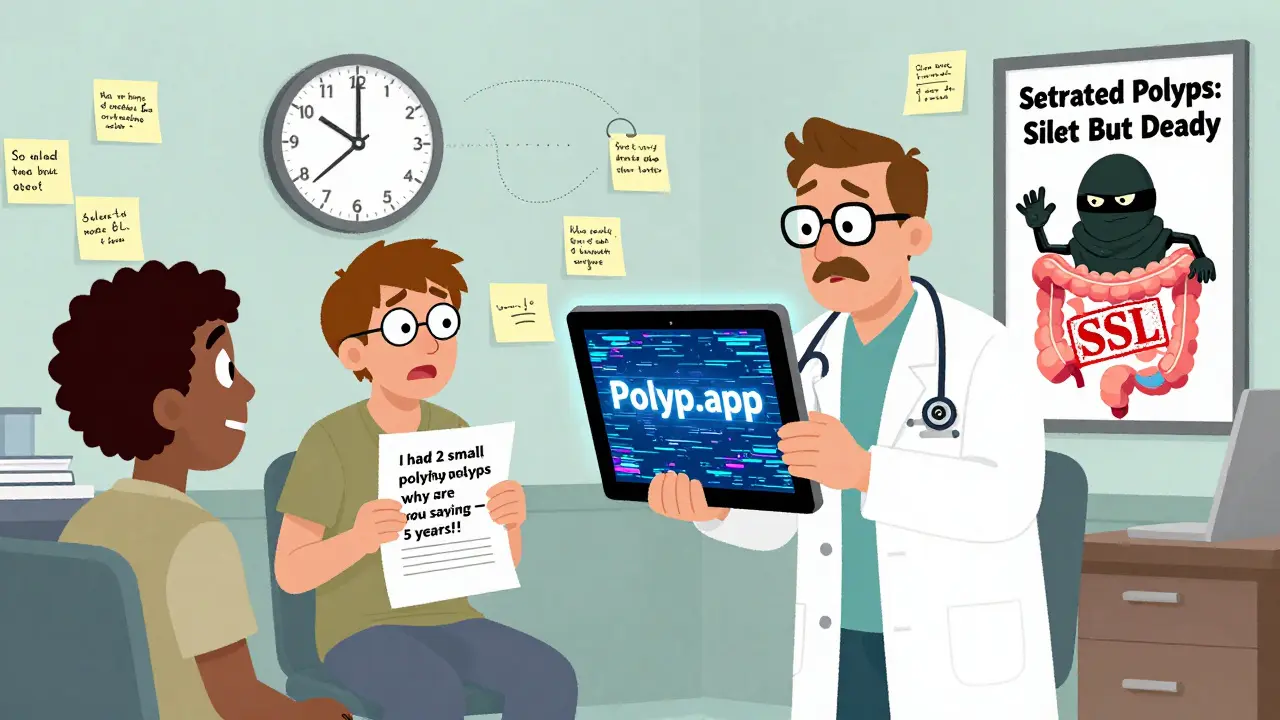
Serrated Polyps: The Silent Threat
Sessile serrated lesions (SSLs) are the silent killers of colon cancer. They don’t bulge out like classic polyps. They’re flat, hidden in folds, and easy to miss-even by experienced endoscopists. If you had one or two SSLs under 10 mm, you’re in the same boat as low-risk adenomas: 5 to 10 years is fine. But if you had three to four SSLs? That’s a 3 to 5 year window. Five or more? Back in 3 years. And if any SSL was 10 mm or larger? That’s a hard 3-year rule. Here’s the catch: hyperplastic polyps (HPs) that are 10 mm or larger are often mistaken for SSLs. If your doctor isn’t sure, or if the bowel prep was messy, they’ll likely recommend a 3 to 5 year follow-up. Better safe than sorry.What About Serrated Polyposis Syndrome?
This is rare but serious. It means you have a bunch of serrated polyps scattered throughout your colon-sometimes dozens. If you’ve been diagnosed with this, you’re not just doing routine screening anymore. You’re in a high-risk monitoring program. Guidelines vary: some say yearly, others say every 1-2 years until age 75. The goal? Catch every new polyp before it becomes a problem. If you’ve had two clean exams with no polyps over 10 mm, your doctor might stretch the interval to every 2 years.Why Do So Many People Get Colonoscopies Too Soon?
Here’s the ugly truth: most people get repeat colonoscopies way earlier than they need to. A 2020 study at a Veterans Affairs hospital found only 18.6% of doctors followed the updated 7-10 year rule for low-risk adenomas. Most stuck with the old 5-year rule-even when they knew the new guidelines. Why? Fear. Legal risk. Confusion. Some doctors don’t trust the data. Others worry a patient will get cancer and blame them. Primary care providers often don’t know the rules either. One survey found only 37% of gastroenterologists could correctly identify all the risk categories. And for serrated polyps? Only 28% got it right. The result? Millions of unnecessary colonoscopies every year. That’s wasted money, wasted time, and unnecessary risk from sedation and bowel prep.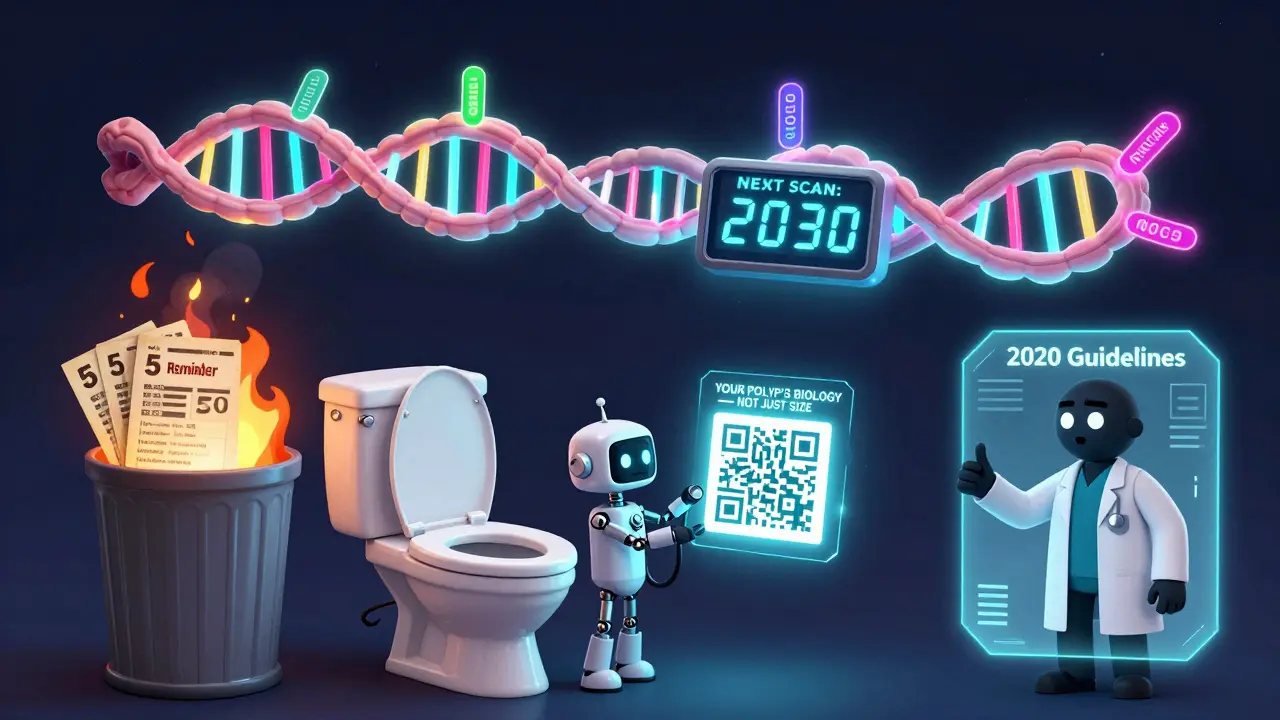
Tools to Help You Get It Right
There’s an app called Polyp.app, built by doctors at Massachusetts General Hospital. It takes your polyp details-size, number, type-and spits out the exact recommended interval. Over 12,400 clinicians use it. Many hospitals now have EHR systems (like Epic or Cerner) that auto-populate your next colonoscopy date based on what was found during your procedure. If your doctor says, “Come back in 5 years,” ask: “What kind of polyps were found? What size? Was the resection complete?” If they can’t answer, ask for a copy of your pathology report. You have a right to know what was found-and what it means for your future.What If You’re Not Sure What You Had?
If your report says “adenoma” or “polyp” without details, call your endoscopist’s office. Ask for the pathology report. It will say things like:- “Tubular adenoma, 6 mm, low-grade dysplasia”
- “Sessile serrated lesion, 8 mm, completely resected”
- “Hyperplastic polyp, 12 mm, no dysplasia”
The Future: Personalized Timing
Right now, we count polyps. But soon, we’ll be testing them. Researchers are studying DNA markers in polyp tissue to predict cancer risk. One trial (NCT04567821) is looking at methylation patterns-chemical tags on DNA-that signal whether a polyp is likely to turn dangerous. If it works, your next colonoscopy might be scheduled based on your polyp’s biology, not just its size or number. That’s the future. But today? Stick to the numbers. Know what you had. Ask the right questions. And don’t let outdated advice push you into a colonoscopy you don’t need.How long should I wait for my next colonoscopy after having one small adenoma removed?
If you had one or two small adenomas (under 10 mm) that were completely removed and your bowel prep was good, you can wait 7 to 10 years for your next colonoscopy. This is based on 2020 guidelines from the US Multi-Society Task Force, which found cancer risk in this group is nearly the same as people with no polyps.
Do I need a colonoscopy every 5 years if I had polyps?
Not necessarily. The old rule of five years applied to all polyps, but guidelines changed in 2020. Only certain cases require a 5-year interval: three to four small adenomas, or one to two sessile serrated lesions. For one or two small adenomas, 7 to 10 years is now standard. Always check your polyp type and size before assuming the interval.
What if my polyp was removed in pieces?
If a polyp larger than 20 mm was removed in pieces (piecemeal resection), you need a follow-up colonoscopy in 6 months. This is to make sure no tissue was left behind that could grow into cancer. This rule applies regardless of polyp type and is consistent across major guidelines in the US, Japan, and Korea.
Are serrated polyps more dangerous than adenomas?
They’re different, not necessarily worse. Adenomas follow a clear path to cancer. Serrated polyps-especially sessile serrated lesions (SSLs)-are harder to spot and can turn cancerous without ever looking like a polyp. They grow slowly, often in the right side of the colon, and are linked to a different type of cancer. Because they’re sneaky, guidelines treat them seriously: even small SSLs require careful follow-up.
Can I skip my next colonoscopy if I feel fine?
No. Colon cancer often has no symptoms until it’s advanced. Polyps grow silently. Even if you feel perfectly healthy, skipping your recommended follow-up puts you at risk. The goal of surveillance is to catch changes before they become cancer. Feeling fine doesn’t mean you’re safe.
Why do doctors sometimes recommend a 3-year interval when I only had one small polyp?
It could be because of one of several reasons: your bowel prep was poor, the polyp wasn’t fully removed, or your doctor suspects it might be a sessile serrated lesion instead of a simple adenoma. Sometimes, doctors play it safe due to legal concerns or outdated training. Ask for your pathology report and clarify the polyp type before accepting a shorter interval.
Is it true that some countries recommend longer intervals than the US?
Yes. European guidelines, especially from the UK and Netherlands, allow intervals longer than 10 years for people with one to four small adenomas. US guidelines are more conservative, recommending 7-10 years. The difference comes from how each region interprets long-term cancer data. US data focuses on preventing cancer in high-risk groups, while European data suggests that missed polyps-not new growth-are the main cause of post-colonoscopy cancer.
Comments
Mike Rengifo
December 20, 2025 AT 11:28Still, I get why people panic. My mom had one removed and now she checks her calendar like it’s a Netflix release.
Matt Davies
December 21, 2025 AT 21:53Meenakshi Jaiswal
December 22, 2025 AT 23:03Andrew Kelly
December 24, 2025 AT 05:58mary lizardo
December 26, 2025 AT 04:33Moses Odumbe
December 26, 2025 AT 08:09PS: If you’re still doing 5-year checks for low-risk stuff, you’re doing it wrong. 🚫🩺
Isabel Rábago
December 28, 2025 AT 08:02Anna Sedervay
December 30, 2025 AT 04:58Dev Sawner
December 31, 2025 AT 02:11Mahammad Muradov
December 31, 2025 AT 23:00jessica .
January 1, 2026 AT 11:34Ashley Bliss
January 2, 2026 AT 22:17bhushan telavane
January 4, 2026 AT 21:10