
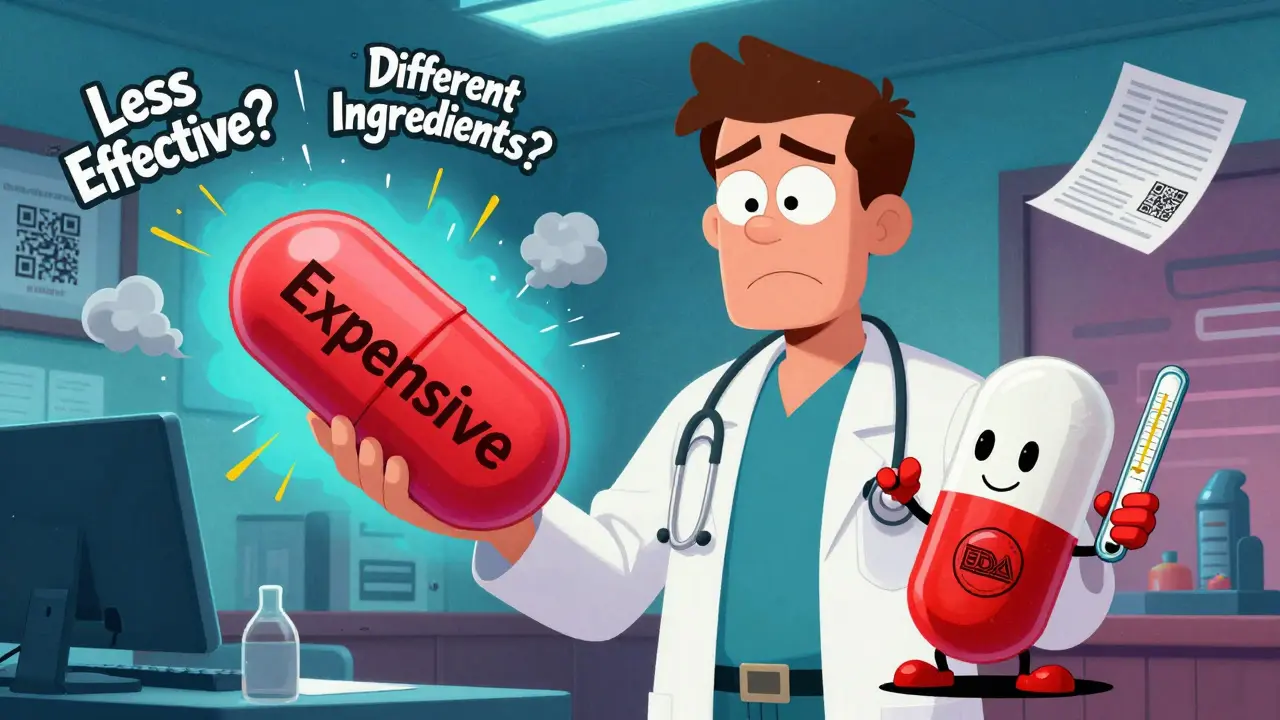
Doctors prescribe generics every day-over 90% of prescriptions in the U.S. are for them. But many still hesitate. Why? Because the myths won’t go away. Patients ask: Is this really the same? Insurance companies push for switches. Clinicians wonder: Do I have the right info to make this call confidently?
What Exactly Makes a Generic Drug the Same?
A generic drug isn’t a copy. It’s not a knockoff. It’s a scientifically identical version of a brand-name drug, approved by the FDA under the same strict standards. The key? Bioequivalence. That means the generic delivers the same amount of active ingredient into the bloodstream at the same rate as the brand. The FDA requires this to be within 80% to 125% of the brand’s performance. That’s not a wide range-it’s tight. It’s the same as saying two thermometers must read within half a degree of each other when measuring body temperature.
The process isn’t guesswork. Before approval, the manufacturer must prove the generic matches the brand in active ingredients, strength, dosage form, and route of administration. Then they run tests in 24 to 36 healthy volunteers to measure blood levels over time. No shortcuts. No exceptions. And once approved, the FDA keeps watching. In 2022, they reviewed over 12,000 adverse event reports for generics-almost the same number as for brand-name drugs. Safety isn’t an afterthought. It’s built in.
Why Doctors Still Doubt Generics (And How to Fix It)
Even with all the data, skepticism lingers. Some doctors remember stories from decades ago when generics had inconsistent absorption. That’s outdated. Modern manufacturing is precise. Others worry about complex drugs-like inhalers, topical creams, or injectables-where small differences in formulation can matter more. But even here, the FDA has clear standards. For inhalers, for example, they require matching particle size, spray pattern, and lung deposition-not just chemical content.
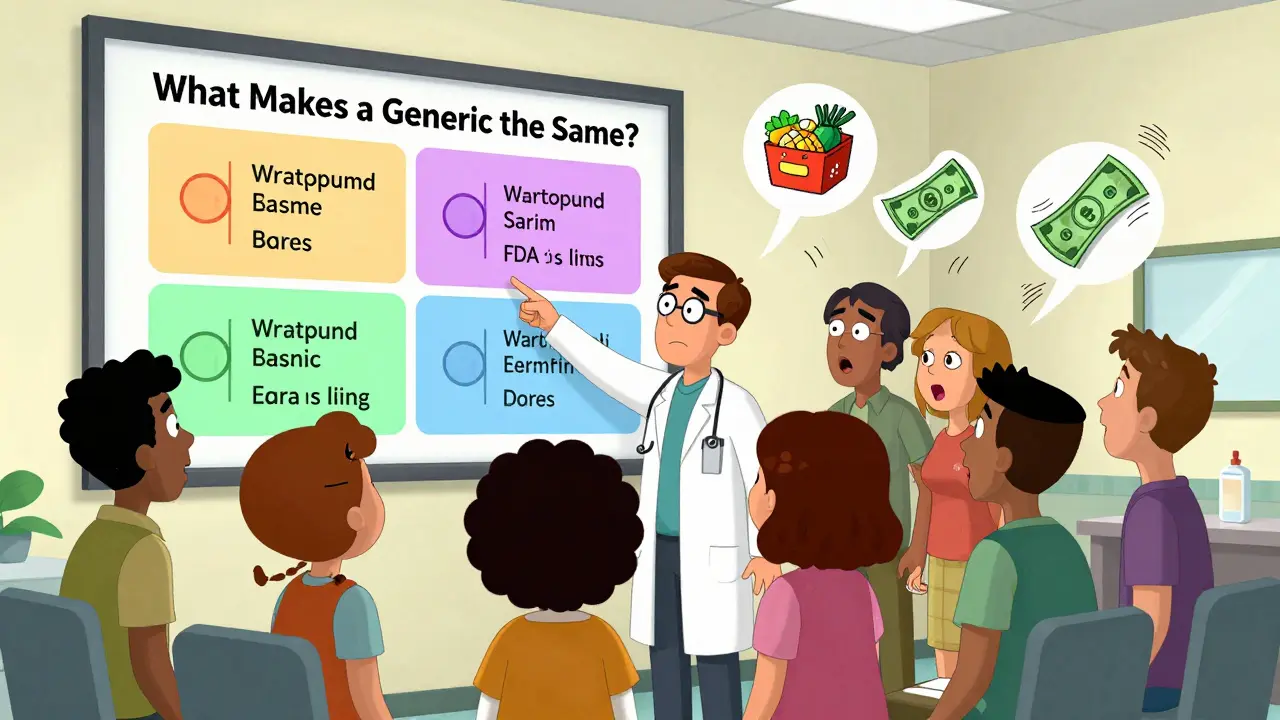
The real issue? Lack of exposure. A 2023 survey found only 48% of physicians even knew the FDA’s Generic Drugs Stakeholder Toolkit existed. That toolkit includes ready-to-use materials: social media posts, patient handouts, infographics. One infographic, titled “What Makes a Generic the Same as a Brand-Name Drug?”, breaks down the approval process in plain visuals. It’s not dense science. It’s designed for quick reading during a 10-minute visit.
Doctors who used these resources saw real change. One rural family physician in Nebraska boosted her generic prescribing rate from 62% to 89% in 18 months-not by forcing switches, but by showing patients the same FDA-approved standards that apply to both drugs. She used the infographic. Patients stopped asking, “Is this cheaper because it’s worse?” and started asking, “Why isn’t this the default?”
Cost Isn’t Just a Patient Issue-It’s a Clinical One
When a patient can’t afford their medicine, it doesn’t end with a missed dose. It ends in hospital visits, ER trips, worsening conditions. The American College of Physicians found that 20-30% of new prescriptions are never filled because of cost. For a $300-a-month brand-name drug, switching to the generic saves the patient $262.50 every month. That’s not a small difference. That’s enough to pay for groceries, bus fare, or insulin.
And it’s not just about price. It’s about adherence. A 2022 study showed that patients who switched to generics for high-cost medications like statins or blood pressure drugs were significantly more likely to stay on treatment. One patient told her doctor: “I didn’t skip my pills because I forgot. I skipped them because I had to choose between medicine and my kid’s school lunch.” That’s not a pharmacy problem. That’s a prescribing decision.
Doctors who received structured education on generics were 2.3 times more likely to start conversations about cost with patients. Not because they were told to. Because they finally had the tools to explain why switching wasn’t a compromise-it was an improvement.
Where the Resources Fall Short (And What You Can Do About It)
The FDA’s materials are solid. But they’re not everywhere. Only 37% of major electronic health record systems include pop-up reminders or embedded guides when a brand-name drug is selected. That means doctors have to leave their workflow, open a browser, hunt for a PDF, print it, and hope the patient reads it.
One doctor on Reddit put it bluntly: “I need this info in my Epic alert box, not as a PDF I have to hunt for.” That’s the gap. The tools exist. They just aren’t integrated.
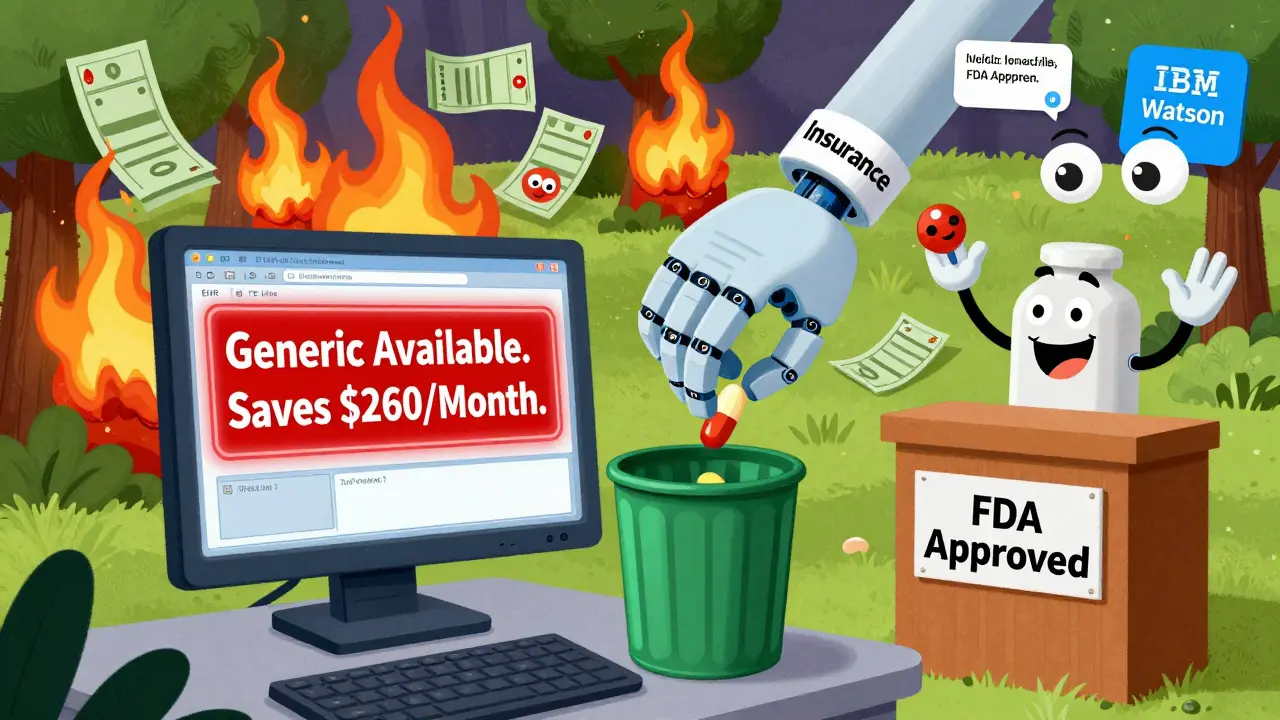
Some systems are fixing this. Kaiser Permanente embedded FDA-approved generic drug facts directly into their Epic system. Within six months, brand-name prescribing dropped by nearly 19%. No training sessions. No flyers. Just a prompt that appeared when a doctor typed in a brand name: “Generic available. Equivalent. Saves patient $260/month.”
Here’s what you can do today, even without EHR integration:
- Keep the FDA’s Prescriber Flyer (Version 2) on your desk. It’s one page. Fits in a standard literature rack.
- Use the QR code on the flyer to show patients the Spanish version if needed. Health equity matters.
- Print the “Generic Drug Facts” handout. Keep it in your exam rooms. Patients read it while waiting.
- Use the simple script: “This generic has the same active ingredient, same dose, same effect. The only difference? Price. And it’s been tested just as thoroughly.”
Complex Generics: Where Education Gets Tricky
Not all generics are created equal in perception-and that’s where education needs to go deeper. Inhalers, topical creams, and injectables have more variables. For inhalers, it’s not just about the chemical. It’s about how the drug is delivered: particle size, spray force, lung deposition. The FDA tests these. But many doctors don’t know that.
Same with topical medications. A cream’s base-whether it’s petroleum-based or water-based-can change how well the drug penetrates skin. Generics must match this too. But if a patient says, “My old cream felt different,” the doctor needs to know why that’s normal-and how to explain it.
Then there’s the confusion around “authorized generics.” These are brand-name drugs made by the same company but sold under a generic label. They’re identical to the brand-same factory, same formula. But 61% of physicians don’t realize this. That’s not just a knowledge gap. It’s a missed opportunity to reassure patients.
Start by asking: “Is this a brand, a generic, or an authorized generic?” If you don’t know, check the FDA’s online database. It’s free. It’s updated daily. You don’t need a subscription. You just need five minutes.
What’s Next? AI, Policy, and the Future of Prescribing
The future is coming fast. In 2023, IBM Watson Health tested an AI tool that analyzed patient records and suggested personalized generic switches based on cost, condition, and past responses. In a trial with 120 doctors, patient acceptance jumped by 29 percentage points. The AI didn’t replace the doctor. It gave the doctor better talking points.
Policy is catching up too. Medicare Part D now offers financial incentives for plans that educate prescribers on therapeutic alternatives. That means more funding for training. More resources. More integration.
But the biggest driver? Cost. From 2010 to 2020, generics saved the U.S. healthcare system over $2.29 trillion. The next five years? Another $1.87 trillion. That’s not a number on a spreadsheet. That’s millions of patients who can afford their meds. That’s fewer hospitalizations. Fewer complications. Fewer regrets.
The data is clear. The tools are ready. The only thing missing is consistent use.
How to Start Using These Resources Today
You don’t need to overhaul your practice. Just start small.
- Download the FDA’s Prescriber Flyer (Version 2) and Generic Drugs Stakeholder Toolkit. Both are free. No login needed.
- Print one flyer. Put it next to your computer. Glance at it before each visit.
- Use one line from the script: “This generic works the same way. It’s been tested just as hard.”
- When a patient says, “I’ve always taken the brand,” ask: “What made you choose it originally?” Listen. Then respond with facts, not force.
- Ask your EHR vendor: “Can you add FDA generic education prompts into the prescribing screen?” If they say no, ask why.
It’s not about convincing every doctor. It’s about giving the ones who care the tools to make a real difference. One patient at a time.
Are generic drugs really as effective as brand-name drugs?
Yes. Generic drugs must meet the same strict standards as brand-name drugs set by the FDA. They contain the same active ingredient, in the same strength and dosage form, and deliver the same therapeutic effect. The FDA requires bioequivalence testing-meaning the generic must absorb into the bloodstream at the same rate and to the same extent as the brand. Over 90% of prescriptions in the U.S. are for generics, and their safety and effectiveness are continuously monitored through postmarket surveillance.
Why do some patients and doctors still prefer brand-name drugs?
Many misconceptions persist from older generations of generics, when manufacturing quality varied. Today’s generics are made under the same strict conditions as brand-name drugs. Some patients associate higher price with better quality. Others have had personal experiences-like a different pill shape or color-that felt “off,” even though the active ingredient is identical. Education helps. When doctors show patients the FDA’s infographic comparing manufacturing standards, patient trust increases significantly.
Do generics cause more side effects than brand-name drugs?
No. In 2022, the FDA analyzed over 12,400 adverse event reports for generic drugs and compared them to over 11,800 for brand-name drugs. The rates were nearly identical. Side effects come from the active ingredient, not whether the drug is branded or generic. Differences in inactive ingredients (like fillers or dyes) can rarely cause reactions, but these are uncommon and are also monitored by the FDA.
What should I tell patients who say their insurance forced them to switch?
Acknowledge their concern, then explain: “Your insurance isn’t forcing you to take something weaker-they’re helping you access the same medicine at a lower cost. The FDA requires generics to be just as safe and effective. In fact, 90% of prescriptions in the U.S. are generics because they work just as well. If you’ve had a bad experience before, let’s check if this is an authorized generic-it’s made by the same company as the brand.”
Are there situations where I shouldn’t prescribe a generic?
Rarely. For most medications, generics are safe and effective. Exceptions may include narrow-therapeutic-index drugs like warfarin or levothyroxine, where small changes in blood levels matter. But even here, studies show generics perform just as well when properly monitored. The key is consistency-if a patient is stable on a generic, don’t switch them back to brand unless there’s a clear clinical reason. The FDA and major medical societies agree: generics should be the default unless there’s a documented intolerance.
How can I access the official FDA resources for prescribers?
All FDA prescriber education materials for generics are free and publicly available at fda.gov/generics. Look for the “Generic Drugs Stakeholder Toolkit” and “Prescriber Flyers.” You’ll find printable handouts, infographics, social media templates, and even Spanish-language versions. No registration is required. Download, print, and use them in your clinic today.
Next Steps for Clinicians
Start with one step: Download the FDA’s Prescriber Flyer. Print it. Put it where you see it every day. In a week, try using one line from the script during a patient visit. In a month, ask your EHR vendor if they can integrate generic education prompts. In six months, look at your prescribing data. You might be surprised how much you’ve changed-without changing your practice at all.
The goal isn’t to replace brand-name drugs. It’s to make sure patients get the medicine they need-without having to choose between health and affordability.
Comments
Kelly McRainey Moore
January 22, 2026 AT 06:25Been using generics for years and never had an issue. My grandma takes six different ones and still dances at weddings. If it works, it works. No need to overthink it.
Amber Lane
January 23, 2026 AT 02:22My patient last week said, 'I thought generics were fake meds.' I showed her the FDA infographic. She cried. Not because she was upset-because she finally felt heard. That’s the power of simple tools.
Ashok Sakra
January 24, 2026 AT 01:50THIS IS A CONSPIRACY. BIG PHARMA IS LYING TO YOU. THE FDA IS IN THEIR POCKET. I SAW A GUY ON YOUTUBE WHO SAID GENERICS MADE HIS HAIR FALL OUT. HE WAS A DOCTOR TOO. HE KNOWS.
michelle Brownsea
January 25, 2026 AT 19:58It’s not merely about bioequivalence-it’s about epistemological trust in institutional science. The FDA’s standards are rigorous, yes-but how many clinicians have actually read the guidance documents? Or are they relying on fragmented, emotionally charged anecdotes from patients who equate price with efficacy? This isn’t pharmacology-it’s cognitive dissonance dressed in white coats.
lokesh prasanth
January 26, 2026 AT 20:01generic dont work same. i saw friend take it. got sick. doctor said its fine. but he was wrong. big pharma lies.
Yuri Hyuga
January 27, 2026 AT 16:27👏 This is the kind of practical, patient-centered wisdom we need more of in medicine! The fact that a simple flyer and one sentence can shift prescribing habits? That’s not just education-that’s transformation. Keep pushing for integration in EHRs. The future is here, and it’s cost-effective, evidence-based, and human. 💪💊
Coral Bosley
January 28, 2026 AT 04:35I used to think generics were cheap knockoffs until my blood pressure meds switched and I didn’t die. Then I realized the brand was just a fancy label on the same damn pill. The real villain? The placebo effect of price tags.
Kevin Narvaes
January 28, 2026 AT 22:20my doc switched me to generic and i felt weird for a week. turned out i was just stressed. but now i dont trust any generic. they got different dyes or something. i can feel it.
Dee Monroe
January 29, 2026 AT 07:36You know what’s wild? The fact that we’re even having this conversation. We live in a world where people will pay $10 for a latte but freak out over $5 for a pill that does the exact same thing. It’s not about science-it’s about identity. We attach meaning to brand names like they’re status symbols. But medicine isn’t fashion. It’s biology. And biology doesn’t care if the pill has a logo on it. The real tragedy isn’t the cost-it’s that we’ve made patients feel guilty for wanting to live without choosing between rent and their heart medication.
Alex Carletti Gouvea
January 30, 2026 AT 15:02USA makes the best drugs. Why are we letting foreign factories make our meds? This is a national security issue. If your heart med comes from India, you’re gambling with your life.
Philip Williams
January 31, 2026 AT 12:36Can anyone point me to the specific FDA guidance on bioequivalence thresholds for complex generics like inhalers? I’d like to review the technical appendices before discussing this with my residents.
Ben McKibbin
February 2, 2026 AT 02:23There’s something quietly revolutionary about a 1-page flyer changing how an entire clinic thinks. It’s not flashy. It doesn’t need a grant. Just clarity. And maybe a little dignity-for the doctor who’s tired of explaining, and the patient who’s tired of being treated like a liability.
Melanie Pearson
February 3, 2026 AT 18:57While I appreciate the sentiment, this piece fundamentally underestimates the systemic fragility of pharmaceutical supply chains. The assertion that 'generics are equivalent' is statistically valid but ontologically insufficient. Regulatory equivalence does not equate to clinical indistinguishability across heterogeneous patient populations-particularly those with polypharmacy, renal impairment, or genetic polymorphisms in drug-metabolizing enzymes. The FDA’s 80–125% window is a statistical convenience, not a biological guarantee.
Jerry Rodrigues
February 4, 2026 AT 23:55My clinic started using the flyer. Patients stopped asking if it’s 'the real stuff.' Now they just say 'cool, thanks.' Sometimes the simplest fix is the one you’ve been ignoring.
Uju Megafu
February 5, 2026 AT 22:53YOU THINK THIS IS ABOUT DRUGS? NO. THIS IS ABOUT CONTROL. WHO GETS TO DECIDE WHAT’S SAFE? BIG PHARMA. THE GOVERNMENT. THE DOCTORS. NOT THE PATIENT. I’M NOT TAKING A GENERIC UNTIL I CAN TASTE THE SAME CHEMICALS. I HAVE A RIGHT TO KNOW WHAT’S INSIDE.