

Mirtazapine Weight Gain Calculator
Calculate Your Weight Gain Risk
Your Estimated Weight Gain
Enter your details above to see your estimated weight gain.
Estimated Weight Gain:
Estimated Percentage Gain:
This is an estimate based on clinical studies showing average weight gain patterns.
What This Means for You
When you start taking mirtazapine for depression, you’re hoping to feel better - not heavier. But for a lot of people, weight gain becomes an unavoidable part of the journey. It’s not just a minor side effect. It’s one of the most common and noticeable changes people experience, often showing up within the first few weeks. If you’ve noticed the scale creeping up or your clothes feeling tighter, you’re not alone. And you’re not imagining it - this is a well-documented, biologically driven effect, not just poor diet or lack of willpower.
Why Does Mirtazapine Make You Gain Weight?
Mirtazapine doesn’t cause weight gain because it makes you lazy or hungry in the usual sense. It rewires your body’s chemistry at a deep level. The drug works by blocking certain receptors in your brain - especially the H1 histamine receptor and the alpha-2 adrenergic receptor. Blocking H1 is what makes you sleepy, but it also turns up your appetite like a volume knob. Studies show people on mirtazapine report stronger cravings for sweets and carbs, even when their calorie intake is tightly controlled. One 2019 study found that after just seven days on the drug, participants had a 18.7% spike in insulin and a 15.3% rise in C-peptide, meaning their bodies were pumping out more insulin even before they ate more. That’s a direct metabolic shift.
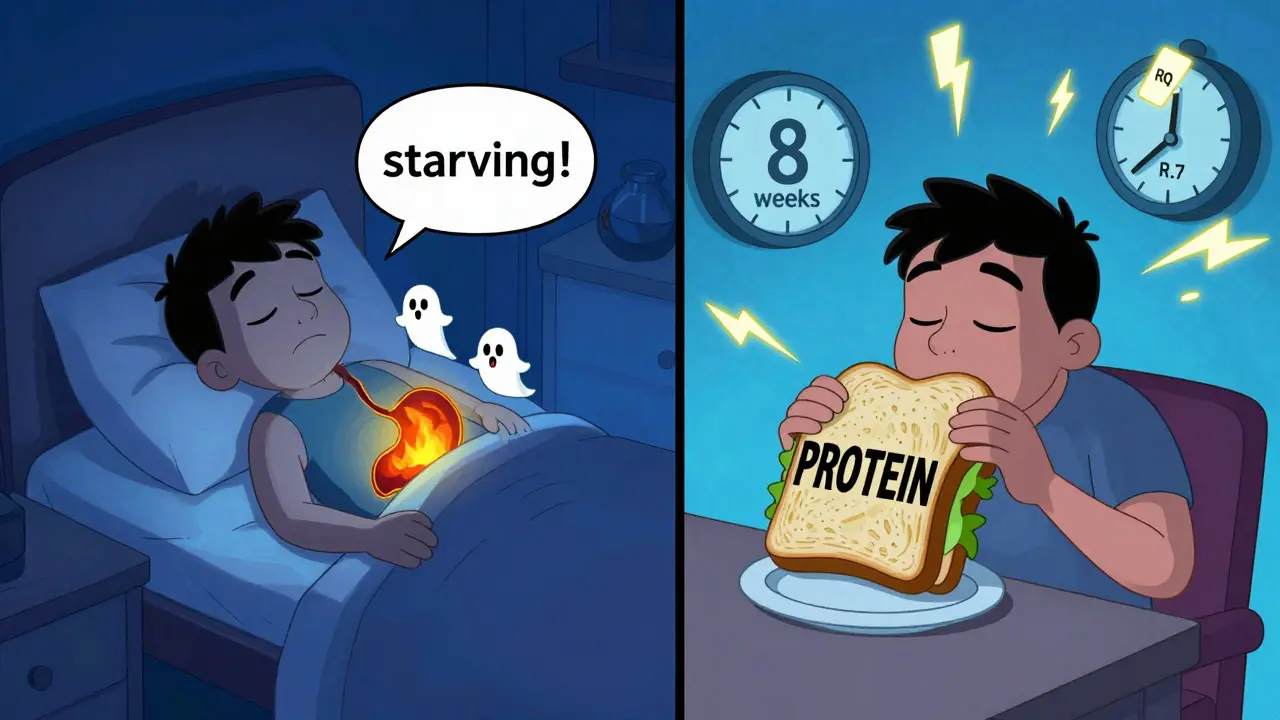
On top of that, mirtazapine changes how your body uses energy. It shifts your metabolism toward storing carbs as fat, not burning them. Researchers measured this using something called the respiratory quotient (RQ), which tells you whether your body is burning carbs or fat for fuel. People on mirtazapine showed a clear rise in RQ - meaning their bodies were favoring carbs, even when they weren’t eating more. This happens even if your weight hasn’t changed yet. The fat storage process is already kicking in.
How Much Weight Do People Actually Gain?
The numbers vary, but they’re not small. Clinical trials show about 25% of people gain 7% or more of their body weight - that’s 11 pounds for someone who weighs 150 pounds. On average, people gain around 8 pounds over six weeks. But here’s the twist: some gain nothing. Others gain 30, 40, even 100 pounds. The difference isn’t about discipline. It’s biology.
A 2020 analysis comparing 21 antidepressants ranked mirtazapine as the second most likely to cause weight gain - only paroxetine was worse. Compared to sertraline or escitalopram, mirtazapine caused significantly more weight gain. And unlike bupropion, which often leads to weight loss, mirtazapine pushes you in the opposite direction. Even when compared to other drugs used for depression, like venlafaxine or citalopram, mirtazapine consistently shows higher weight gain numbers.
But not all studies agree on how fast it happens. Some say you gain most of the weight in the first 12 weeks. Others show that after that, the scale often stabilizes. One analysis found the average gain in the first 8 to 12 weeks was only about 3 pounds - less than many expect. So while the fear is real, the reality is often more gradual than dramatic. Still, for those who do gain heavily, it can be overwhelming.
It’s Not Just About Eating More
People often assume weight gain means you’re snacking all day. But research shows that’s not the whole story. Even when people on mirtazapine eat the same number of calories as before, they still gain weight. Why? Because the drug changes how those calories are used. It lowers your resting energy expenditure - the number of calories you burn just by sitting still. One study found a 5-7% drop in energy use, though the effect wasn’t always statistically significant, suggesting your body might compensate over time.
Another hidden factor is leptin. This hormone tells your brain when you’re full. Mirtazapine increases leptin levels by 25-30%, which sounds good - until your brain stops listening. That’s called leptin resistance. Your body thinks it’s starving, even though you’re gaining fat. So you keep eating, even when you’re full. It’s not a lack of control. It’s a broken signal.
Lower Doses Don’t Always Mean Less Weight Gain
A lot of people think taking a lower dose - like 7.5 mg or 15 mg - will help them avoid weight gain. And sometimes it does. One study found that people on 7.5 mg gained about 1.2 kg (2.6 lbs) over 12 weeks, while those on 30 mg gained 2.1 kg (4.6 lbs). That’s a real difference. But here’s the catch: the drug’s receptor binding doesn’t change much between doses. The same receptors are blocked whether you take 7.5 mg or 45 mg. So why does the lower dose sometimes help?
It’s likely because higher doses increase norepinephrine activity, which can reduce the sedative effects of H1 blockade. That means people on higher doses may feel less sleepy during the day - and therefore less tempted to snack. But the appetite drive is still there. So while a lower dose may slow weight gain, it doesn’t stop it. And if you need the higher dose for depression, you may still gain weight - just a little slower.
When Weight Gain Is Actually a Benefit
Here’s something you won’t hear in every doctor’s office: for some people, mirtazapine’s weight gain effect is the reason they’re taking it. People with cancer, eating disorders, or severe chronic illness often lose too much weight. Their bodies are too weak to fight back. In these cases, mirtazapine isn’t a side effect - it’s a tool. A 2024 trial in JAMA Oncology showed that cancer patients on mirtazapine ate more protein and fat, helping them stay strong enough to finish chemotherapy. One patient posted on a support forum: “I gained 12 pounds in 8 weeks. It helped me finish chemo.”
For these patients, the goal isn’t to avoid weight gain - it’s to use it. That’s why mirtazapine is still widely used in palliative care and geriatric psychiatry. In older adults, it’s not just about mood. It’s about survival. A 2022 analysis found that nearly 28% of mirtazapine prescriptions in the U.S. are for patients in hospice or cancer care. For them, gaining a few pounds can mean the difference between staying home and needing hospitalization.

What You Can Do About It
If you’re on mirtazapine and worried about weight gain, you’re not powerless. Here’s what actually works, based on real studies:
- Start low, go slow. If your doctor agrees, begin with 7.5 mg. You might still gain weight, but it’ll be slower.
- Take it at night. Mirtazapine is sedating. Taking it in the evening helps you sleep and reduces daytime cravings. One study showed evening dosing cut carb cravings by 15% compared to morning dosing.
- Focus on protein. A 2022 pilot study found that people who ate 1.2-1.6 grams of protein per kilogram of body weight each day gained 63% less weight than those who didn’t. Protein keeps you full longer and helps preserve muscle while you gain fat.
- Monitor your numbers. Your doctor should check your weight, waist size, blood sugar, and triglycerides every month for the first three months. Mirtazapine can raise triglycerides and lower HDL cholesterol - even without weight gain. That’s a hidden risk.
- Don’t stop cold turkey. Stopping mirtazapine suddenly can cause severe withdrawal. If you want to switch, work with your doctor to taper slowly and replace it with another antidepressant that doesn’t cause weight gain, like bupropion or sertraline.
What’s Next for Mirtazapine?
Pharmaceutical companies know the weight gain problem is holding mirtazapine back. Merck has already filed a patent for a new version of the drug that keeps the antidepressant effects but cuts H1 receptor binding by 87%. That could mean a version that treats depression without the weight gain. It’s still in testing.
The National Institute of Mental Health is also running a trial combining mirtazapine with low-dose naltrexone - a drug used for addiction and alcohol dependence. Early results show it cuts weight gain in half, without hurting mood improvement. That could be a game-changer.
But for now, mirtazapine remains a vital option - especially for people who haven’t responded to other antidepressants or who need help eating. It’s not perfect. But for many, the benefits still outweigh the downsides.
Final Thoughts
Mirtazapine and weight gain go hand in hand - not because you’re eating too much, but because your body’s chemistry has changed. The weight gain is real, predictable, and biological. But it’s not inevitable for everyone. Some people gain nothing. Others gain a lot. The key is knowing what to expect, monitoring your health, and working with your doctor to find the right balance.
If you’re on mirtazapine and gaining weight, don’t blame yourself. Talk to your doctor about dose, timing, and diet. You don’t have to choose between feeling better and feeling healthy. With the right strategy, you can do both.
Does mirtazapine cause weight gain in everyone?
No, not everyone gains weight on mirtazapine. About 25% of people gain 7% or more of their body weight, but many others gain little to none. Factors like genetics, baseline metabolism, diet, and activity level all play a role. Some people report no change even after months on the drug.
How soon after starting mirtazapine does weight gain begin?
Weight gain often starts within the first 2 to 4 weeks. Some people notice increased hunger and cravings as early as day 3. By 6 to 8 weeks, most of the weight gain that’s going to happen has already occurred. After 12 weeks, the rate usually slows down significantly.
Can I prevent weight gain on mirtazapine by eating less?
Simply eating less rarely stops weight gain on mirtazapine. The drug changes how your body stores fat and uses energy, even when calorie intake is controlled. Studies show people on mirtazapine gain weight even when their food intake stays the same. The solution isn’t just dieting - it’s protein-focused eating, timing doses at night, and regular movement.
Is weight gain from mirtazapine permanent?
Not necessarily. If you stop taking mirtazapine, many people lose the weight over time - especially if they adopt healthier eating and activity habits. But if you’ve been on it for years and gained a lot of weight, your body may have adapted to a higher weight set point. Losing it will require consistent effort, and it may not come off as easily as it went on.
Are there antidepressants that don’t cause weight gain?
Yes. Bupropion (Wellbutrin) is the most well-known antidepressant that often leads to weight loss. Sertraline and escitalopram tend to cause little to no weight gain. Fluoxetine (Prozac) can cause slight weight loss in the first few months. If weight gain is a major concern, talk to your doctor about switching to one of these alternatives - but don’t stop mirtazapine without medical guidance.
Can mirtazapine be used to gain weight intentionally?
Yes, it’s commonly used off-label for this purpose. Doctors prescribe it to cancer patients, people with anorexia, or elderly individuals who’ve lost too much weight. It increases appetite and food intake, especially for protein and fat. In these cases, weight gain is the goal - not a side effect.
Comments
Jamie Hooper
January 24, 2026 AT 11:05Helen Leite
January 25, 2026 AT 11:15Tommy Sandri
January 26, 2026 AT 14:42Luke Davidson
January 28, 2026 AT 09:21asa MNG
January 29, 2026 AT 22:06Sushrita Chakraborty
January 31, 2026 AT 13:53Josh McEvoy
February 1, 2026 AT 21:49Heather McCubbin
February 2, 2026 AT 14:18Sawyer Vitela
February 3, 2026 AT 15:37Shanta Blank
February 4, 2026 AT 07:28