
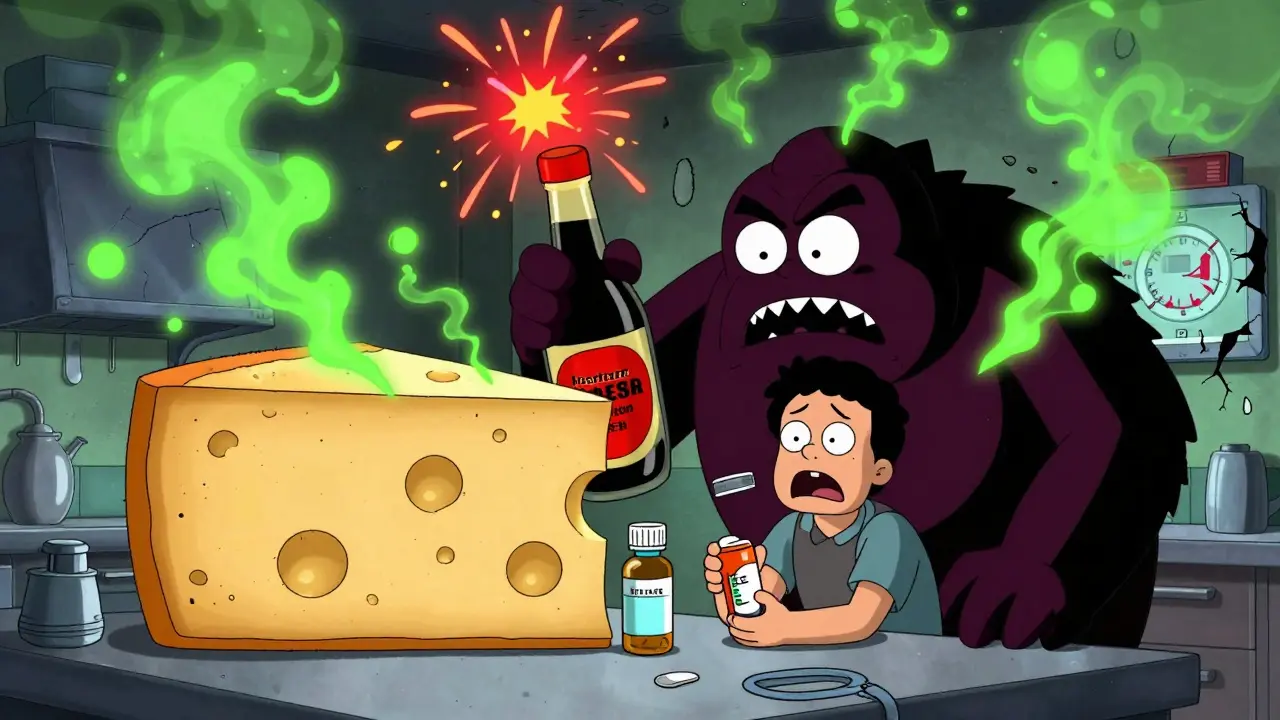
MAO inhibitors, or MAOIs, are one of the oldest classes of antidepressants still in use today. They work by blocking the enzyme monoamine oxidase, which normally breaks down key brain chemicals like serotonin, norepinephrine, and dopamine. This helps lift mood in people with treatment-resistant depression. But here’s the catch: MAO inhibitors don’t just affect your brain-they affect how your whole body handles certain foods, over-the-counter meds, and even common prescriptions. A single wrong combination can send your blood pressure soaring or trigger a life-threatening surge in serotonin. These aren’t hypothetical risks. Real people have ended up in intensive care because they took a cold pill or a supplement they thought was harmless.
Why MAOIs Are So Risky
MAOIs work by stopping the enzyme that clears out neurotransmitters. That’s great for depression-but dangerous when something else floods your system with those same chemicals. The body can’t handle the overload. Two major dangers come from this: hypertensive crisis and serotonin syndrome.
Hypertensive crisis happens when tyramine-a compound found in aged, fermented, or spoiled foods-builds up because MAOIs can’t break it down. Tyramine triggers a massive release of norepinephrine, which spikes blood pressure. In severe cases, systolic pressure can jump from normal levels to 200-250 mmHg in under two hours. That’s enough to cause a stroke, heart attack, or brain hemorrhage. One case report from the Cleveland Clinic described a patient who ate a slice of aged cheddar cheese and ended up in the ER with a blood pressure of 230/120. They didn’t even realize the cheese was the problem.
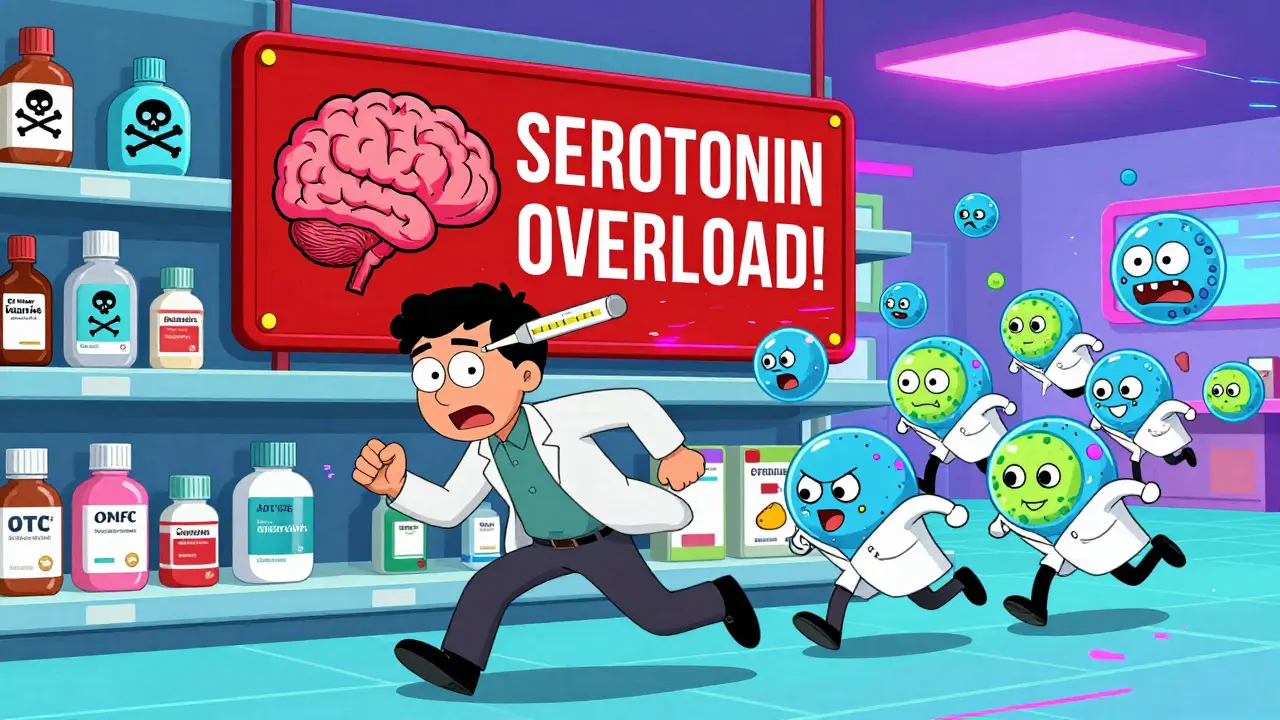
Serotonin syndrome is even more unpredictable. It occurs when too much serotonin accumulates in your nervous system. This can happen if you take an MAOI with almost any other drug that boosts serotonin-antidepressants, painkillers, cough syrups, or even herbal supplements. Symptoms start mild: shivering, sweating, diarrhea. Then they escalate fast: muscle rigidity, fever over 104°F, seizures, organ failure. The mortality rate for severe cases is between 2% and 12%. It doesn’t take days to develop. One person took a single 30mg dose of dextromethorphan (a common cough suppressant) while on phenelzine and was hospitalized within hours.
Medications You Must Avoid
There’s no gray area here. Some drugs are absolute no-gos with MAOIs. The FDA has issued black box warnings on these combinations, and electronic health records now block them automatically. But many people still get caught because they don’t know what’s in their medicine cabinet.
- SSRIs and SNRIs (like fluoxetine, sertraline, venlafaxine): Combining these with MAOIs is one of the most common causes of serotonin syndrome. You need at least 14 days between stopping one and starting the other. For fluoxetine, wait five weeks-it sticks around in your system too long.
- Dextromethorphan: Found in more than 100 cough and cold products. Even a single dose can trigger serotonin syndrome. The FDA has warned about this since 1992, yet many OTC labels still don’t make it clear enough.
- Tramadol, meperidine, methadone: These painkillers are especially dangerous. A 32-year-old man on selegiline took 50mg of tramadol for back pain and ended up intubated in the ICU. His body temperature hit 105°F.
- Linezolid: This antibiotic is also an MAOI. Taking it with an MAOI antidepressant is like doubling down on the same mechanism. There are documented deaths from this combo. If you’re on an MAOI and get an infection, tell your doctor immediately-there are safer antibiotics.
- Phenylephrine and pseudoephedrine: These are in almost every cold and sinus medication. They act like adrenaline in your blood vessels. With an MAOI, they can cause a sudden, dangerous spike in blood pressure.
Supplements and Herbal Products That Can Kill
People think herbal means safe. That’s not true with MAOIs. Many supplements boost serotonin or mimic stimulants-and they don’t come with warning labels.
- St. John’s Wort: Used for mild depression, but it’s a potent serotonin booster. A 2018 case report described a patient who developed a temperature of 105°F and blood pressure of 220/110 after taking it with phenelzine.
- 5-HTP: A direct precursor to serotonin. Taking it with an MAOI is like pouring gasoline on a fire. One patient took 200mg and needed emergency treatment.
- SAMe: Marketed for mood and joint pain. It increases serotonin and dopamine. The American Psychiatric Association explicitly warns against combining it with MAOIs.
- Ginseng: Early reports from the 1980s linked it to mania and tremors in people on MAOIs. Even if the reaction was partly due to caffeine contamination, it’s still a red flag.
Foods That Can Trigger a Crisis
Most people know they shouldn’t eat aged cheese on MAOIs. But what about soy sauce? Tap beer? Pepperoni? The tyramine levels in these foods are higher than you’d expect.
- Aged cheeses (cheddar, parmesan, blue cheese): More than 6 months old = high tyramine. Just one ounce can contain 15mg-enough to trigger a crisis.
- Fermented soy products: Soy sauce, miso, tempeh. One tablespoon of soy sauce can have up to 30mg tyramine.
- Cured and smoked meats: Pepperoni, salami, liverwurst. These are preserved with nitrates and aged, which builds tyramine.
- Draft and tap beer: Pasteurized bottled beer is usually safe. But unpasteurized beer, especially craft or homebrewed, can contain 8-20mg per 12oz.
- Red wine: Chianti and other aged wines can have 8mg tyramine per 5oz glass.
The threshold for a hypertensive crisis is around 10-25mg of tyramine. That’s not a lot. One slice of aged cheese, a splash of soy sauce, or a pint of draft beer can push you over the edge.
What’s Safer Now? The Emsam Patch
Not all MAOIs are created equal. The transdermal selegiline patch (Emsam) delivers the drug through the skin instead of the gut. This means less tyramine gets absorbed into the bloodstream. At the lowest dose (6mg/24hr), you don’t need to follow strict dietary restrictions. Studies show patients can eat moderate amounts of tyramine-containing foods without risk.
As of 2023, the Emsam patch accounts for 68% of all MAOI prescriptions in the U.S. That’s because it’s the safest option available. But it’s not risk-free. Higher doses still require dietary caution. And it still interacts dangerously with serotonergic drugs.
How Prescribing Has Changed
Doctors don’t hand out MAOIs like they used to. In the 1980s, they were common. Now, they’re prescribed in less than 1% of antidepressant cases. Most go to psychiatrists, not primary care doctors. Why? Because the risks are too high for anyone without specialized training.
Electronic health records now block MAOI prescriptions if a patient is already on a contraindicated drug. That’s because between 1998 and 2003, there were 127 reported interactions-including 19 deaths. The FDA mandated these safety blocks in 2004.
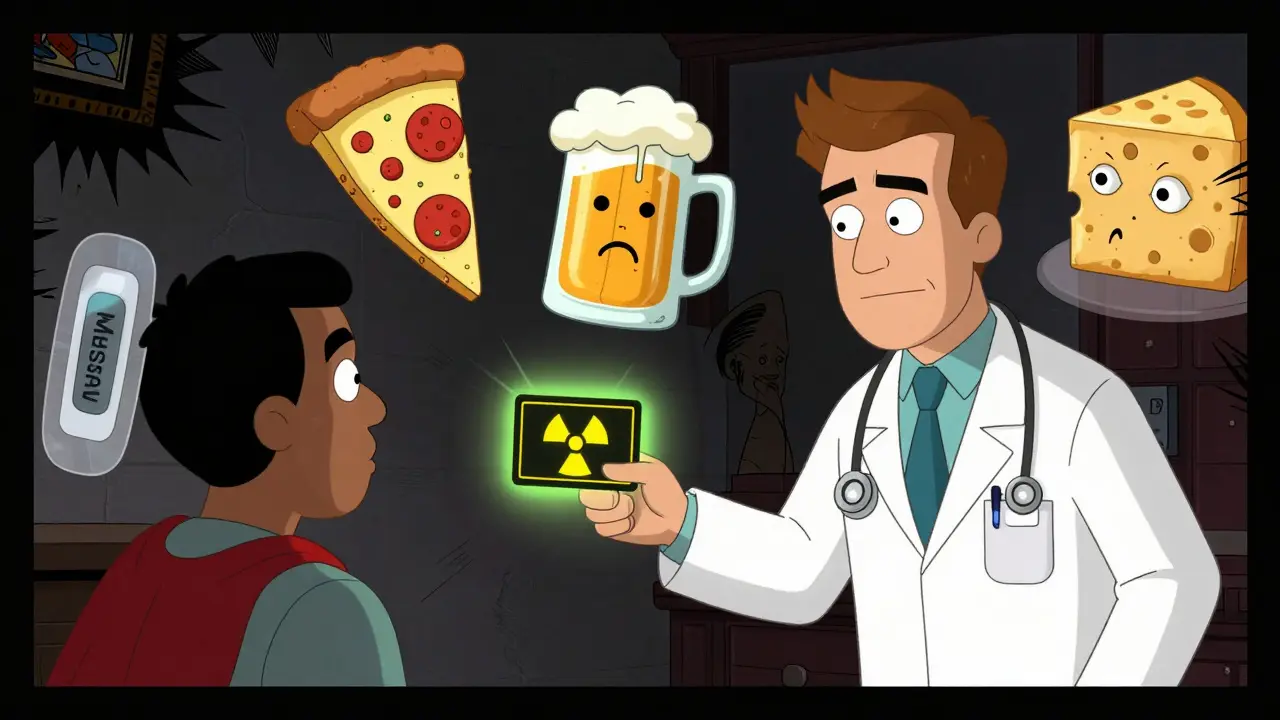
Many psychiatrists now give patients a wallet card listing every dangerous drug and supplement. A 2020 survey found 78% of prescribers do this. But here’s the problem: a 2021 study showed 34% of family doctors didn’t even know dextromethorphan was off-limits. That’s a huge gap.
What You Should Do
If you’re on an MAOI:
- Carry a wallet card with your medications and contraindications.
- Always tell every doctor, dentist, or pharmacist you see that you’re on an MAOI-even for a simple cold.
- Check every OTC medicine, supplement, or herbal product before taking it.
- Never stop or switch medications without a 14-day (or longer) washout period.
- If you feel sudden headache, chest pain, rapid heartbeat, confusion, or fever-seek emergency help immediately.
If you’re not on an MAOI but someone you care about is: learn the warning signs. A simple cold medicine could be deadly. Ask your pharmacist to review all their medications. Don’t assume they know.
Why This Still Matters
MAOIs aren’t going away. They work when nothing else does. But their danger isn’t theoretical. It’s written in hospital records, case reports, and obituaries. As people take more medications-especially older adults on an average of 4.5 prescriptions-the chance of accidental interactions grows. The FDA still requires warning labels on dextromethorphan products, but a 2020 government audit found 12% of them were missing the warning entirely.
MAOIs are not for everyone. But for the right person, they can be life-changing. The key isn’t fear-it’s awareness. Know what’s in your medicine cabinet. Know what’s in your food. And never assume something is safe just because it’s sold over the counter.
Can I take ibuprofen with MAO inhibitors?
Yes, ibuprofen and other standard NSAIDs like naproxen are generally safe with MAOIs. They don’t affect serotonin or norepinephrine levels. But always check with your doctor before starting any new medication, even common pain relievers, because individual health factors can change risk.
Is it safe to drink alcohol while on MAOIs?
It’s not recommended. Alcohol can increase dizziness and lower blood pressure, which may worsen side effects of MAOIs. Some alcoholic drinks, like red wine and tap beer, also contain tyramine and can trigger a hypertensive crisis. Even small amounts carry risk, so most doctors advise complete avoidance.
What should I do if I accidentally take a dangerous drug with an MAOI?
Seek emergency medical help immediately. Don’t wait for symptoms. Call 911 or go to the nearest ER. Tell them you’re on an MAOI and what you took. Early treatment with medications like chlorpromazine or cyproheptadine can prevent serious complications. Time is critical.
Can I switch from an MAOI to an SSRI safely?
Yes, but only after a waiting period. For most MAOIs, you must wait 14 days after stopping before starting an SSRI. For fluoxetine (Prozac), wait five weeks because it and its active metabolite stay in your system much longer. Never switch without medical supervision.
Are there any newer MAOIs with fewer interactions?
Moclobemide is a reversible MAO-A inhibitor used in Europe and Canada with a much lower risk of dietary and drug interactions. But it was never approved in the U.S. because its effectiveness in clinical trials was considered modest compared to existing options. The Emsam patch is currently the safest MAOI available in the U.S., especially at the lowest dose.
Final Thoughts
MAO inhibitors are powerful tools-but they come with serious responsibilities. They’re not outdated. They’re just misunderstood. People who take them need to be informed, vigilant, and proactive. The good news? With the right precautions, they can work when nothing else can. The bad news? One mistake can be fatal. That’s why knowing the risks isn’t optional. It’s survival.
Comments
Diana Dougan
January 31, 2026 AT 18:06So let me get this straight - you’re telling me I can’t have a slice of pizza with extra cheese, a glass of wine, or a NyQuil when I’m sick… but I can take 12 different antidepressants at once? Thanks, medicine. Real helpful.
Also, why does every single OTC label say ‘may cause drowsiness’ but never ‘may kill you if you’re on MAOIs’? Someone’s getting sued over this.
Holly Robin
February 1, 2026 AT 19:22THIS IS A GOVERNMENT COVER-UP. They don’t want you to know that Big Pharma *wants* you to die so they can sell you the next drug. MAOIs were banned in the 70s because they worked too well and didn’t make enough money. Now they’re back - with scary labels - because they’re *profitable* to scare people into taking newer, pricier meds.
And don’t get me started on Emsam. That patch? It’s a Trojan horse. The FDA approved it because the manufacturer owns half the committee. I’ve seen the emails. They’re all in cursive. You can’t trust cursive.
Also, soy sauce is a bio-weapon. I’m not eating anything that’s been fermented. I’ve started eating only raw kale and distilled water. My colon is now a temple.
Shubham Dixit
February 2, 2026 AT 21:44In India, we have been using Ayurvedic herbs for thousands of years without any of these fancy Western warnings. St. John’s Wort? We call it Hypericum and use it with turmeric and ashwagandha - no hospital visits. Why? Because our bodies are stronger. Your bodies are weak because you eat processed food, sit on chairs all day, and take pills for everything. MAOIs are dangerous? So is your lifestyle. You need to sweat, not scroll.
Also, why do Americans think every medicine must come with a 10-page warning? In my village, we just ask the local herbalist. He knows what to mix. He doesn’t need an FDA form. Your system is broken.
And if you think tyramine is dangerous, try eating fermented fish paste for 30 years - you’ll learn what real risk looks like. Your cheese is a snack. Our food is survival.
KATHRYN JOHNSON
February 4, 2026 AT 13:13There is no excuse for the lack of standardized education around MAOIs in primary care. The fact that 34% of family physicians are unaware of dextromethorphan contraindications is a systemic failure - not an individual one. This is preventable harm. Every prescribing physician should be required to complete a certified MAOI safety module before writing the prescription. No exceptions. Patient safety is not negotiable.
Additionally, OTC labeling must be legally mandated to include bold, capitalized warnings: ‘DANGEROUS WITH MAOIS - MAY BE FATAL.’ Not fine print. Not a footnote. A red banner. If a drug can kill, it deserves to scream.
Gaurav Meena
February 5, 2026 AT 09:52Hey everyone - I just want to say thank you for this post. My mom’s on Emsam and I used to be terrified of her taking anything. Now I know what to look for.
My advice? Make a Google Doc with all the no-gos and share it with your whole family. I did. My aunt even printed it out and taped it to her fridge. We all check before we give her anything - even cough drops.
And hey, if you’re on an MAOI, you’re not alone. We’ve got your back. 💪❤️
Also - if you’re scared to ask your doctor something? Write it down. Bring it in. You’re not being annoying - you’re saving your life.
Katie and Nathan Milburn
February 7, 2026 AT 04:04It is interesting to observe the disparity between the clinical efficacy of MAOIs and the public perception of their safety profile. The pharmacokinetic mechanisms are well-documented, yet the dissemination of risk information remains inconsistent across healthcare platforms. One might posit that the decline in prescribing is not solely attributable to risk, but also to the increasing administrative burden associated with patient education and monitoring. This, in turn, may disincentivize providers from utilizing an otherwise effective therapeutic modality. The Emsam patch represents a significant advancement in mitigating dietary interactions; however, pharmacodynamic interactions remain a persistent challenge. Further research into pharmacogenomic predictors of adverse reactions may yield more personalized risk stratification in the future.
Claire Wiltshire
February 9, 2026 AT 02:58Thank you for this incredibly clear and vital guide. I’m a pharmacist and I see this mistake all the time - patients don’t realize their ‘natural’ supplement is just as dangerous as a prescription.
Pro tip: If you’re on an MAOI, keep a list of banned meds and supplements on your phone. I use the ‘Notes’ app and call it ‘MAOI SAFETY CARD.’ I share it with my family, my dentist, even my yoga instructor. No one thinks to ask about supplements - but they should.
Also - yes, ibuprofen is safe. No, alcohol isn’t. And yes, if you feel a headache + racing heart after taking NyQuil - go to the ER. Don’t wait. You’ll thank yourself later.
Darren Gormley
February 10, 2026 AT 09:30Actually, the real danger is that people think this is *unique* to MAOIs. 🤡
Every drug has hidden killers. SSRIs can cause suicidal ideation. Opioids? Addiction. Statins? Muscle rot. But we don’t make people carry wallet cards for Tylenol.
MAOIs are just the poster child for fear-mongering. The fact that you need a PhD to take an antidepressant is a symptom of a broken system - not a feature.
Also, I’ve had 3 MAOIs in my life. Ate blue cheese. Drank wine. Took Robitussin. Still here. 🤷♂️
Statistics ≠ personal experience. Just saying.
Sheila Garfield
February 12, 2026 AT 00:28I appreciate the depth of this post - it’s rare to see something so thorough without being overwhelming.
My dad’s on selegiline and we had no idea about the soy sauce thing until his doctor mentioned it. Now we use coconut aminos instead. It’s weird at first, but honestly? Tastes better.
And yeah, I get why people think herbal = safe. But if your grandma’s got a jar of ‘mood booster’ tincture from the farmer’s market, that’s not a wellness product - it’s a landmine.
Thanks for reminding us to ask questions. Even the small ones.
Shawn Peck
February 13, 2026 AT 13:12MAOIs are basically Russian roulette with a side of cheese. You take one pill and now you can’t eat anything that’s been in a fridge longer than a week. No beer. No cold medicine. No coffee. What’s left? Air and regret.
And don’t even get me started on the patch. That thing’s like a tiny drug tattoo. You’re not taking medicine - you’re wearing a warning label.
Why not just give people electroshock and be done with it? At least you don’t have to worry about your lunch.
Niamh Trihy
February 14, 2026 AT 08:18Great breakdown - especially the part about fluoxetine’s 5-week washout. So many people don’t know that. I’ve had patients try to switch after 10 days and end up in the ER.
One thing I’d add: always check the inactive ingredients. Some cough syrups use dextromethorphan under the name ‘DXM’ or ‘dextro’ - and it’s not always listed in the ‘active’ section. Read the whole label.
And yes - ibuprofen is fine. But if you’re on blood thinners or have kidney issues? Still check with your doc. No blanket rules.
Sarah Blevins
February 15, 2026 AT 10:49The data on MAOI-related fatalities is statistically significant, yet the narrative remains anecdotal. This imbalance undermines public health messaging. Standardized, mandatory patient education materials - delivered digitally and in print - should be required by regulatory bodies. Compliance rates are currently unmonitored and therefore unenforced. This is negligence.
Jason Xin
February 16, 2026 AT 11:24My cousin was on phenelzine. She ate a bag of pepperoni pizza and ended up in the ICU. Didn’t even know it was a problem. Thought it was just ‘bad pizza.’
She’s fine now. But she carries a laminated card in her wallet. So do I. I showed my mom. Now she checks every label. It’s weird, but it’s life-saving weird.
Also - if you’re on an MAOI and you’re feeling weird after taking something? Go to the ER. Don’t wait. Don’t Google it. Just go. I mean it.
Blair Kelly
February 17, 2026 AT 02:56Let’s be real - MAOIs are the last resort for people who couldn’t handle the real world. They’re not ‘life-changing.’ They’re a chemical crutch for people who don’t want to do therapy, meditate, or go outside.
And now we’re turning them into a public health emergency because someone ate blue cheese? Grow up.
Also, the Emsam patch? That’s just a fancy way of saying ‘I’m too lazy to take a pill.’
Stop infantilizing patients. We’re not toddlers. We’re adults. If you want to eat cheese and die? Go ahead. But don’t make the rest of us read a 5,000-word warning label because you can’t read a pamphlet.
Diana Dougan
February 17, 2026 AT 23:45Wow. So now the guy who ate the cheese is the villain? And the person who wrote the post is the hero?
Meanwhile, my doctor prescribed me MAOIs and didn’t mention soy sauce until I asked. So now I’m the idiot for not knowing the secret code?
Maybe the problem isn’t the patient. Maybe it’s the system that expects us to be pharmacologists before breakfast.