
Medication Itching Risk Checker
Check Your Medication Risk
Enter your medications to see if they're associated with itching risk. Results based on FDA data and clinical studies.
Important: This tool doesn't replace medical advice. Always consult your doctor before changing medications.
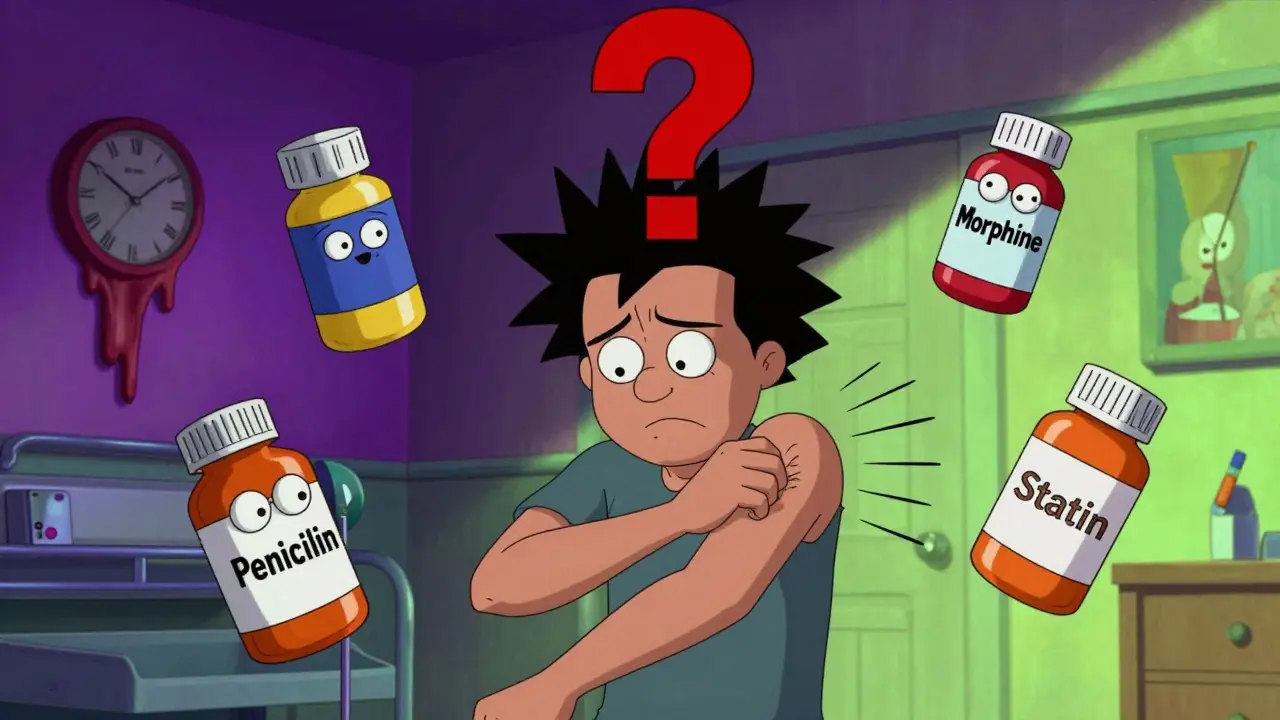
Itching from medications isn’t just a minor annoyance-it can be relentless, disruptive, and even disabling. If you’ve started a new drug and suddenly can’t stop scratching, you’re not alone. Thousands of people experience this every year, often without knowing why. The medical term for this is drug-induced pruritus, and it’s more common than most doctors realize. It doesn’t always come with a rash, redness, or swelling. Sometimes, it’s just an intense, unexplained itch that won’t go away, no matter how much you scratch.
Which Medications Cause Itching?
Itching can come from almost any type of medication, but some are far more likely to trigger it. Antibiotics like penicillin and tetracycline, blood pressure drugs like ACE inhibitors and sartans, cholesterol-lowering statins, and even common painkillers like aspirin and ibuprofen have all been linked to pruritus. But the most surprising culprits? Antidepressants, anti-seizure meds like carbamazepine, and opioids like morphine. One of the most well-documented cases involves opioids. When given during spinal anesthesia, up to 90% of patients develop intense itching within hours. It’s not an allergic reaction-it’s a direct effect on nerve pathways in the spinal cord. Another big one is chloroquine, used for malaria. In Black African patients, it causes severe itching in 55-90% of cases, usually lasting a few days. And then there’s hydroxyethyl starch, a fluid given in hospitals. If you get more than 200 grams, itching can start weeks later and last up to 15 months. But here’s the twist: the most talked-about recent issue isn’t from taking a drug-it’s from stopping one. Cetirizine (Zyrtec) and levocetirizine (Xyzal), common antihistamines for allergies, can cause severe itching after you quit them. The FDA confirmed this in 2023, reviewing over 200 cases. Most people had been taking these drugs for months or years. When they stopped, itching hit within two days. In 90% of cases, restarting the drug made it vanish. But if you try to quit again, it often comes back.Why Does This Happen?
Not all itching is the same. Some is caused by histamine, the chemical your body releases during allergies. That’s why antihistamines help with hives or hay fever. But drug-induced itching often has nothing to do with histamine. Many drugs trigger itching by messing with nerve signals, liver function, or skin moisture-not by causing an immune response. Opioids, for example, activate receptors in your spinal cord that send itch signals straight to your brain. Statins can cause dry skin or mild liver stress, which leads to bile buildup and itching. Some antibiotics alter gut bacteria, which can indirectly affect skin sensitivity. And with antihistamines like cetirizine, your body may become dependent on the drug to block itch signals. When you stop, the system rebounds hard. Research shows that women are more likely to experience this than men-70% of reported cases are female. Black patients also show higher rates, especially with drugs like chloroquine and certain antibiotics. This isn’t just coincidence. Genetic differences in how the body processes drugs play a role. So if you’ve had unexplained itching before, your risk might be higher.How Long Does It Last?
The timing tells you a lot. If the itching started within days of beginning a new drug, it’s likely a direct reaction. Acute cases (under 6 weeks) often fade once you stop the medication. But chronic itching (over 6 weeks) is trickier. It can linger even after you’ve stopped the drug, especially with things like hydroxyethyl starch or long-term statin use. With antihistamine withdrawal, the pattern is clear: itching hits fast, peaks within 3-5 days, and can last weeks. In one study, 92% of people who stopped cetirizine after long-term use got itching. And 71 out of 79 people who restarted it saw relief within days. That’s not an allergy-it’s a physiological rebound.
What Should You Do If You’re Itching?
Don’t just reach for more antihistamines. If your itching started after a new medication, the first step is to look at your drug list. Write down everything you’re taking-prescription, over-the-counter, supplements, even herbal teas. Sometimes, the culprit is something you didn’t think could cause itching. Talk to your doctor before stopping anything. Some meds, like blood pressure or heart drugs, can’t be stopped abruptly. But if you’re on a drug with a known link to itching-like a statin or an ACE inhibitor-your doctor might switch you to an alternative. For example, switching from lisinopril (an ACE inhibitor) to a calcium channel blocker like amlodipine often clears up the itch. For antihistamine withdrawal, restarting the drug and then tapering slowly works for many. One approach: go back on cetirizine for a week, then cut the dose in half for another week, then stop. About 38% of people who tried this avoided a full return of itching.Treatment Options Beyond Stopping the Drug
If you can’t stop the medication, or if the itching persists after stopping, there are other options. Topical treatments like menthol creams, capsaicin lotion, or low-dose steroid creams can help soothe the skin. Moisturizing daily is critical-dry skin makes itching worse. Look for fragrance-free, ceramide-based lotions. For stubborn cases, doctors may turn to non-antihistamine options. Antidepressants like amitriptyline or sertraline can calm overactive nerve signals that cause itch. Gabapentin, usually used for nerve pain, has shown success in treating drug-induced pruritus too. In rare, severe cases, immunosuppressants or light therapy may be used. The Cleveland Clinic notes that some antidepressants work because they affect the brain’s itch-processing centers-not because they treat depression. It’s not about mood. It’s about rewiring how your body interprets itch signals.
When to Worry
Most drug-induced itching is uncomfortable but not dangerous. But in rare cases, it can be a sign of something serious. If you have itching along with:- Yellowing skin or eyes (jaundice)
- Dark urine or pale stools
- Fever, swelling, or trouble breathing
- Thoughts of self-harm or extreme distress
Comments
Layla Anna
December 31, 2025 AT 19:47Been on Zyrtec for 3 years and stopped cold turkey last month… holy hell the itching was like my skin was full of ants crawling under glass. Didn’t even know this was a thing until I read this. Now I’m scared to quit anything ever again.
Bobby Collins
January 1, 2026 AT 08:47They’re hiding the truth. Big Pharma knows antihistamines rewire your nervous system. They don’t want you to know you’re addicted. The FDA’s ‘warning’? Just PR to keep you buying the next bottle. They profit from the rebound. I’ve seen it. I’ve researched it. This isn’t medicine-it’s manipulation.
jaspreet sandhu
January 2, 2026 AT 14:45Everyone here is acting like itching is some new mystery. In India we’ve known for decades that stopping antihistamines causes rebound. Doctors there just tell you to taper or deal. No big deal. You Americans treat everything like a crisis. Just take the pill again. Problem solved. No need for all this drama.
Kristen Russell
January 3, 2026 AT 02:44Same. Took Zyrtec for 4 years. Stopped. Itched for 6 weeks. Restarted. Gone in 3 days. Tapered slow this time-cut dose in half for 2 weeks. No return. It’s not an allergy. It’s your body forgetting how to chill.
Bryan Anderson
January 3, 2026 AT 19:19This is incredibly well-researched. I’m a pharmacist and I’ve seen this pattern repeatedly-especially with statins and ACE inhibitors. The key is documenting the timeline. Patients often don’t connect the dots until the itch is unbearable. We need better patient education tools.
Matthew Hekmatniaz
January 5, 2026 AT 13:02As someone who’s had chronic pruritus from a statin for over a year, I want to say thank you for writing this. I thought I was crazy. My dermatologist said ‘it’s probably dry skin.’ Turns out it was rosuvastatin. Switched to pravastatin-itch vanished in 10 days. Knowledge is power. Share this with your doctor.
Heather Josey
January 6, 2026 AT 06:17Thank you for sharing this. I’ve been suffering in silence for months. I didn’t realize this was a documented phenomenon. I’m going to talk to my doctor about tapering off my antihistamine instead of quitting cold turkey. You’ve given me hope.
Olukayode Oguntulu
January 7, 2026 AT 09:34Itching is merely the epiphenomenon of systemic pharmacological dissonance. The dermal nervous architecture is a substrate for xenobiotic entanglement-when homeostatic equilibrium is violated by chronic ligand exposure, the somatosensory cortex undergoes maladaptive plasticity. The FDA’s ‘warning’ is merely a linguistic artifact of regulatory capture. The real issue? Our reductionist medical paradigm cannot comprehend non-histaminergic pruritus. We need neurophenomenological frameworks, not pill swaps.
Lee M
January 8, 2026 AT 03:10So let me get this straight-your body gets used to a drug that blocks itch… so when you stop, it overcompensates? That’s not addiction. That’s biology. You’re not weak. Your nervous system is just doing what it’s supposed to do. Stop calling it ‘addiction’-it’s neuroadaptation. We need better words.
Alex Warden
January 8, 2026 AT 05:53Why are we letting Big Pharma control our bodies? This is why I don’t trust meds. I’d rather just use salt water and prayer. America’s too soft. We need to toughen up. Stop taking pills. End of story.
LIZETH DE PACHECO
January 9, 2026 AT 09:41You’re not alone. I’ve been there. I’m proud of you for speaking up. Your body is trying to tell you something-listen. And please, talk to your doctor. You deserve relief.