
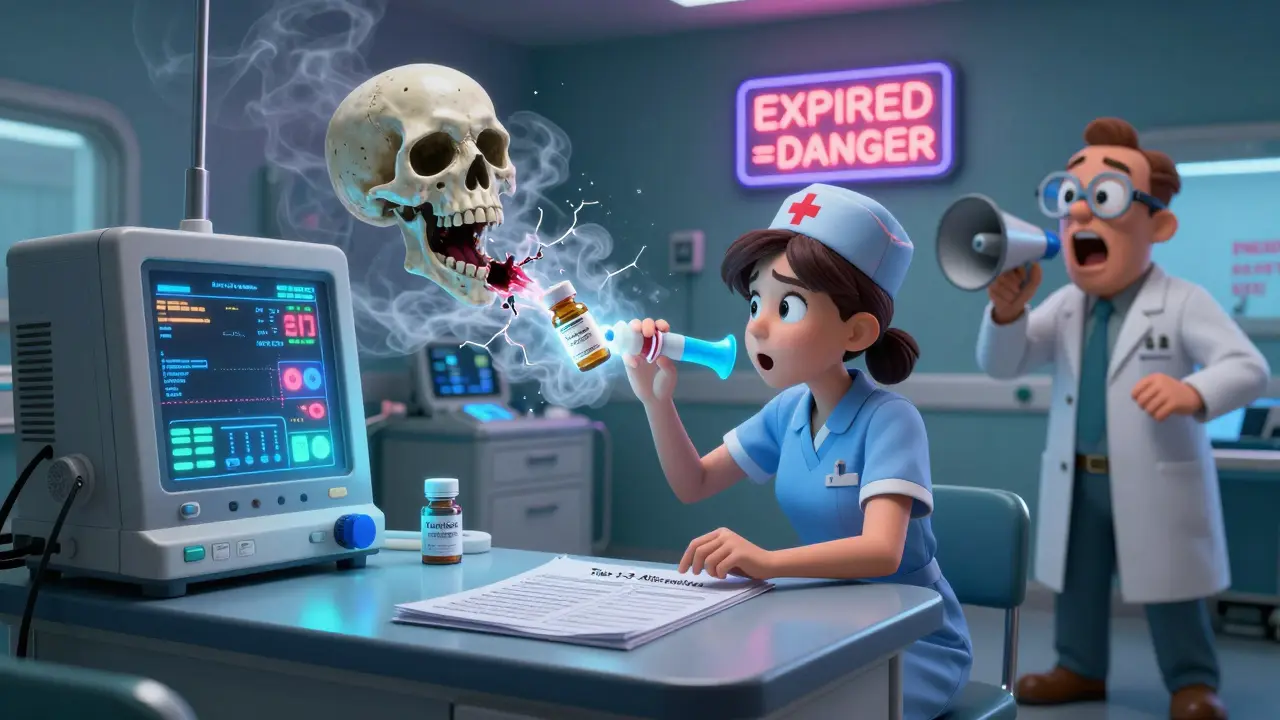
When a critical medication expires, it’s not just a paperwork issue-it’s a patient safety emergency. Imagine a patient on a ventilator in the ICU whose fentanyl infusion runs out. The vial is expired. The pharmacy has no more. Now what? If the team doesn’t act fast and smart, the patient could go into withdrawal, have a seizure, or even die. This isn’t hypothetical. In 2024, over 40% of critical care medications faced some kind of supply disruption, and expired stock was a major contributor. The good news? There’s a proven way to handle this. It’s not guesswork. It’s not luck. It’s a structured, step-by-step process used by top hospitals-and you can use it too.
Understand What Makes a Medication "Critical"
Not all expired drugs are the same. A pain reliever that expired last month? Maybe you can wait. But if it’s a sedative for a mechanically ventilated patient, a vasopressor for someone in shock, or an anticonvulsant for a patient with seizures-those are critical. These are drugs where even a few hours without the right dose can change outcomes. The ASHP (American Society of Health-System Pharmacists) defines critical medications as those that:- Are essential for life-sustaining therapy
- Have no therapeutic equivalent
- Are used in high-risk populations (ICU, neonatal, oncology)
- Require precise dosing or monitoring
For example, neuromuscular blockers like cisatracurium are critical because they’re used to keep patients on ventilators stable. If they expire and aren’t replaced properly, the patient might fight the ventilator, tear out their breathing tube, or develop lung damage. You don’t wait. You don’t improvise. You move fast-with a plan.
Use the Three-Tier Replacement System
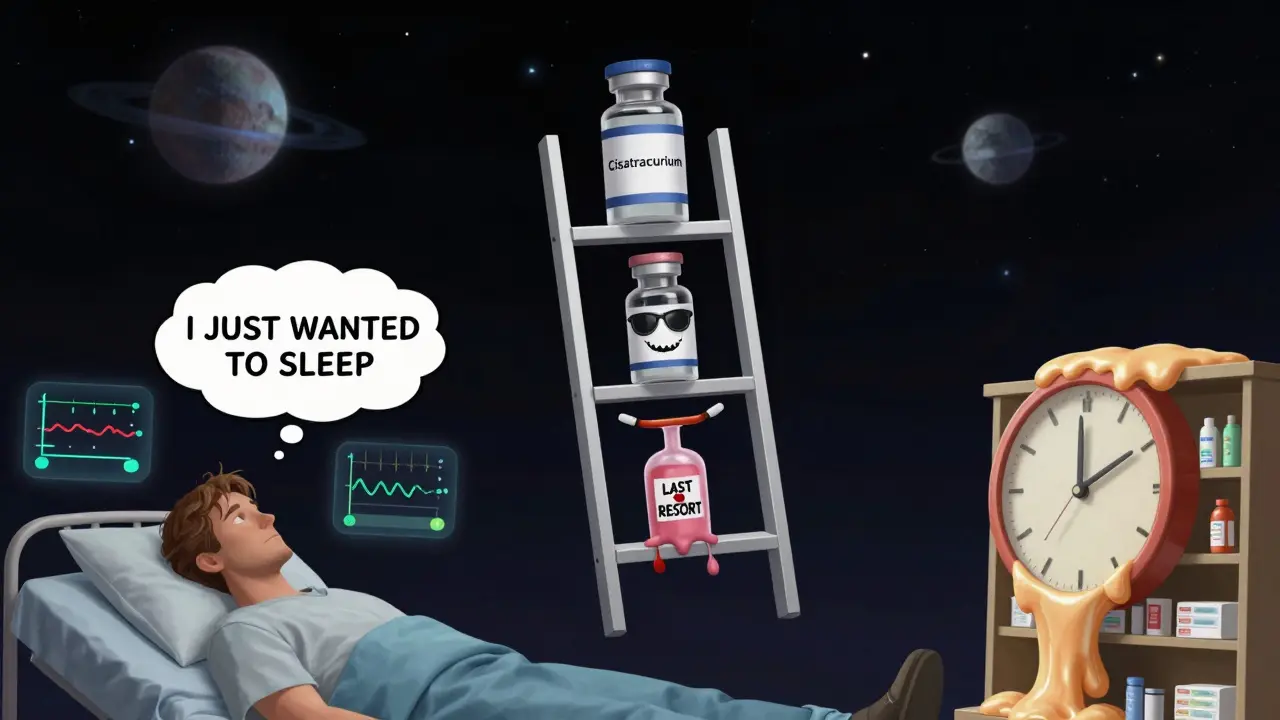
The best hospitals don’t scramble. They use a tiered approach developed by critical care experts. Think of it like a ladder: you start at the top and go down only if you have to.1st Line: The exact same drug, if available. If not, move to the next.
2nd Line: A closely matched alternative with similar pharmacokinetics. For example:
- Expired cisatracurium? Use rocuronium or vecuronium.
- Expired midazolam? Use lorazepam or propofol (with dose adjustments).
- Expired norepinephrine? Use phenylephrine or epinephrine-but monitor closely for side effects.
3rd Line: The fallback. These are less ideal, harder to titrate, or carry more risk. For instance, atracurium or pancuronium as last-resort muscle relaxants. These might require more frequent monitoring or cause longer recovery times.
This isn’t theory. A 2025 study from CU Anschutz showed that using this tiered system cut medication errors in the ICU by 58%. It’s built into protocols at 87% of academic medical centers. The key? You don’t decide on the fly. You have the list ready before the expiration happens.
Follow the Seven-Step Protocol
Every replacement starts with a process. Skipping steps leads to mistakes. Here’s what works:- Validate the expiration-Double-check the lot number, expiration date, and quantity. Was it really expired? Could it have been mislabeled?
- Check remaining stock-How much is left? Is it enough for one dose or three days? This tells you how urgent the replacement is.
- Identify affected patients-Who’s on this drug? How many? Are they stable? In crisis? Prioritize the most vulnerable first.
- Match alternatives using tiered guidelines-Pull up your pre-approved list. Don’t rely on memory. Use the ASHP or institutional protocol.
- Adjust doses-Alternatives aren’t identical. Rocuronium isn’t cisatracurium. You’ll need different dosing. Pharmacists must calculate this based on weight, kidney function, and current condition.
- Update systems-Change the electronic order, barcodes, and medication administration records. If the system still shows the expired drug, someone might accidentally grab it again.
- Monitor and document-Track vital signs, sedation scores (like RASS), and lab values for the next 24-48 hours. Document every change. This isn’t bureaucracy-it’s your legal and clinical safety net.
One ICU in Perth used this exact process after a fentanyl shortage. They transitioned 12 patients over 72 hours with zero withdrawal events. The difference? They had the steps written down. They practiced them quarterly. They didn’t wing it.
Why Pharmacists Are Non-Negotiable
You can’t do this without a pharmacist. Not a pharmacy tech. Not a nurse. A licensed pharmacist with critical care training.Why? Because replacing a drug isn’t just about finding something similar. It’s about understanding:
- How the drug is metabolized
- How it interacts with other meds
- How the patient’s liver or kidneys are handling it
- How to adjust for age, weight, or organ failure
Studies show that hospitals with full-time critical care pharmacists have 18.7% lower mortality rates and 2.3 fewer ICU days per patient. That’s not a small win. That’s life or death. And the data is clear: 89% of top-performing hospitals have pharmacists embedded in ICU rounds. The ones without? They’re using outdated, risky workarounds.
Some administrators say, "We can’t afford a pharmacist." But the cost of a wrong substitution-extended ICU stay, organ failure, readmission-is far higher. A 2024 survey found that hospitals without pharmacist-led protocols had 11.2 more days of hospitalization per medication-related error. That’s tens of thousands of dollars per patient.
Technology Is Your Ally
The smartest hospitals aren’t just using paper lists. They’re using tech.- Automated expiration alerts-Systems that flag drugs with 30 days left before expiry. No more surprises.
- Barcoding with substitution logic-When a nurse scans a drug, the system checks if it’s expired and suggests alternatives.
- AI-driven decision tools-Pilot programs at CU Anschutz use AI to analyze 147 patient factors (kidney function, sedation level, heart rate, oxygen needs) and recommend the best alternative. Early results? 94.7% agreement with expert pharmacists.
Even simple tools help. One community hospital in Western Australia started using a color-coded shelf system: red for critical meds, yellow for high-risk, green for routine. They cut expired medication incidents by 72% in six months.
What Happens Without a Plan
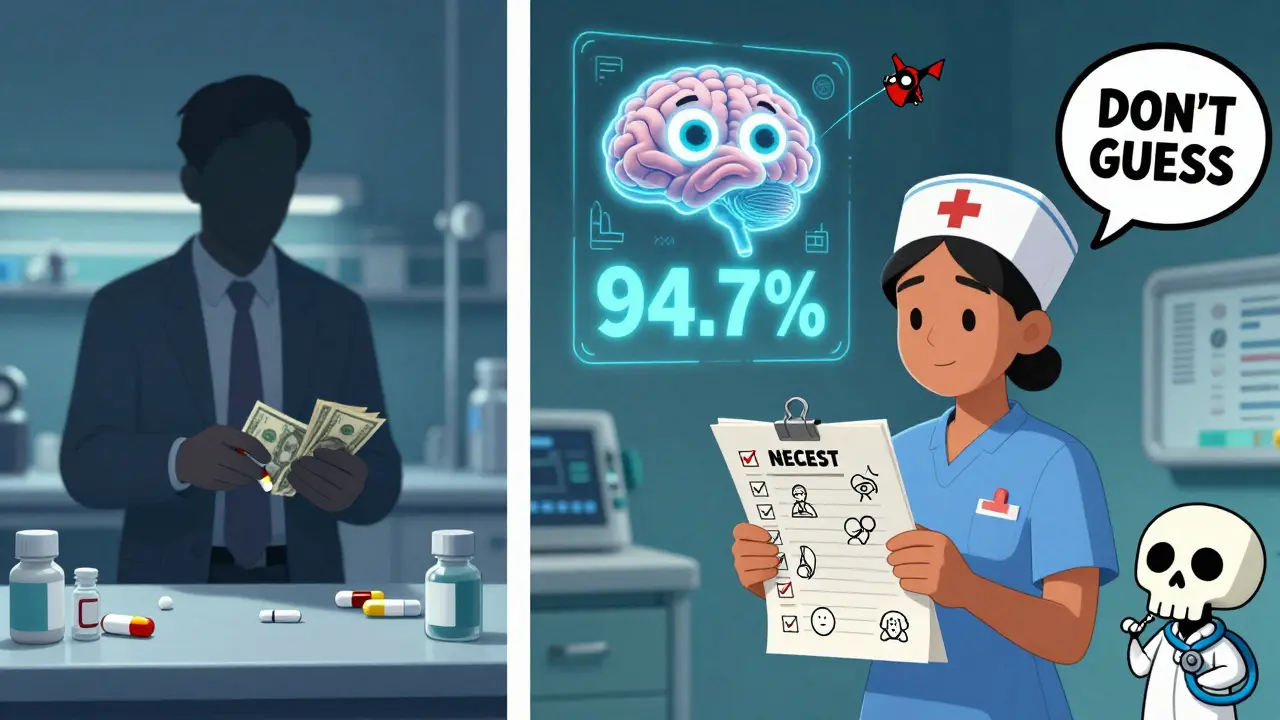
The alternative to a protocol is chaos.During the early days of the pandemic, hospitals without clear guidelines resorted to random methods: first-come-first-served, lottery systems, even giving drugs based on who had the loudest family. Some gave patients drugs they’d never used before. Others didn’t give anything at all.
Results? A 2024 study found that hospitals without structured replacement protocols had:
- 3x more medication errors
- 22% higher 30-day readmission rates
- 14% longer ICU stays
One patient in Texas was given the wrong muscle relaxant because the nurse didn’t know the difference. She had a cardiac arrest. She survived-but with brain damage. That’s the cost of improvising.
How to Start Today
You don’t need a $1 million system. You don’t need to wait for corporate approval. Start now:- Identify your top 5 critical medications. List them.
- Find the ASHP tiered alternatives for each. Download their 2023 guidelines.
- Assign one pharmacist to build a one-page quick-reference card for your unit.
- Run a mock drill: "What if fentanyl expires tomorrow?" Practice the steps.
- Install expiration alerts in your inventory system-even if it’s just a spreadsheet with conditional formatting.
High-performing units don’t wait for disasters. They prevent them. And every hospital, no matter how small, can do this. It’s not about money. It’s about discipline.
What’s Coming Next
The FDA is testing new ways to extend drug shelf life through better stability testing. Early data shows up to 22% less waste. ASHP will release updated guidelines in early 2026 with specific rules for expired meds-not just shortages. AI tools are getting smarter. But none of this matters if your team doesn’t have a plan today.Expired medication isn’t a pharmacy problem. It’s a patient safety problem. And the solution isn’t complicated. It’s just not optional anymore.
What should I do if a critical medication expires and I don’t have a replacement on hand?
Don’t wait. Immediately activate your institution’s emergency drug protocol. Contact your pharmacy and clinical pharmacist right away. Use your pre-approved tiered alternatives list. If none are available, notify the medical team and document the risk. In critical cases, contact regional drug distribution networks or the FDA’s Emergency Drug Access program. Never give a drug that’s expired-even in small amounts. The risk of harm outweighs any perceived benefit.
Can I use a drug from another hospital’s stock?
Yes, but only under strict conditions. Most states and countries have emergency drug-sharing agreements between hospitals. These require documentation, chain-of-custody tracking, and pharmacist verification. Never transfer a drug without confirming its expiration date, storage conditions, and lot number. Never accept a drug without a signed transfer log. Unauthorized transfers can lead to legal liability and patient harm.
Why can’t I just use a similar drug from a different class?
Because drugs aren’t interchangeable just because they seem "similar." For example, switching from a benzodiazepine like midazolam to a barbiturate like phenobarbital for sedation changes how the body processes the drug, how long it lasts, and how it affects breathing. These differences can cause respiratory depression, prolonged coma, or withdrawal. Pharmacists use pharmacokinetic models to predict these risks. Guessing leads to serious harm.
Is it ever okay to use an expired drug in an emergency?
No. The FDA and ASHP both state that expired medications should never be used, even in emergencies. Stability testing shows that potency drops over time, and chemical breakdown can create toxic byproducts. In critical care, where dosing precision is everything, even a 10% loss in potency can be fatal. The risk is never worth it. Always find a replacement.
How can my hospital afford better medication management?
Start small. Use free resources like ASHP’s guidelines and CDC’s medication safety tools. Train one pharmacist to lead a weekly medication safety huddle. Implement expiration alerts in your inventory system-many are built into existing software. Track how many days patients stay longer due to medication errors. Show the cost savings from reducing those stays. Hospitals that do this often see ROI within 6 months from avoided readmissions and shorter ICU stays.
For more information, refer to the ASHP Guidelines on Managing Drug Product Shortages (2023) and the FDA’s draft guidance on expiration dating (Docket #FDA-2025-D-1147).
Comments
Stephen Archbold
February 24, 2026 AT 15:05Man, this post hit different. I work in a small ICU in Cork and we just had a fentanyl shortage last month. We didn’t have a plan, and it was chaos. One patient went into withdrawal at 3am, screaming, shaking, and we had to grab rocuronium off a shelf we didn’t even know we had. Thank god the pharmacist remembered the ASHP tiers. This stuff isn’t theoretical-it’s survival. If your hospital doesn’t have a one-pager on this, you’re one bad shift away from a death.
Nerina Devi
February 25, 2026 AT 20:38As someone from Mumbai who’s seen hospitals run on duct tape and hope, I can say this: the tiered system works. We had a similar crisis with midazolam last monsoon. We used lorazepam, adjusted doses by weight, and tracked RASS scores like our lives depended on it. And we did. Because in India, you don’t get to wait for corporate to send new stock. You adapt, or someone dies. This guide should be printed and taped to every ICU wall in the Global South.
Dinesh Dawn
February 26, 2026 AT 16:53Really solid breakdown. I’m a nurse in Delhi and we’ve been using color-coded shelves since last year-red for critical, yellow for risky, green for chill. Cut our expired med incidents by half. The best part? No one had to buy new tech. Just sticky notes and a printer. Sometimes the simplest fixes are the ones that save lives. Also, pharmacists are legends. Treat them like gold.
Vanessa Drummond
February 28, 2026 AT 05:16Ugh. I’ve seen this so many times. Nurses getting blamed for giving expired meds because the pharmacy didn’t update the system. Meanwhile, the hospital’s CEO is flying to Bali while someone’s kid has a seizure because no one had a replacement list. This isn’t about ‘protocols’-it’s about leadership failure. Stop asking nurses to be pharmacists. Hire the damn pharmacists. Or stop pretending you care about patient safety.
Nick Hamby
February 28, 2026 AT 11:52There’s a deeper philosophical layer here, and I think it’s worth acknowledging. The act of replacing an expired critical medication is not merely a clinical task-it is a moral act. It is the institution’s commitment to the sanctity of life, not as an abstract ideal, but as a daily, tangible responsibility. When we reduce this to a checklist, we risk losing the humanity of care. The tiered system, the pharmacist’s presence, the documentation-they are not bureaucratic hurdles. They are rituals of reverence. To skip them is to treat a human being as an algorithm. And that, in the end, is the true crisis.
kirti juneja
March 1, 2026 AT 10:01OMG YES. I just printed this out and laminated it for our med cart. We’ve been winging it for years and it’s been a nightmare. Now we have a ‘Critical Meds Cheat Sheet’ with emojis (yes, emojis) next to each drug. Cisatracurium = 💀, Rocuronium = ✅, Fentanyl = 🚨. It’s dumb, but it works. Nurses remember it. Even the new grads. And guess what? We haven’t had a single withdrawal event since. Stop overcomplicating it. Just make it stupid simple.
Haley Gumm
March 1, 2026 AT 15:26Let’s be real. This whole post is just a fancy way of saying ‘do your job.’ If you’re a nurse or pharmacist and you didn’t know about ASHP guidelines, maybe you shouldn’t be in critical care. The fact that this even needs to be explained in 2025 is embarrassing. I’ve worked in 12 hospitals. Every single one had this protocol. If yours doesn’t, maybe the problem isn’t the system-it’s the people.
John Smith
March 2, 2026 AT 10:22Wow. So much effort to say ‘use a pharmacist’ and ‘don’t use expired drugs.’ I mean, really? This is groundbreaking? I read a textbook in 1998 that said the same thing. This feels like someone monetizing common sense. Next up: ‘How to Avoid Walking Into Walls: A Step-by-Step Guide’
Shalini Gautam
March 3, 2026 AT 04:06As an Indian nurse who’s worked in rural hospitals, I’ve seen drugs expire because of poor logistics, not negligence. But this guide? It’s written like it’s only for US hospitals. We don’t have AI alerts or $1 million systems. We have one pharmacist for 200 beds. We use whatever works. Maybe instead of preaching protocols, help us build them with what we have. Not every hospital has a CU Anschutz budget.
Timothy Haroutunian
March 3, 2026 AT 18:15Look. I’ve been in this game for 20 years. I’ve seen every protocol, every guideline, every ‘proven system.’ And I’ll tell you this: none of it matters if the hospital doesn’t fund the damn pharmacy department. You can have the best tiered system in the world, but if your pharmacist is working 80-hour weeks just to keep the lights on, none of this works. And don’t get me started on how the FDA’s ‘draft guidance’ is just a polite way of saying ‘we’re not fixing this.’ This whole thing is a performance. A very expensive, very well-written performance. Meanwhile, real nurses are still pulling vials from refrigerators with expired stickers half-peeled off. This post? It’s a TED Talk with footnotes. And we’re all just clapping.