
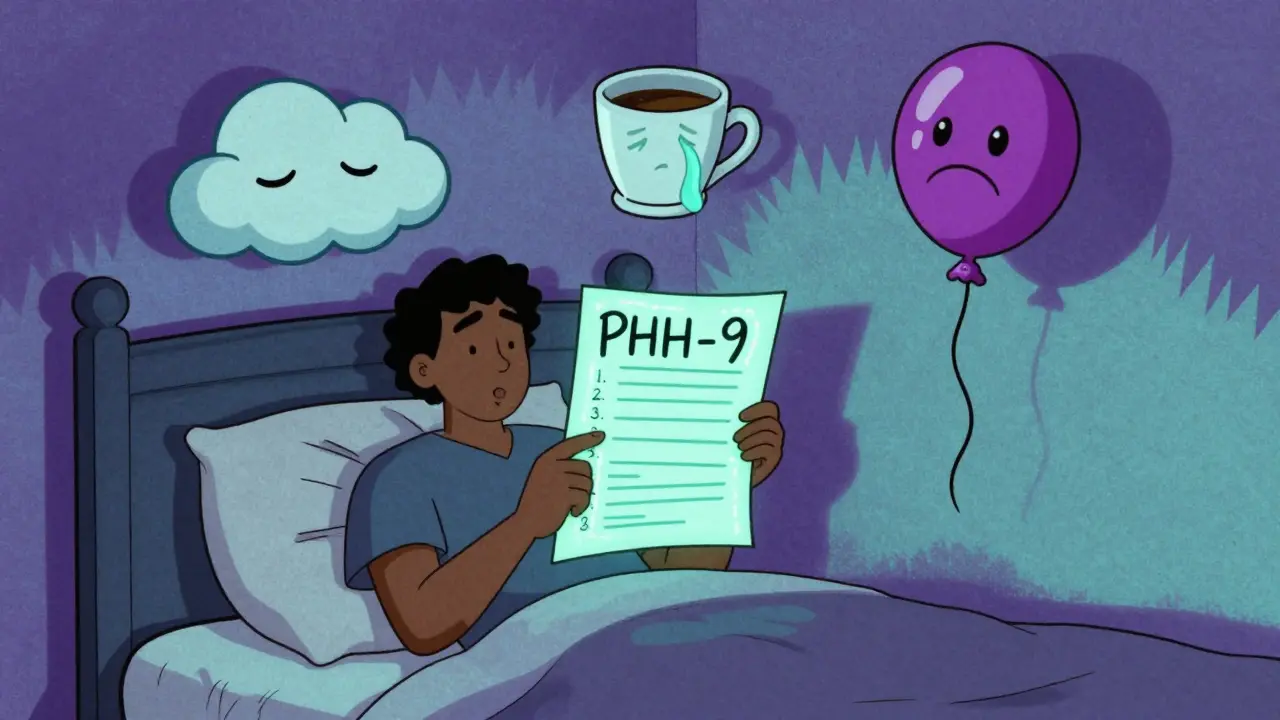
Depression Symptom Tracker (PHQ-9)
How Your Results Help Your Treatment
Tracking your symptoms with PHQ-9 provides clear data for your doctor. Studies show that patients who track symptoms see better treatment outcomes. Bring your scores to appointments and ask: "What does this mean for my treatment?"
Your PHQ-9 Results
Starting an antidepressant is just the beginning. The real work happens after the first pill is taken. Many people expect to feel better within days, but the truth is, it takes weeks-sometimes months-to see real change. And while some find relief, others wrestle with side effects that feel just as heavy as the depression itself. The key isn’t just taking the medicine. It’s knowing how to track whether it’s working and when to speak up about what’s not.
Why Tracking Matters More Than You Think
Studies show that nearly 4 out of 10 people don’t get better on their first antidepressant. And more than 7 in 10 experience at least one side effect-dry mouth, weight gain, sleep trouble, or sexual dysfunction. Yet, in a 2022 survey of over 1,000 people, only 39% felt their doctor truly listened when they talked about these problems. That’s not because doctors don’t care. It’s because they often don’t have clear data to work with.
Without numbers, it’s easy to say, “I feel okay,” even when you’re not. Or to brush off a side effect as “just part of it.” But depression doesn’t improve in vague terms. It improves in measurable steps: sleeping through the night, getting out of bed without dread, talking to a friend without forcing it. Tracking turns feelings into facts. And facts lead to better decisions.
The Tools That Actually Work
You don’t need fancy lab tests to start. The most effective tools are simple, free, and backed by decades of research.
- PHQ-9: Nine questions about mood, energy, sleep, appetite, and thoughts of self-harm. Scored 0-27. Anything above 15 means moderate to severe depression. A drop of 5 points over two weeks is a sign the treatment is working.
- Beck Depression Inventory (BDI): 21 questions that dig deeper into emotional and physical symptoms. A 50% drop in score over 6 weeks is a strong indicator of response.
- Antidepressant Side Effect Checklist (ASEC): Lists 15 common side effects-like nausea, dizziness, or loss of libido-rated from 0 (none) to 4 (severe). Keep a printed copy or screenshot on your phone. Update it every two weeks.
These aren’t just paper forms. They’re communication tools. Bring them to your appointments. Hand them to your doctor. Say: “Here’s how I’ve been feeling. Here’s what’s bothering me. What do you think?”
What to Track Daily (Without Overwhelming Yourself)
You don’t need to journal every hour. But a few minutes a day makes a difference.
- Mood (1-10 scale): Rate how you feel right now. Not how you felt yesterday. Not how you want to feel. Right now. This catches subtle shifts.
- Side effects: Note one or two that stood out. “Headache after lunch.” “Couldn’t orgasm all week.” Don’t judge. Just record.
- Function: Did you shower? Call someone? Go to work? Get out of the house? These matter more than scores sometimes.
Apps like Moodfit and Sanvello make this easy. But paper works too. A notebook by your bed is just as powerful. The goal isn’t perfection. It’s pattern recognition. If your mood dips every Thursday after taking your pill, that’s data. That’s something your doctor can act on.

When to Worry About Side Effects
Not all side effects are equal. Some fade after a few weeks. Others don’t. Here’s how to tell the difference:
- Temporary: Nausea, drowsiness, mild headache. These often go away in 2-4 weeks.
- Sticking around: Weight gain over 5+ pounds, persistent sexual problems, emotional numbness, or severe insomnia after 6 weeks. These need attention.
- Red flags: New suicidal thoughts, racing heart, chest pain, or extreme agitation. Call your doctor immediately. Don’t wait.
Sexual side effects are the #1 reason people quit antidepressants. In one study, 61% of users stopped SSRIs because their doctor never offered solutions. That’s unacceptable. There are options: lowering the dose, switching to bupropion (which has fewer sexual side effects), or adding medications like sildenafil. But you won’t get there unless you speak up.
Therapeutic Drug Monitoring: Is It Worth It?
Some people wonder: Should I get a blood test to check my antidepressant levels?
The answer: Maybe. If you’ve tried two or more meds without improvement, or if you’re on a drug like amitriptyline or nortriptyline (TCAs), it can be life-changing. Blood tests can show if you’re not absorbing the medicine, metabolizing it too fast, or if your dose is too low-even if you’re taking it exactly as prescribed.
But here’s the catch: Only 8-12% of doctors order these tests. They’re expensive ($50-$150 per test) and not always covered by insurance. Still, studies show that when used in treatment-resistant cases, they improve outcomes by 25-35%. If you’ve been stuck for months, ask your psychiatrist: “Can we check my drug levels?”
What Your Doctor Should Be Doing (But Often Isn’t)
Guidelines from the American Psychiatric Association and the World Federation of Societies of Biological Psychiatry are clear: Measure. Track. Adjust. But in real life? Many primary care doctors don’t have time. They ask, “How are you?” and take your word for it.
That’s why you need to be the driver. Bring your PHQ-9 scores. Show your side effect log. Say: “I’ve been tracking this. My score was 22 last month, now it’s 14. My sleep improved, but my libido is gone. What do we do next?”
Doctors are more likely to act when you give them clear, organized data. They’re not mind readers. They’re problem solvers-and they need the right tools.

Real Stories, Real Results
One woman in Perth, on sertraline for 8 months, felt “fine but not alive.” She started using PHQ-9 every Sunday. Her score dropped from 21 to 13-but she still felt empty. She brought the log to her doctor. They switched to bupropion. Within 3 weeks, she started walking her dog again. She didn’t feel “happy.” But she felt like herself again.
Another man, on fluoxetine, had constant nausea and couldn’t eat. He tracked his meals and side effects daily. His doctor noticed the nausea spiked 3 hours after his pill. They moved his dose to bedtime. The nausea vanished. His mood improved. Simple fix. But only because he tracked it.
What to Do If You Feel Stuck
Feeling like nothing’s working? You’re not alone. Here’s your action plan:
- Get your PHQ-9 or BDI score from your last visit. Write it down.
- Start daily tracking: mood, side effects, function. Do it for 2 weeks.
- Make a list of 3 specific goals: “Sleep 6 hours,” “Walk outside 3x/week,” “Talk to my sister once.”
- At your next appointment, say: “I’ve been tracking. Here’s what’s changed. Here’s what hasn’t. What’s next?”
- If your doctor dismisses you, ask for a referral to a psychiatrist or mental health clinic. You deserve better.
There’s no shame in needing help. There’s shame in giving up because no one asked the right questions.
The Future Is Here-And It’s in Your Hands
In January 2024, the FDA approved the first digital therapy app (Rejoyn) that requires weekly PHQ-9 completion. Companies like Quartet and Lyra now build monitoring into every depression treatment plan. AI tools are starting to predict who will respond to which drug-based on patterns in your notes and scores.
But none of this matters unless you’re part of the process. You’re not just a patient. You’re the most important data point in your own treatment.
Start small. Track one thing. Bring it to your next appointment. Ask: “Is this working? What should I change?”
You’ve already taken the hardest step-reaching out. Now take the next one. Your mind deserves more than hope. It deserves evidence. And you’re the one who holds it.
How long should I wait before deciding if my antidepressant is working?
Most antidepressants take 4 to 8 weeks to show full effects. But you should start seeing small improvements-like better sleep or more energy-by week 2 to 4. If there’s no change by week 6, talk to your doctor. A 50% drop in your PHQ-9 or BDI score by week 6 is a strong sign the medication is working. If your score hasn’t budged, it’s time to adjust the dose or try a different drug.
Can I stop taking my antidepressant if the side effects are too bad?
Never stop abruptly. Stopping suddenly can cause withdrawal symptoms like dizziness, nausea, brain zaps, or mood swings. Instead, document your side effects using a checklist like the ASEC. Bring it to your doctor. They can help you taper slowly, switch to a different medication, or add something to counteract the side effect-like a low dose of bupropion for sexual dysfunction. Your comfort matters as much as your mood.
Do I need blood tests to monitor my antidepressant?
Not always-but they’re helpful in specific cases. If you’ve tried two or more antidepressants without success, or if you’re taking older drugs like amitriptyline, a blood test can show if your body is absorbing the right amount. About 50-70% of people who don’t respond have drug levels that are too low-even if they take their pills. Blood tests cost $50-$150 and aren’t covered everywhere, but they can save months of trial and error. Ask your psychiatrist if it’s right for you.
What’s the difference between feeling better and being in remission?
Feeling better means your symptoms have lessened. Remission means your symptoms are gone-or so mild they don’t interfere with daily life. On the PHQ-9, that’s a score of 5 or lower. On the BDI, it’s under 10. Many people think “I’m not crying all day” means they’re done. But remission means you’re back to your old self-eating normally, enjoying hobbies, not forcing smiles. Don’t settle for “better.” Aim for remission.
Can I use apps instead of paper logs?
Yes-and many people find apps easier to stick with. Apps like Moodfit, Sanvello, and Rejoyn let you track mood, sleep, and side effects quickly. They also generate reports you can email to your doctor. But don’t rely on them alone. Paper logs are just as valid and don’t need batteries. The best tool is the one you’ll actually use. If you forget your phone, a notebook in your pocket works fine.
What if my doctor won’t listen to my tracking data?
If your doctor ignores your data, dismisses your concerns, or says “you’re just being dramatic,” it’s time to find a new one. You deserve care that respects your experience. Ask for a referral to a psychiatrist or a mental health clinic that uses Measurement-Based Care (MBC). Many now require patients to track symptoms. If your doctor refuses to use validated scales or ignores your side effects, they’re not following current guidelines. Your mental health is too important to settle for less.
Comments
vivek kumar
January 17, 2026 AT 10:24Finally, someone who gets it. Tracking isn't just helpful-it's survival. I used PHQ-9 religiously for 6 months on sertraline. Score dropped from 20 to 8, but my libido was MIA. I brought the printout to my doc. He shrugged. I switched to bupropion. Two weeks later, I hugged my dog for the first time in a year. Data doesn't lie. Doctors do.
Riya Katyal
January 18, 2026 AT 14:49Oh wow, a whole article about not being a zombie. Groundbreaking. Next up: 'How to breathe without feeling like you're underwater.' At least now I know I'm not crazy for hating how my antidepressant turned me into a dull, dry-mouthed robot. Thanks for the 2000-word pep talk, doc.
Henry Ip
January 20, 2026 AT 08:58Love this. Simple, real, no fluff. I started tracking mood and showers daily. Didn't think it mattered. But after 3 weeks, I saw a pattern-mood crashed every time I skipped breakfast. Changed my routine. My PHQ-9 dropped 7 points. Sometimes the fix is that small. You don't need a PhD. Just a notebook and the guts to show up.
kanchan tiwari
January 20, 2026 AT 14:00THEY’RE ALL LYING. THE PHQ-9 IS A TOOL OF THE PSYCHIATRIC INDUSTRY TO KEEP YOU DEPENDENT. THEY WANT YOU TO TRACK SO THEY CAN KEEP SELLING YOU PILLS. I STOPPED ALL MEDS. NOW I EAT CAYENNE PEPPER AND YELL AT THE MOON. I’M 100% FREE. NO MORE SIDE EFFECTS. NO MORE DOCTORS. JUST ME AND THE COSMOS. THEY’RE AFRAID OF WHAT HAPPENS WHEN YOU STOP BEING A PATIENT.
Bobbi-Marie Nova
January 20, 2026 AT 21:05Ugh I used Sanvello for 3 months. It auto-generated reports. My doc was like ‘wow, you’re actually doing the work?’ Like I was some kind of unicorn. Then she prescribed more meds. I said ‘nope, I’m taking a break.’ She didn’t even blink. So I went to a new one. Found someone who actually cares. Moral of the story? Don’t settle for a doctor who thinks your journal is cute.
Samyak Shertok
January 22, 2026 AT 18:17So we’re just supposed to trust this data? Who designed these scales? White, middle-class, neurotypical, cis-het therapists who’ve never cried in a Walmart parking lot while eating cold ramen from the tub. Depression isn’t a math problem. It’s a metaphysical collapse. You can’t quantify the soul’s silence with a 1-10 scale. But hey, if it makes you feel better… keep tracking your feelings like a spreadsheet monk.
Stephen Tulloch
January 24, 2026 AT 05:04Bro. I took 3 different SSRIs. All gave me brain zaps and zero libido. Blood test showed my levels were half of what they should’ve been. Turns out I metabolize meds like a caffeinated squirrel. Switched to nortriptyline + dose adjustment based on labs. Now I sleep. I laugh. I text my mom back. $$$ was worth it. Ask for the test. Don’t be a hero. Be a data nerd.
evelyn wellding
January 25, 2026 AT 12:14YOU GOT THIS. I was at a 23 on PHQ-9. Now I'm at 6. Took 14 weeks. Had days I wanted to quit. But I wrote down ONE thing I did right every day. Showered? Check. Called my sister? Check. Walked to the mailbox? HUGE WIN. You’re not broken. You’re rebuilding. And every tiny step counts. I believe in you 💪❤️
Chelsea Harton
January 26, 2026 AT 19:46side effects are real but so is the numbness. i tried everything. paper. apps. spreadsheets. nothing changed until i stopped trying to fix it and just sat with it. sometimes the medicine isn’t the problem. the system is.
Corey Chrisinger
January 27, 2026 AT 10:35What’s the difference between tracking and self-obsession? When you start measuring your sadness like a scientist measuring a chemical reaction, you’re not healing-you’re objectifying your pain. But if you use it as a bridge to speak, not to prove, then maybe… maybe it’s not a cage. Maybe it’s a language. I don’t know. I’m still figuring it out. But I’m trying.