
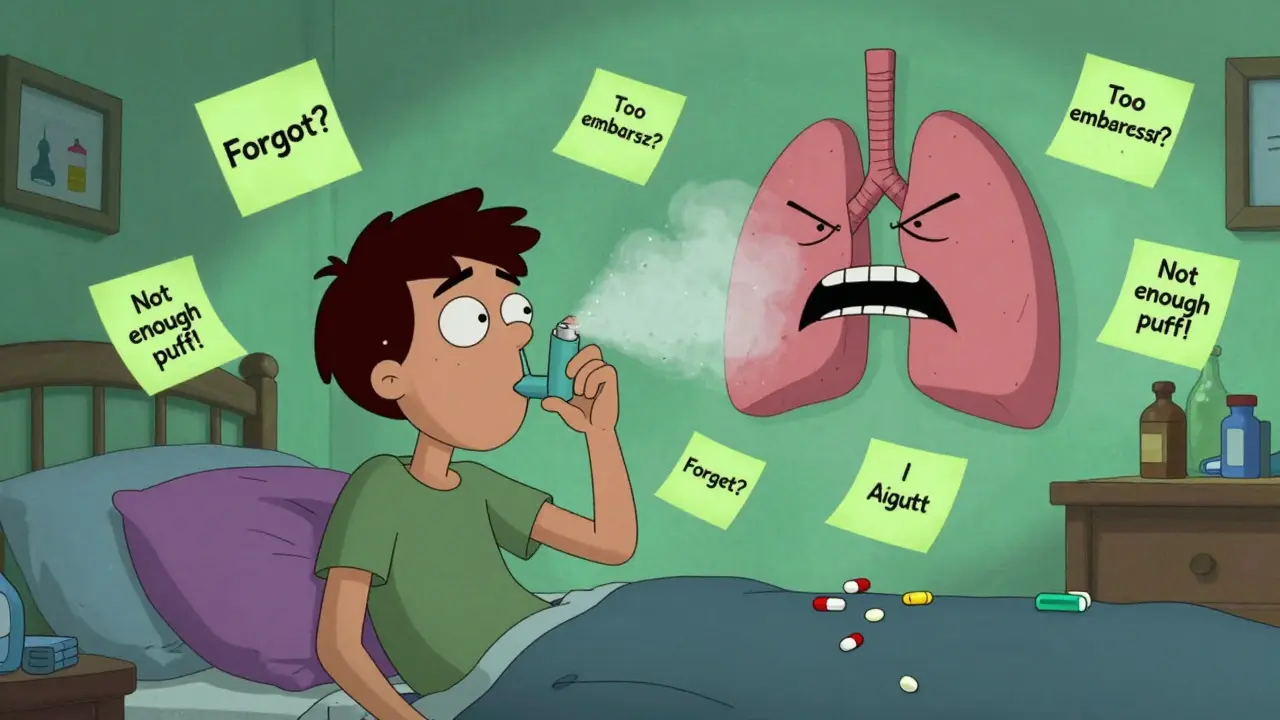
Getting your medication right isn’t just about taking it-it’s about taking it correctly, consistently, and on time. For people using inhalers, patches, or injectables, this is harder than it looks. Studies show that between 30% and 70% of patients don’t take their medications as prescribed. That’s not laziness. It’s often confusion, discomfort, fear, or just plain forgetfulness. The result? More hospital visits, worse health, and higher costs. But there are real, proven ways to fix this-and they’re not all high-tech.
Why Adherence Matters More Than You Think
When you skip an inhaler dose, miss a patch change, or skip an injection, the effects aren’t always obvious right away. But over time, it adds up. For asthma or COPD patients, missing inhaler doses increases the chance of an emergency room visit by up to 50%. For diabetes patients using insulin pens, inconsistent injections raise HbA1c levels and increase nerve and kidney damage risk. Patches for pain or hormone therapy? Skipping even one can trigger withdrawal symptoms or flare-ups.
The CDC estimates that poor medication adherence causes 125,000 deaths each year in the U.S. alone-and costs the system between $100 billion and $289 billion. That’s not just a statistic. It’s your neighbor, your parent, your friend. The good news? Even small improvements in adherence can cut hospitalizations by 25% or more.
Adherence Problems Are Different for Each Delivery Method
You can’t treat inhalers, patches, and injectables the same way. Each has its own set of barriers.
Inhalers are tricky because most people don’t use them right. A 2021 study found that over 60% of asthma patients don’t coordinate their breath with the puff. Even if they take it, they’re not getting the medicine into their lungs. Then there’s the stigma-some people avoid using inhalers in public. Others forget because they’re not in symptoms yet.
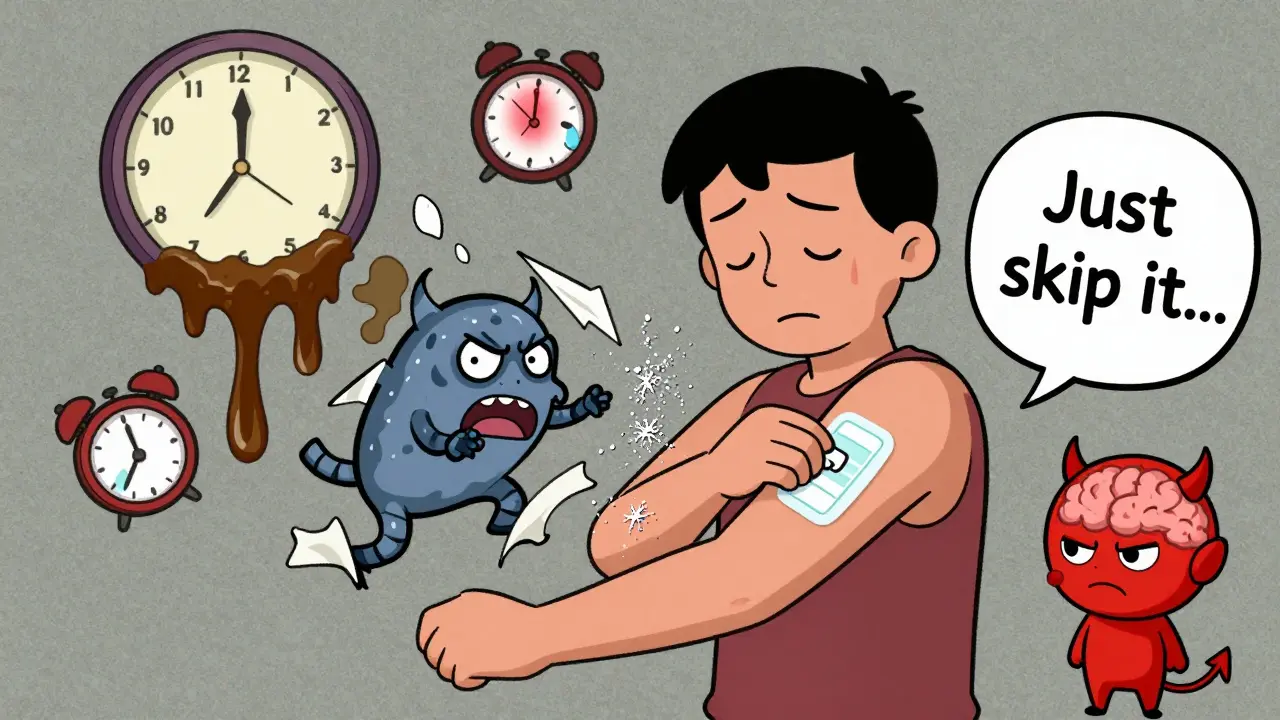
Patches seem simple: stick it on, wait. But skin irritation, peeling, sweating, or just forgetting to change it every few days breaks the chain. A 2022 survey found that 31% of insulin patch users stopped using them because of redness or itching. Others just don’t like the idea of wearing something all the time.
Injectables come with fear. Needle anxiety is real. Some people dread the pain, others worry about mistakes-giving the wrong dose, reusing needles, or injecting in the wrong spot. Even if they’re not scared, the routine can be overwhelming. A Novo Nordisk study found that 22% of caregivers found companion apps too complicated to use, especially for older adults.
Simple, Low-Tech Fixes That Actually Work
You don’t need a smartphone app to get better adherence. Some of the best tools are old-school-and free.
- Use a pillbox with compartments. Even if you’re on an inhaler or patch, put the device in the same box as your pills. Seeing it every morning reminds you. Label each day. Use different colors if needed.
- Link it to a habit. Put your inhaler next to your toothbrush. Change your patch after your morning coffee. Inject after dinner. Anchoring the dose to something you already do every day cuts down on forgetting.
- Ask your pharmacist for blister packs. Some pharmacies will pre-sort your weekly meds into labeled pouches. It’s not just for pills-some now do it for inhalers and patches too.
- Write it down. Keep a small notebook or use a free app like Google Keep. Just jot down: “Took inhaler at 7 AM.” Seeing a streak builds motivation.
A 2015 meta-analysis found that these basic tools improve adherence by up to 8 percentage points. That might not sound like much, but in real terms, it means one fewer hospital visit per year for many patients.
Smart Technology: Helpful, But Not Magic
Devices like Propeller Health’s sensor for inhalers, Novo Nordisk’s smart insulin pen, or Proteus’s ingestible sensors sound like science fiction. And they are powerful-but only if they fit your life.
Smart inhalers track when and how you use them. Some even give feedback: “You didn’t inhale deeply enough.” That’s useful. One study showed patients using smart inhalers improved adherence by 35% compared to those without. But here’s the catch: 20-30% of users quit within six months. Why? App crashes, battery issues, or just feeling watched.
On Reddit, one user said their smart inhaler app crashed twice a week on their Android phone. Another said the constant reminders made them anxious. That’s not a win. Technology should reduce stress, not add to it.
Smart patches and injectables are even rarer. The FDA approved an ingestible sensor that activates in the stomach to confirm a pill was taken-but it doesn’t work for patches or inhalers. And while smart pens track dose and timing with 98% accuracy, they cost $100-$300 a year. Only 37% of U.S. insurance plans cover them.
Here’s the truth: tech works best when it’s optional. Use it if it helps. Don’t feel pressured. The goal isn’t to be tracked-it’s to feel in control.
The Human Touch: Why Pharmacists Are Your Secret Weapon
One of the most effective ways to improve adherence? Talk to your pharmacist.
Pharmacist-led counseling doesn’t mean a lecture. It means a conversation. Ask: “What’s making it hard for you to take this?” Maybe it’s the cost. Maybe it’s the side effects. Maybe you’re scared of needles. A good pharmacist listens. Then they adjust.
Studies show that when pharmacists spend 20-30 minutes with patients during the first visit-and follow up at 7, 30, and 90 days-long-term adherence improves by 37%. For COPD patients, this approach cut hospitalizations by 28%.
They can also help with:
- Switching to a once-daily version of your medication
- Finding patient assistance programs if you can’t afford it
- Teaching proper inhaler technique with a spacer
- Recommending skin-friendly patch brands if you get rashes
Don’t wait for your doctor to bring it up. Walk into the pharmacy and say: “I’m having trouble staying on track with my meds. Can you help?”
What Works Best? A Simple Framework
There’s no one-size-fits-all fix. But there is a simple 3-step process that works for everyone:
- Assess the barrier. Use the 8-item Morisky scale. It’s free and quick. Ask yourself: Do you ever forget? Do you stop when you feel better? Do you get confused about when to take it? Do you skip doses because of side effects or cost?
- Match the solution. If you forget, use reminders or pillboxes. If you’re scared of needles, ask about numbing sprays or training videos. If you can’t afford it, ask about generics or patient aid programs.
- Check in monthly. Adherence isn’t a one-time fix. It’s a habit. Every month, ask: “What’s working? What’s not?” Adjust as needed.
Experts like Dr. Richard B. Martinello at Yale say adherence has five parts: affordability, accessibility, acceptability, awareness, and activation. If you’re missing one, the whole system breaks.

What to Do Next: Your Action Plan
Here’s what you can do today:
- For inhalers: Ask your pharmacist to watch you use it. Most people are doing it wrong. Use a spacer if you haven’t already.
- For patches: Try rotating the application site. Use a gentle moisturizer before applying. If you get rashes, ask about a different brand.
- For injectables: Practice with a dummy pen. Use a mirror. Keep a log. If you’re scared, ask for a nurse to demonstrate at home.
- For all three: Set a daily phone alarm. Link it to a habit. Write it down. Talk to your pharmacist.
Don’t wait for your next appointment. Start now. Even one small change-like using a pillbox or asking for a spacer-can make a difference.
When to Ask for More Help
Some signs you need more support:
- You’ve missed more than two doses in a month
- You’ve had a flare-up or hospital visit because you skipped meds
- You’re embarrassed to talk about your meds
- You’re running out before your refill
If any of these sound familiar, ask your doctor for a referral to a medication therapy management (MTM) program. These are free or low-cost services offered through pharmacies and clinics. They’re designed for people exactly like you.
Why do people stop using smart inhalers or patches?
Many stop because the tech is frustrating-apps crash, batteries die, or the reminders feel nagging. Some feel like they’re being watched, which causes anxiety. Others find the devices hard to use, especially if they’re older or not tech-savvy. The cost also adds up, and insurance often doesn’t cover it. The key is to try it, but don’t force it. If it doesn’t help, go back to simple tools like pillboxes or reminders.
Can I use a pillbox for inhalers or patches?
Yes, absolutely. You don’t put the inhaler inside the box, but you can put the inhaler next to it. The idea is to link the medication to a daily habit. Put your inhaler on top of your pillbox, or tape your patch to the lid. Visual cues work better than alarms for many people. It’s about creating a routine, not the box itself.
Are generic versions of inhalers or patches just as good?
For most people, yes. Generic inhalers and patches contain the same active ingredients as brand-name versions. But the delivery device might feel different-like the spray pressure or how the patch sticks. If you switch and notice your symptoms change, talk to your pharmacist. They can help you adjust or recommend a different generic brand.
How do I know if I’m using my inhaler right?
Most people get it wrong. A simple test: after puffing, hold your breath for 5-10 seconds. If you don’t, most of the medicine hits your throat, not your lungs. Ask your pharmacist to watch you use it. They can spot mistakes like not shaking the inhaler, not breathing out first, or puffing too fast. Using a spacer can fix up to 80% of technique errors.
What if I can’t afford my medication?
You’re not alone. Many drug companies offer free or discounted programs. Ask your pharmacist-they know which ones are available. Some states have prescription assistance programs. You can also switch to a generic version or ask if a once-daily option is available. Never skip doses because of cost. There are always options.
Final Thought: It’s Not About Perfection
You don’t have to take every dose perfectly to see results. Even getting to 80% adherence cuts your risk of hospitalization in half. The goal isn’t to be flawless. It’s to be consistent. Find what works for your life-not someone else’s. A pillbox, a reminder, a conversation with your pharmacist-these are the real tools. Technology can help, but it’s not the answer. You are.
Comments
Jacob Paterson
January 8, 2026 AT 19:14Let’s be real-most people don’t care enough to follow instructions. You think a pillbox is gonna fix needle fear? Nah. It’s called laziness wrapped in ‘I’m too busy.’ The CDC stats? Yeah, that’s what happens when you let people live like toddlers with insulin pens. Stop making excuses and just do it.
Johanna Baxter
January 9, 2026 AT 09:28i just stopped using my patch because it felt like i was wearing a sticky note from hell. my skin screamed. no app, no reminder, no pharmacist talk-just me, a rash, and a deep hatred for medical plastic. why does everything have to stick to me? literally.
Jerian Lewis
January 9, 2026 AT 11:07It’s not about tech or pillboxes. It’s about autonomy. The system keeps treating patients like children who need to be monitored, tracked, and nagged. The real issue? No one asks what’s *really* going on in their lives. Maybe they’re working two jobs. Maybe they’re depressed. Maybe they’re scared. We don’t fix adherence by adding more tools-we fix it by respecting people enough to listen.
Kiruthiga Udayakumar
January 10, 2026 AT 16:35My uncle in India uses his inhaler only after chai-every single morning. No app. No fancy box. Just habit. He’s 72, never been to a doctor in the U.S., and he’s still breathing fine. Why? Because he tied it to something he loves. Tech is for people who don’t know how to live. Simple beats smart every time.
Catherine Scutt
January 12, 2026 AT 00:35Everyone’s so obsessed with ‘low-tech fixes’ but ignore the fact that most of these patients are elderly, poor, or disabled. A pillbox? Great. But what if you can’t open it? What if you’re blind? What if you have tremors? Stop romanticizing cardboard solutions. Real help means access, not slogans.
Drew Pearlman
January 12, 2026 AT 12:37Look, I get it-people are busy, scared, overwhelmed. But here’s the beautiful truth: adherence isn’t about discipline. It’s about connection. When you link your inhaler to your morning coffee, you’re not just taking medicine-you’re honoring your body’s rhythm. When you write it down, you’re not checking a box-you’re building a story of survival. And when you walk into that pharmacy and say, ‘I need help,’ you’re not admitting defeat-you’re claiming your power. This isn’t about gadgets or guilt. It’s about showing up for yourself, one tiny, imperfect moment at a time. And that? That’s courage.
Chris Kauwe
January 14, 2026 AT 03:05The entire framework is a neoliberal myth. You’re telling people to ‘link it to a habit’ while the pharmaceutical-industrial complex jacks up prices on generics, and insurance denies coverage for smart devices. The ‘human touch’? That’s just a Band-Aid on a hemorrhage. Real adherence requires systemic change: universal healthcare, price controls, and dismantling the profit-driven model that turns chronic illness into a revenue stream. Until then, pillboxes are just psychological props for a broken system.
Meghan Hammack
January 14, 2026 AT 12:09You got this. Seriously. Even if you missed yesterday? Start again today. Put your inhaler next to your toothbrush. Write ‘took it’ on your hand with a marker. Call your pharmacist and say ‘I’m struggling’-they’ve heard it a thousand times and they won’t judge you. You’re not failing. You’re learning. And every single time you choose to show up-even if it’s messy-you’re winning. I believe in you. Keep going.