
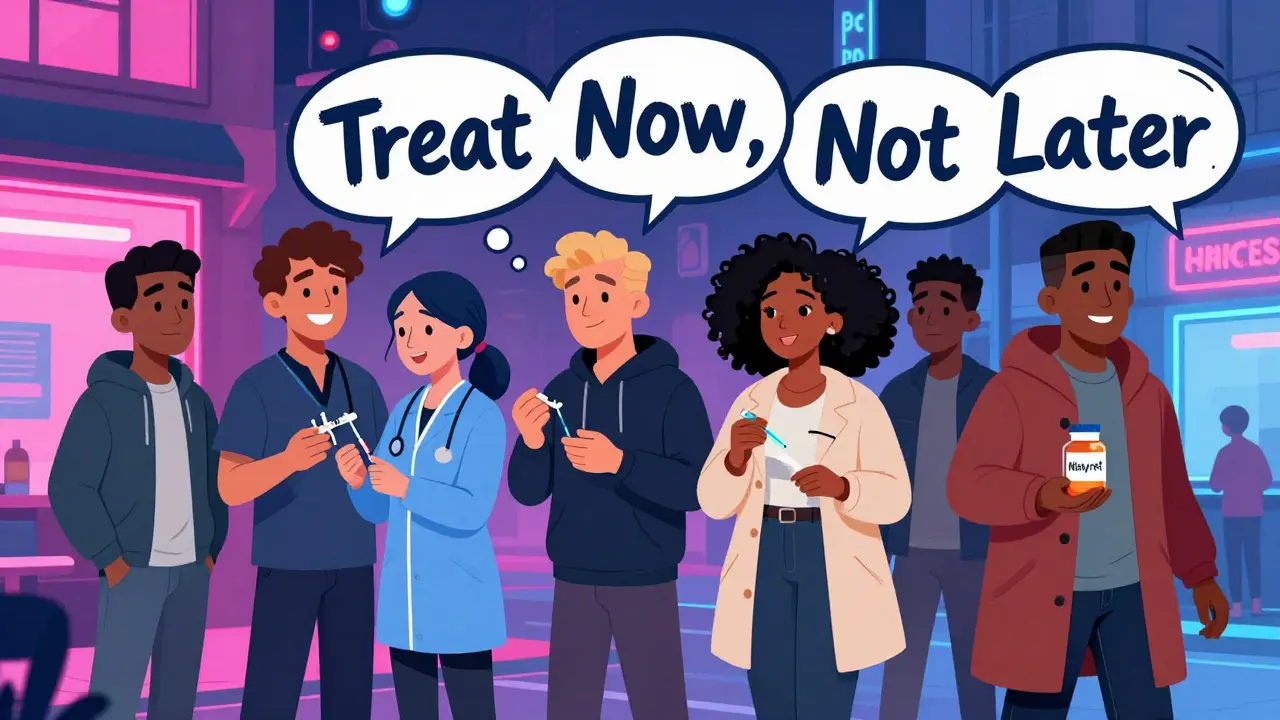
When someone beats hepatitis C with direct-acting antivirals (DAAs), it’s tempting to think the fight is over. But for many, especially those still injecting drugs or living with ongoing exposure, the virus can come back. HCV reinfection isn’t a failure-it’s a reality. And the good news? It’s just as treatable the second, third, or even fourth time around.
Since DAAs hit the market in 2014, cure rates have soared past 95%. That’s not a guess-it’s what the CDC, WHO, and multiple clinical trials confirm. People are clearing the virus with just 8 to 12 weeks of oral pills. No injections. No side effects like fatigue or depression. No more waiting years for a liver transplant. But cure doesn’t mean immunity. The body doesn’t build lasting protection like it does with measles or chickenpox. So if you’re still sharing needles, using unsterile equipment, or having unprotected sex with someone who has HCV, you can get infected again.
Who Gets Reinfection? It’s Not Random
Reinfection doesn’t happen equally across populations. The highest risk is among people under 30 who inject drugs. Data from the HERO study shows they’re over three times more likely to get reinfected than older users. Methamphetamine users face nearly three times the risk too. And the first six months after treatment? That’s the danger zone. Half of all reinfections happen within that window.
Why? Because the virus spreads fast in environments where sterile needles aren’t available, and where stigma keeps people from seeking care. A 2024 survey by the Harm Reduction Coalition found that 68% of people who inject drugs were denied retreatment simply because they were still using drugs. That’s not just cruel-it’s scientifically wrong. The CDC says clearly: treat everyone, as often as needed. No exceptions.
How Is Reinfection Treated? It’s Simpler Than You Think
If you get HCV again, you don’t start over. You don’t need to prove you’ve "cleaned up" or show you’re "ready." You just need to get tested and start treatment. The same drugs that cured you the first time work again. For most cases of reinfection, the go-to combo is glecaprevir/pibrentasvir (Mavyret) for 8 weeks. It’s over 95% effective, even if you’ve been treated before.
But what if you relapsed? That’s different. A relapse means the virus came back after treatment ended, suggesting some virus slipped through. In those cases, doctors may switch to sofosbuvir/velpatasvir/voxilaprevir (Vosevi) for 12 weeks, or add ribavirin to the standard 16-week course. Resistance testing is recommended here-checking for mutations in the NS3 or NS5A genes. But for true reinfection? No testing needed. Just treat.
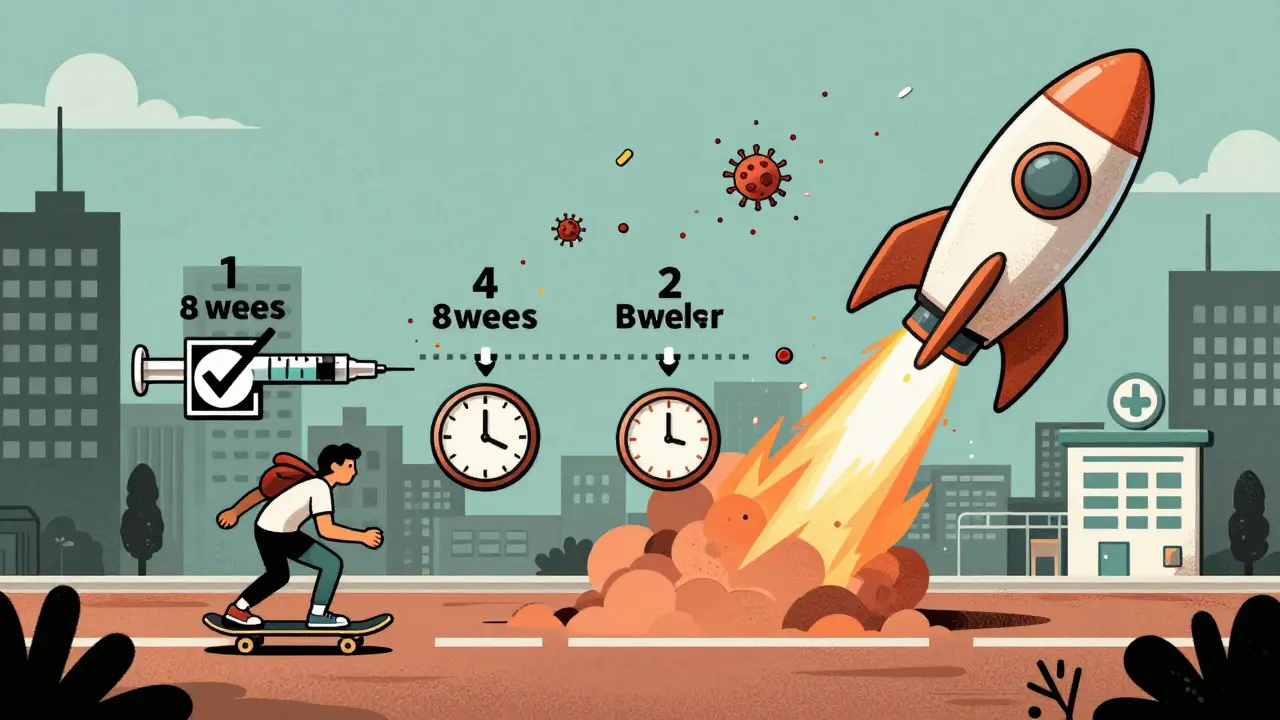
And here’s something new: in June 2025, the FDA approved Mavyret specifically for acute HCV infection-the kind that happens within weeks of exposure. That’s the first time any DAA has been labeled for early infection. It’s based on the PURGE-C trial, which found that 84% of people with new HCV infections were cured in just 4 weeks with the same drug. Not 95%. Not 98%. But 84%. And that’s still better than doing nothing.
Why Shorter Treatments Matter
Eight weeks is doable. Four weeks? That’s life-changing for people who bounce between shelters, jails, and streets. The PURGE-C trial didn’t just test a drug-it tested a new model. If you can treat someone on the same day they test positive, without requiring them to return for follow-ups, you’re more likely to actually cure them. And when you cure them, you stop transmission.
That’s why NIH launched PURGE-2 in April 2025, testing a 2-week course of glecaprevir/pibrentasvir. If it works, we could be looking at a world where HCV is treated in a single clinic visit. Imagine walking into a harm reduction center, getting tested, and walking out with a 28-day supply of pills. No referrals. No waiting. No stigma.
Harm Reduction Isn’t Optional-It’s the Foundation
You can’t cure HCV without addressing how it spreads. You can give someone 100 courses of DAAs, but if they’re still using dirty needles, they’ll get it again. And again. And again.
The data is clear:
- Needle-syringe programs that hand out at least 200 needles per person per year cut HCV transmission by 54%.
- Opioid agonist therapy (like methadone or buprenorphine) reduces new infections by half.
- When HCV treatment is offered right next to addiction services-like in a Boston MAT clinic-82% of people stick with treatment.
That’s not coincidence. That’s integration. People don’t choose between their liver and their addiction. They need both addressed at the same time. Yet in most places, you have to jump through hoops: first go to the addiction clinic, then wait for a referral to a liver specialist, then schedule a lab test, then wait for insurance approval. By then, the window for early treatment has closed.
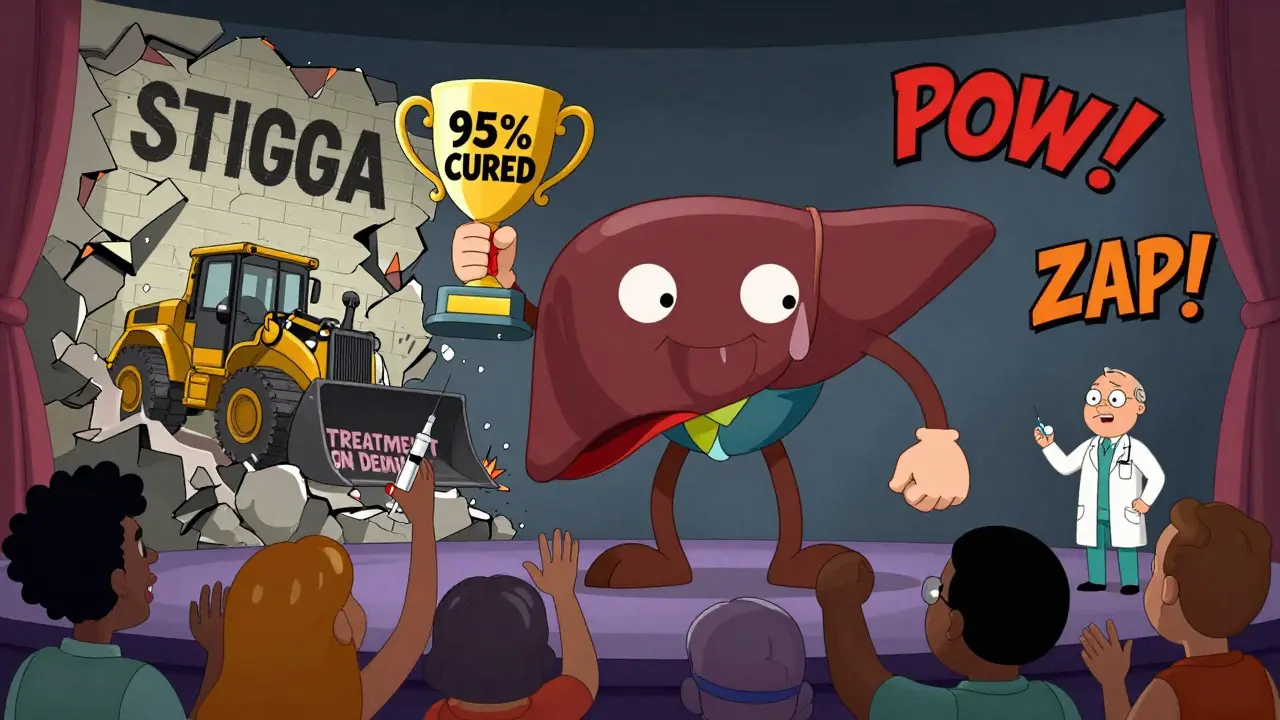
As of August 2025, 32 U.S. states now allow "treatment on demand" for people who inject drugs. That means if you test positive for HCV, you can start treatment that same day-no pre-authorization, no waiting list, no judgment. That’s progress. But only 38% of countries worldwide offer needle programs at the level needed. That’s why global elimination is still a distant goal.
The Real Barrier Isn’t the Virus-It’s Stigma
On Reddit’s r/Hepatology, people who inject drugs talk about being told, "You’ll just get it again," or "Come back when you’re clean." That language isn’t just unhelpful-it’s dangerous. It tells people their health doesn’t matter unless they meet arbitrary standards of "worthiness."
But the science says otherwise. A 2024 study in JAMA Network Open found that retreatment for reinfection works just as well as treatment for first-time infection. No matter your history. No matter your lifestyle. If you have HCV, you deserve to be cured.
And here’s the kicker: curing HCV doesn’t just save your liver. It saves lives. HCV leads to cirrhosis, liver cancer, and death. But when you cure it, you reduce those risks by over 90%. You also stop passing it on. That’s treatment as prevention. It’s not theory. It’s happening in cities that have embraced integrated care.
What You Need to Do Now
If you’ve been cured of HCV and still have risk factors:
- Get tested every 3 to 6 months. HCV RNA testing is the only way to catch reinfection early.
- Use sterile needles every time. Needle exchanges are free and confidential.
- Ask about opioid agonist therapy if you’re using opioids. It cuts your risk of HCV and overdose.
- Don’t wait to get treated again. The sooner you start, the better the outcome.
- Find a clinic that offers HCV care alongside addiction services. Co-location saves lives.
If you’re a provider:
- Treat everyone, no exceptions.
- Offer same-day treatment for acute HCV.
- Link patients to needle programs and MAT before they leave your office.
- Stop asking about "readiness." Ask: "When can we start?"
Looking Ahead
By 2030, the WHO wants to eliminate HCV as a public health threat. That means 90% fewer new infections and 80% fewer deaths. It’s possible-but only if we stop treating people like problems and start treating them like people.
The tools exist. The drugs work. The harm reduction strategies are proven. What’s missing? Political will. Funding. And the courage to say: everyone deserves to live without the fear of a virus they didn’t choose.
Can you get hepatitis C again after being cured?
Yes. Being cured of hepatitis C doesn’t give you immunity. If you’re still exposed to the virus-through sharing needles, unsterile tattoo equipment, or unprotected sex with someone who has HCV-you can get infected again. Reinfection is common among people who inject drugs, but it’s treatable just like the first time.
How soon after treatment can you get reinfected?
The highest risk period is the first six months after cure. That’s when most reinfections happen, especially in people who continue injecting drugs or using unsterile equipment. Risk drops over time, but testing every 3 to 6 months is recommended for anyone with ongoing exposure.
Are retreatment drugs different from first-time treatment?
For reinfection, the same drugs work just as well-usually 8 weeks of glecaprevir/pibrentasvir (Mavyret). For relapse (when the virus comes back after treatment), doctors may use sofosbuvir/velpatasvir/voxilaprevir (Vosevi) for 12 weeks or add ribavirin. Resistance testing is only needed for relapse cases, not reinfection.
Can you get treated for HCV if you’re still using drugs?
Absolutely. The CDC, WHO, and major medical societies state that HCV treatment should be offered to everyone, regardless of drug use. Denying treatment based on substance use is outdated and harmful. Integrated care-offering HCV treatment alongside addiction services-leads to better outcomes.
What’s the best way to prevent HCV reinfection?
Use sterile needles every time, access needle exchange programs, get on opioid agonist therapy if you use opioids, and get tested regularly. These are proven strategies that cut transmission by up to 54%. Treatment alone isn’t enough-you need prevention alongside cure.
People who inject drugs aren’t a separate group from the rest of society. They’re our neighbors, our family members, our coworkers. And they deserve to live without the threat of a curable virus. The science is clear. The tools are here. Now it’s about who we choose to protect.
Comments
Jessica Klaar
February 8, 2026 AT 13:14I’ve seen this play out in my work at the harm reduction center. People get cured, go home, and within weeks they’re back using the same old gear because nothing changed in their life. The magic isn’t just in the pills-it’s in having a worker who remembers your name, who texts you when your next test is due, who doesn’t flinch when you walk in smelling like meth. We gave out 400 needles last month. 12 people started treatment that day. No one had to prove they were "ready." They just needed someone to say, "Let’s go."
Tori Thenazi
February 9, 2026 AT 10:47Wait… so you’re telling me the government is just giving out free drugs to drug users?? And they’re NOT requiring rehab first?? I’m sorry, but this is just… bizarre. Who’s paying for this? Are we just… letting people destroy their bodies? I mean, if you’re going to keep shooting up, why even bother curing you? You’re just going to get it again! It’s like fixing a leaky roof while you’re still pouring water on it…
Jonah Mann
February 9, 2026 AT 20:14lol i just read this and thought: so the real problem isnt the virus its the system? yeah. i work in a clinic and we had a guy come in last week-he’d been cured twice, got reinfection #3, and we started him on mavyret same day. no paperwork. no judgment. he cried. not because he was "clean"-he was still using-but because someone finally said, "we’re not giving up on you."
Tricia O'Sullivan
February 11, 2026 AT 12:55This is a profoundly well-articulated piece. The data presented is not only robust but ethically imperative. The notion that treatment should be contingent upon behavioral compliance is not merely archaic-it is a violation of the fundamental principles of medical ethics. To withhold care based on social stigma is not clinical judgment; it is institutionalized cruelty. The integration of HCV treatment with harm reduction services is not merely effective-it is a moral obligation.
Brandon Osborne
February 11, 2026 AT 20:58YOU’RE TELLING ME WE’RE GIVING OUT FREE MEDS TO PEOPLE WHO JUST DON’T CARE ABOUT THEIR LIVES?!? This is why America is falling apart! You think this is compassion? It’s enabling! If they really wanted to live, they’d quit drugs! Why should taxpayers fund someone who refuses to take responsibility? This isn’t healthcare-it’s a reward system for self-destruction!
Patrick Jarillon
February 12, 2026 AT 13:57Oh, so now it’s "just as treatable"? Funny how the CDC suddenly changed their tune after the pharmaceutical companies got their patents renewed. You think these drugs are cheap? They’re not. They’re priced to make billionaires. And now they’re pushing this "treat everyone" narrative to keep the cash flowing. You think people are getting cured? Or are they just being cycled through the system? I’ve seen this movie before-HIV, hepatitis, now HCV. Same playbook. Same profit. Same lie.
Kathryn Lenn
February 13, 2026 AT 13:28Wow. So the solution to addiction is… more medicine? Brilliant. Let’s just keep handing out pills while the world burns. At least with crack, we had a moral panic. Now we’ve got a corporate-sponsored rehab-industrial complex that’s like, "Hey, here’s a 4-week cure! Now go back to the alley!"
John Watts
February 14, 2026 AT 14:41I’ve been on the streets for 12 years. I got HCV in 2018. Cured it. Got it again in 2020. Cured it again. This time, the clinic had a guy who just… sat with me. Didn’t ask if I was clean. Didn’t ask if I’d quit. Just said, "You got the pills. You got the needles. Let’s go." I’ve been clean for 8 months now. Not because I was forced. Because someone finally treated me like I mattered. That’s all it took.
Angie Datuin
February 16, 2026 AT 03:40I’ve been testing people at our mobile van for three years. We’ve cured 87 people. 21 of them got reinfection. All 21 got treated again. No one was turned away. No one had to beg. That’s not charity. That’s just… medicine.
Camille Hall
February 16, 2026 AT 10:41My cousin got cured twice. The second time, she was living in her car. The clinic gave her a bus pass, a 28-day supply of pills, and a hug. She didn’t have to prove she was "worthy." She just had to show up. That’s what changed everything. Not the drug. The dignity.
Ritteka Goyal
February 18, 2026 AT 02:13India has been doing this since 2017! We have over 1000 centers offering same-day HCV treatment with needle exchange! Why is America so slow? We don’t wait for people to "get clean"-we treat them where they are! You know why? Because we care about life, not judgment! In India, we say: "If you are sick, you are human." Why can’t you say that here? Why do you make people suffer? It’s not right!
Monica Warnick
February 19, 2026 AT 13:27So… you’re saying if you’re still using, you still get the cure? But what if you’re just… not trying? Like, what if you’re just lazy? I mean, I know people who just… don’t care. And now we’re rewarding them? What’s next? Free surgery for people who keep smoking? Free stents for people who keep eating fast food? Where does it end?
Ashlyn Ellison
February 20, 2026 AT 16:554 weeks. That’s all it takes. Imagine walking into a center, getting a blood test, and walking out with a pill bottle. No waiting. No shame. Just… done. That’s the future. And it’s already here.
THANGAVEL PARASAKTHI
February 21, 2026 AT 10:40in india we have free hcv treatment in govt hospitals even for drug users… no one ask you about your life… they just give you medicine and tell you to come back in 3 months… simple… no drama… no judge… just care… why is america so complicated? you have money, you have drugs, you have doctors… but you still make people suffer… it’s not right…
Frank Baumann
February 22, 2026 AT 18:55Look, I get it. You want to save lives. But let’s be real-most of these people aren’t going to change. They’ll get cured, go back to shooting up, get it again, get cured again… and it just keeps going. It’s a never-ending cycle. And the cost? Billions. Billions of dollars spent on people who won’t even take care of themselves. At some point, isn’t it just… throwing money into a black hole? Shouldn’t we be focusing on people who actually want to live? Not the ones who just… don’t care?