
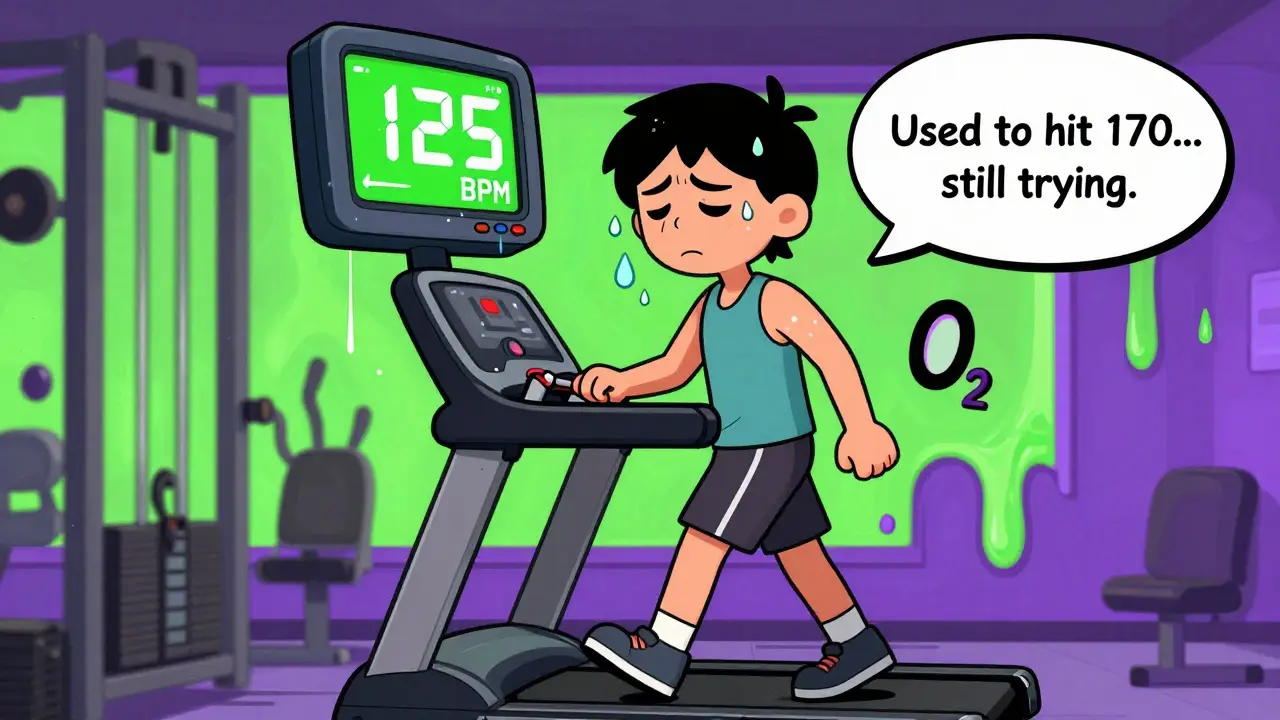
When you're on beta-blockers, your body doesn't respond to exercise the way it used to. You might find yourself gasping for air after a light walk, or feeling completely drained after 20 minutes on the treadmill-even though you used to run for hours. This isn't laziness. It's not weakness. It's your medication doing exactly what it's supposed to do: slowing your heart down. But that also means your body can't pump blood and oxygen as fast during physical activity. The result? Fatigue that feels out of proportion to your effort.
Why Beta-Blockers Make Exercise Feel So Hard
Beta-blockers like metoprolol, propranolol, and atenolol work by blocking adrenaline from hitting your heart. That’s great for lowering blood pressure, reducing heart strain, and preventing arrhythmias. But it also means your heart can’t speed up the way it should when you start moving. Studies show these drugs can cut your maximum heart rate by 20-30%. If you used to hit 170 bpm during a run, you might now max out at 120-130 bpm-even if you’re pushing yourself just as hard.This drop in heart rate directly lowers your VO₂ max-the maximum amount of oxygen your body can use during exercise. For most people on beta-blockers, that number drops by 10-15%. That’s like carrying an extra 10 pounds everywhere you go. Your muscles don’t get enough oxygen fast enough, so they fatigue sooner. You might feel like you’re working hard, but your heart just can’t keep up.
And it’s not just your heart. Beta-blockers also reduce how much energy your body pulls from stored sugars during activity. Adrenaline normally helps unlock that fuel. When it’s blocked, your body runs on a lower setting. That’s why you might feel tired even when you’re not sweating much. Some users report dry mouth and minimal sweat on mild effort-a red flag for dehydration that many mistake for normal side effects.
How Other Medications Compare
Not all heart medications slow you down the same way. ACE inhibitors like lisinopril or calcium channel blockers like amlodipine don’t limit heart rate the way beta-blockers do. They might cause leg swelling or dizziness, but they won’t crush your ability to raise your pulse during exercise. Diuretics can mess with your electrolytes, making muscles cramp, but they don’t restrict your heart’s ability to respond.That makes beta-blockers unique. They’re the only class of heart meds that directly shut down your heart’s natural response to movement. That’s why trying to follow standard heart rate targets-like aiming for 70% of your max-is useless. Your heart rate isn’t a reliable gauge anymore. If you keep chasing old numbers, you’ll either give up out of frustration or push too hard and risk injury.
What to Use Instead of Heart Rate
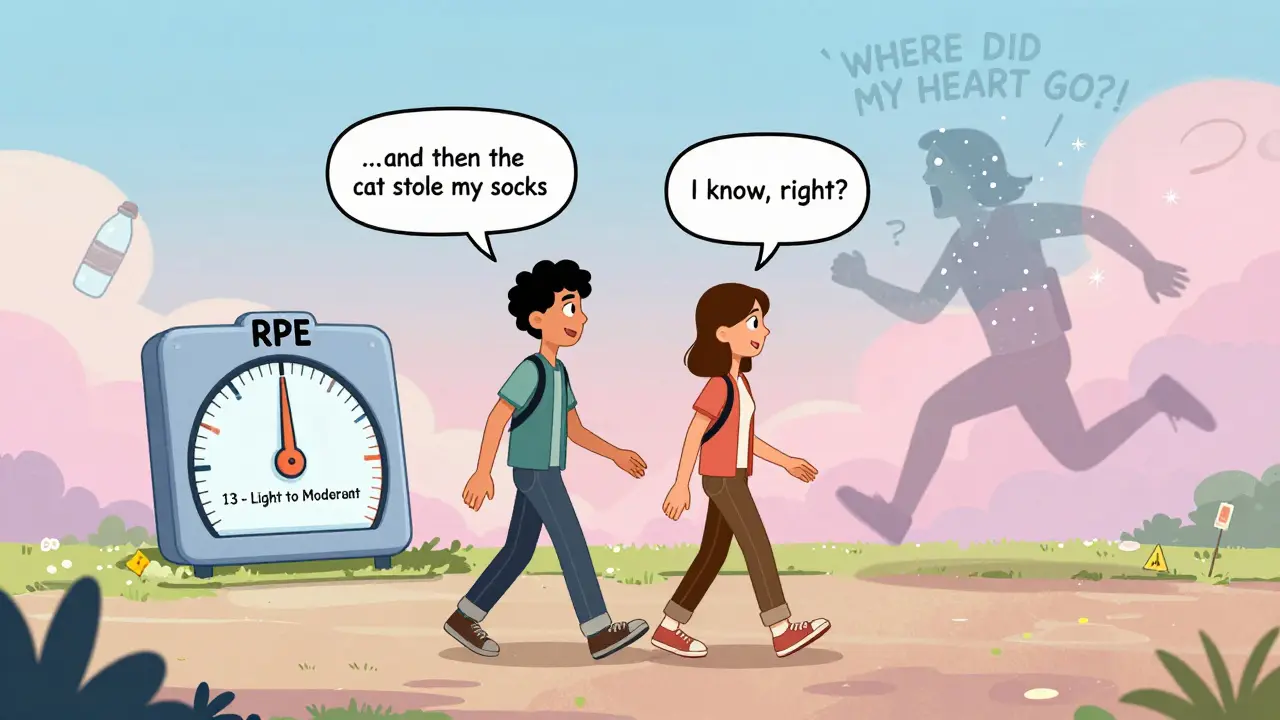
The good news? You don’t need to stop exercising. You just need to change how you measure effort.The talk test is the simplest and most effective tool. If you can talk comfortably during your workout but not sing, you’re at the right intensity. If you can’t say a full sentence without gasping, you’re going too hard. If you could recite the alphabet without breathing hard, you can probably go a bit faster. This method works because it reflects how hard your body is working, not what your heart rate says it should be doing.
Another reliable option is the Borg Rating of Perceived Exertion (RPE) scale. This is a 6-to-20 scale where 6 means “no effort at all” and 20 means “maximal effort.” Most people on beta-blockers should aim for 12-14 (light to moderate) for daily activity. That’s where you feel like you’re working, but you’re not struggling. If you used to train at 17-19 before starting beta-blockers, you’ll now need to drop to 14-16 to get the same cardiovascular benefit. Don’t fight it. Adjust your expectations.
How to Adjust Your Workouts
Extend your warm-up. Instead of 5 minutes of light walking, spend 10-15 minutes easing into your workout. Your heart needs more time to adjust. Rushing into activity can cause sudden dizziness or chest tightness.
Go longer, not harder. Since you can’t push as hard, you need to spend more time moving. The American Heart Association recommends 180-188 minutes of moderate activity per week for beta-blocker users, instead of the standard 150. That’s about 30-35 minutes a day, five days a week. A brisk walk, gentle cycling, or swimming are all excellent choices.
Use interval training wisely. Short bursts of effort followed by rest can be more effective than steady-state cardio. Try 2 minutes of walking fast, then 1 minute of slow walking. Repeat for 20-30 minutes. Research shows this improves endurance better than continuous moderate exercise for people on beta-blockers.
Adjust strength training. Beta-blockers don’t weaken your muscles-they just limit your heart’s ability to support them. You can still lift weights, but reduce the load by 15-20%. Keep the same number of reps and sets. Focus on control and form, not how heavy you can lift. Building muscle helps your body use oxygen more efficiently, which offsets some of the fatigue.
Red Flags You Can’t Ignore
Some symptoms are normal. Others mean you need to stop and call your doctor.
Stop exercising and seek help if you experience:
- Resting heart rate below 45 bpm with dizziness or lightheadedness
- Systolic blood pressure dropping below 90 mmHg during activity
- Chest pain, pressure, or tightness that doesn’t go away with rest
- Severe shortness of breath that doesn’t improve after stopping
- Unusual confusion, cold sweats, or nausea
These aren’t just side effects-they’re warning signs. About 5% of beta-blocker users experience dangerously low heart rates with symptoms. 3% see dangerous drops in blood pressure during exercise. Don’t wait to see if it passes. Get help.
What’s New in 2026
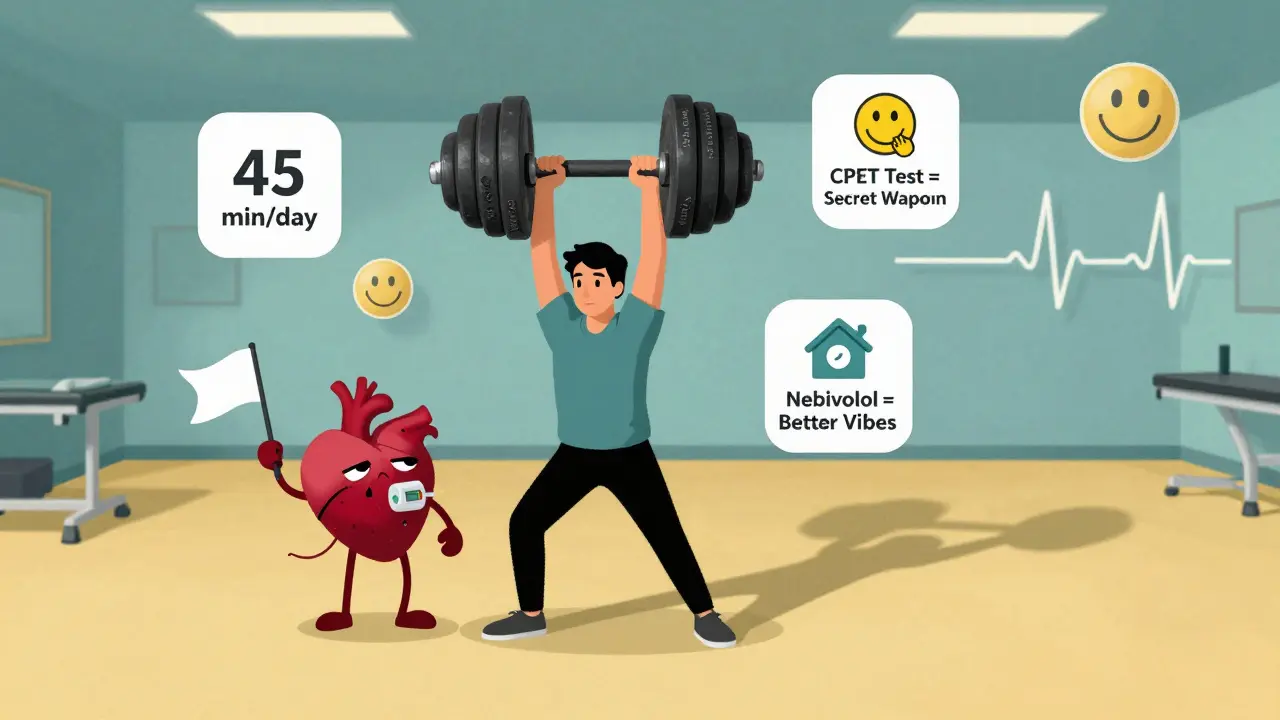
Newer beta-blockers like nebivolol (Bystolic) are designed to be more heart-selective and cause less reduction in VO₂ max-about 8-10% less than older versions. That’s a small but meaningful improvement.
Technology is catching up too. Apple Watch’s latest software now includes beta-blocker-adjusted heart rate zones. It doesn’t magically fix your limits, but it stops showing you misleading numbers. If you’re using a fitness tracker, make sure your settings reflect your medication. Many apps still assume you’re not on heart meds.
Cardiopulmonary exercise testing (CPET) is becoming more common in cardiac rehab centers. This test measures exactly how your body uses oxygen during activity and gives you a personalized exercise prescription. If your doctor hasn’t mentioned it, ask. It’s the most accurate way to know what you can safely do.
Real Stories, Real Adjustments
One user on Reddit, on 100mg metoprolol, saw his 5K time go from 25:30 to 29:15-even though he felt like he was trying just as hard. That’s a 15% drop in performance, exactly what clinical studies predict. He didn’t quit. He switched from tracking pace to using the talk test. Now he walks 45 minutes a day, five days a week, and says he feels stronger than he has in years.
Another user, on atenolol, stopped obsessing over heart rate numbers and started walking with a friend. They chatted the whole time. She didn’t realize how much better she felt until she compared her energy levels to when she was forcing herself to hit a target bpm. “I stopped fighting my body,” she said. “And finally, I started enjoying movement again.”
It’s not about going back to how you were. It’s about finding a new normal. Your heart isn’t broken. It’s just being protected. And with the right adjustments, you can still move well, stay strong, and feel alive-without pushing your body past its limits.
Can I still do high-intensity workouts on beta-blockers?
High-intensity interval training (HIIT) is less effective on beta-blockers because your heart can’t reach the necessary rates. While you can still do modified intervals-like 2 minutes of brisk walking followed by 1 minute of slow walking-traditional HIIT with sprints or heavy lifting is unlikely to give you the same benefits. Focus on longer, steady, moderate efforts instead. Your heart will thank you.
Why am I not sweating even when I feel tired?
Beta-blockers can reduce sweat production because they block adrenaline, which normally triggers sweat glands. This doesn’t mean you’re not working hard-it means your body’s normal cooling response is dampened. You’re still losing fluids through breathing and skin evaporation. Drink water before, during, and after exercise, even if you don’t feel thirsty. Dry mouth and minimal sweat during mild effort are warning signs of dehydration risk.
Should I stop exercising if my heart rate is too low?
No-your heart rate is supposed to be lower. That’s the point of the medication. But if your heart rate drops below 45 bpm and you feel dizzy, faint, or confused, stop immediately and contact your doctor. That’s not normal. Low heart rate alone isn’t dangerous if you feel fine. It’s the symptoms that matter.
Do beta-blockers affect muscle strength?
No. Beta-blockers don’t reduce muscle strength or size. They limit your heart’s ability to deliver oxygen during activity, which makes you feel tired faster. But your muscles themselves are still strong. You can maintain or even build muscle with resistance training-just use lighter weights and focus on controlled movements and higher reps.
How long does it take to adjust to exercising on beta-blockers?
Most people notice a difference within the first 2-4 weeks. Full adaptation takes 6-12 weeks. During this time, your body learns to use oxygen more efficiently and your muscles get better at extracting it from the blood. Don’t get discouraged if your first few workouts feel awful. Stick with the talk test, keep moving, and give yourself time. You’ll find your new rhythm.
Comments
Annette Robinson
January 7, 2026 AT 16:58I remember when I first started on metoprolol-I thought I was just getting lazy. Turns out, my heart was just being polite and saying, "Nope, not today." The talk test changed everything for me. I stopped checking my watch and started checking in with my breath. Now I walk with my dog every morning, and we chat like old friends. No numbers. Just presence.
It’s not about what you used to do. It’s about what your body can do right now. And that’s enough.
Luke Crump
January 8, 2026 AT 04:46Let me get this straight-you’re telling me the solution to modern medicine’s greatest betrayal is… walking slower? And calling it "self-care?" Where’s the revolution? Where’s the biohacking? The cryo? The fasting? We’ve been reduced to counting breaths like monks in a monastery while our hearts are being held hostage by Big Pharma’s polite little pills.
My heart rate doesn’t lie. It just got fired. And now I’m supposed to be grateful for the pension?
Someone get me a T-shirt that says: "I survived beta-blockers. And all I got was this lousy walk."
Manish Kumar
January 9, 2026 AT 16:16You know, in India, we have a saying-"Jab dil tham jaaye, toh saans chalne do"-when the heart stops, let the breath flow. It’s not about forcing your body to behave like it did ten years ago. It’s about listening. Beta-blockers don’t make you weak-they make you aware. Most people chase metrics like they’re running from a tiger, but you’re not running from anything. You’re walking with purpose.
I’ve seen grandfathers in Delhi do 90 minutes of slow yoga in the park, no heart monitor, no app, just breath and rhythm. They’re not trying to break records. They’re trying to stay alive. And they’re winning.
Stop measuring your worth in bpm. Measure it in peace. In consistency. In showing up-even if it’s just for 20 minutes. That’s the real strength.
Also, if you’re not sweating? Good. That means your body isn’t fighting itself. Let it be gentle. It’s not broken. It’s being healed.
Prakash Sharma
January 11, 2026 AT 10:33USA thinks everything can be fixed with an app. You want to know what works? Get up. Walk. Don’t wait for Apple Watch to tell you it’s okay. My uncle in Mumbai was on beta-blockers for 12 years. He never wore a tracker. He walked to the temple every morning. 3 kilometers. Slow. Steady. No heart rate zones. Just faith and feet.
You think your body is broken because your numbers are low? No. Your mind is broken because you’re addicted to numbers. Stop blaming the pill. Start blaming your ego.
And if you’re still complaining? Go do 10 push-ups. Then come back and tell me your heart rate matters more than your will.
Donny Airlangga
January 13, 2026 AT 04:37Just wanted to say thank you for writing this. I’ve been on atenolol for two years and felt so alone in this. Everyone else talks about hitting PRs. I just want to walk to the mailbox without feeling like I ran a marathon.
The Borg scale helped me more than any doctor ever did. I used to think I was failing because I couldn’t get to 150 bpm. Now I aim for 13. If I can talk while walking, I’m doing great. If I can laugh? Even better.
It’s not less. It’s different. And honestly? I like this version of me better.
Kristina Felixita
January 14, 2026 AT 21:38OMG YES!!! I was like, am I crazy?? Why am I so tired after walking to the fridge?? Then I found this post and it was like someone finally spoke my language!!
I switched to the talk test and now I just hum along to podcasts while I walk. No numbers, no guilt, no shame. And guess what? I’m actually enjoying it now. I used to dread it. Now I look forward to my 30-minute "me time".
Also, dry mouth?? YES. I thought I was dehydrated but kept drinking water and still felt like a desert. Turns out, my sweat glands are just on strike. So now I sip water like it’s my job. And I don’t even feel guilty for not sweating buckets anymore.
Thank you for validating my weird little life.
Joanna Brancewicz
January 16, 2026 AT 10:38VO₂ max reduction: 10–15%. RPE 12–14 optimal. Talk test > HR zones. CPET gold standard. Nebivolol superior for oxygen utilization. Dehydration risk underappreciated. Interval training > steady state. No muscle atrophy. Adaptation window: 6–12 weeks.
Stop chasing metrics. Start optimizing effort.
Lois Li
January 17, 2026 AT 19:02I want to say this gently, but I really need you to hear it: You’re not broken. You’re not failing. You’re not lazy. You’re adapting.
I’ve been on beta-blockers since my heart attack five years ago. I used to run marathons. Now I walk with my granddaughter. We don’t race. We stop to look at flowers. We talk about her school. We don’t count steps. We count smiles.
There’s no shame in changing how you move. There’s only beauty in finding new ways to be alive.
If you’re reading this and feeling alone-I’m here. We’re all here. And we’re still moving. Even if it’s slow. Even if it’s quiet. We’re still here.
christy lianto
January 17, 2026 AT 22:15Let me be real with you-this isn’t about exercise. It’s about grief. You’re mourning the version of yourself that could run 10 miles without breaking a sweat. And that’s okay. Grieve it. Then get up. Walk. Breathe. Repeat.
I cried the first time I realized I couldn’t hit my old heart rate. I felt like my body had betrayed me. But here’s the truth: your body isn’t betraying you. It’s protecting you. And that’s not weakness. That’s wisdom.
So go slow. Go steady. Go loud with your joy. Don’t wait for your heart to catch up. Let your spirit lead. You’re not behind. You’re just on a different track.
And yes-you’re still strong. Even if your sweat is gone.
Ken Porter
January 18, 2026 AT 13:35So… you’re telling me the answer to being tired is… walking more? Wow. Groundbreaking. Next you’ll tell me water is wet.
I’m on beta-blockers too. I just stopped exercising. Why waste time pretending I’m still an athlete? I’m not. I’m a patient. And I’m fine with that.
Stop pretending this is a lifestyle hack. It’s a downgrade. Own it.
swati Thounaojam
January 18, 2026 AT 14:05thank you for this. i was scared to move because i felt so weak. now i know its not me. its the meds. i started walking 15 min a day. just 15. and i feel better. not perfect. but better. thank you.
Aubrey Mallory
January 19, 2026 AT 11:59Ken, you’re not wrong. But you’re also not helping anyone by calling it a downgrade.
There’s a difference between accepting limits and surrendering to them. This post isn’t about giving up. It’s about rewiring your definition of strength.
My husband used to lift 200 lbs. Now he lifts 100 with perfect form. He’s not weaker. He’s smarter. And he’s still here. Still moving. Still alive.
Don’t reduce this to a binary. It’s not ‘before’ vs ‘after’. It’s ‘before’ vs ‘now’. And ‘now’ can still be powerful.
Dave Old-Wolf
January 19, 2026 AT 19:35I didn’t even know CPET existed until I read this. My cardiologist never mentioned it. I just assumed I had to quit cardio. Turns out I just needed the right tool.
Anyone know if insurance covers CPET? I’m in the US and I’m scared of the bill.
Also-has anyone tried the 2-min fast / 1-min slow intervals? I tried it yesterday and it felt… kinda good? Like my body finally got a break. Not sure if it’s placebo, but I’m keeping it.
Molly Silvernale
January 20, 2026 AT 21:23The heart doesn’t beat to impress-it beats to sustain. And sometimes, sustaining is the most radical act of courage there is.
They told me I’d never run again. I believed them. Until I realized I didn’t need to run to feel alive. I just needed to breathe. To walk. To notice the way the light hits the trees at 6 a.m.
My heart rate is lower. My soul? It’s wider.
They call it a limitation. I call it a recalibration. A quiet revolution in slow motion.
And honestly? I think I’m finally learning how to be human again.
Evan Smith
January 22, 2026 AT 12:33So… I’m just gonna say it: this post is basically the yoga of cardiac rehab. "Feel your breath, not your BPM." Cute. I’m just gonna keep my Apple Watch on and ignore the red zone warnings.
Also-nobody talks about how depressing it is to see your Fitbit say "You’re not trying hard enough" while you’re gasping after climbing stairs.
Thanks for the info, I guess. Still think we need better drugs.