
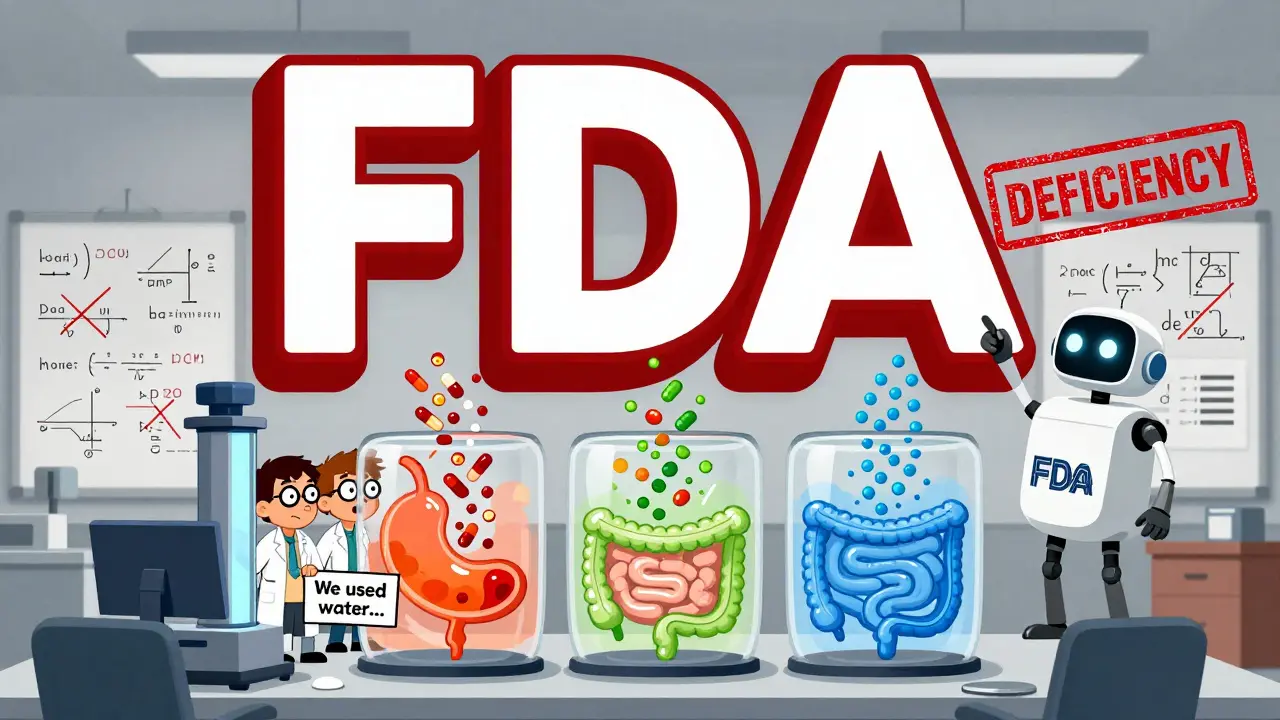
When a generic drug company submits an application to the FDA, they’re not just waiting for approval-they’re waiting for a deficiency letter. These aren’t polite notes. They’re formal notices that say: "Your application is incomplete, wrong, or doesn’t meet standards. Fix this or wait another year." For companies trying to bring affordable medicines to market, a deficiency letter can cost millions and delay access to life-saving drugs by over a year.
Over 70% of all major problems in Abbreviated New Drug Applications (ANDAs) are quality-related. The FDA doesn’t reject applications because they’re poorly written. They reject them because the drug doesn’t match the brand-name version in how it works, how it’s made, or what’s in it. And the most common reasons? They’re not random. They repeat over and over.
Dissolution Problems Are the #1 Reason for Deficiency Letters
If you think dissolution just means "how fast the pill breaks down," you’re underestimating it. Dissolution testing isn’t a formality-it’s the core proof that your generic will behave the same way in the body as the brand drug. In 2023, 23.3% of all ANDA deficiencies were tied to dissolution issues. That’s more than one in five applications.
Most applicants use outdated methods. They test in water or simple buffers, not in conditions that mimic the human gut. The FDA expects dissolution testing across multiple pH levels: 1.2 (stomach), 4.5 (early intestine), and 6.8 (late intestine). They also require Apparatus 2 for immediate-release tablets, and Apparatus 3 or 4 for modified-release products like extended-release pills. If you use the wrong apparatus or skip pH testing, you’ll get flagged.
Even worse, many companies don’t validate their methods properly. Validation means proving your test can tell the difference between a good batch and a bad one. If your method can’t detect small changes in drug release, the FDA won’t accept it. One company lost 14 months because their dissolution method couldn’t distinguish between batches made on different equipment. The FDA said: "This isn’t a quality control test-it’s a guess."
Drug Substance Sameness Is a Hidden Minefield
"Sameness" sounds simple: your active ingredient must be identical to the brand’s. But "identical" means more than chemical structure. It means particle size, crystal form, hydration state, and even how it’s handled during manufacturing.
In 2024, 19% of major deficiencies came from drug substance (DS) sameness issues. The biggest culprit? Incomplete characterization of the raw material. For example, if your API has three different crystal forms and you only test one, you’re at risk. The FDA wants data showing your version behaves the same under stress-heat, humidity, light, and mechanical pressure.
Peptide drugs make this even harder. These aren’t small molecules. They’re chains of amino acids that fold into shapes. If your peptide doesn’t fold the same way as the brand, it won’t work the same. The FDA now requires circular dichroism, Fourier-transform infrared spectroscopy, and size-exclusion chromatography to prove structural similarity. Most small companies don’t have access to this equipment. They outsource it-and often get back incomplete data.
Impurities Are the Silent Killer
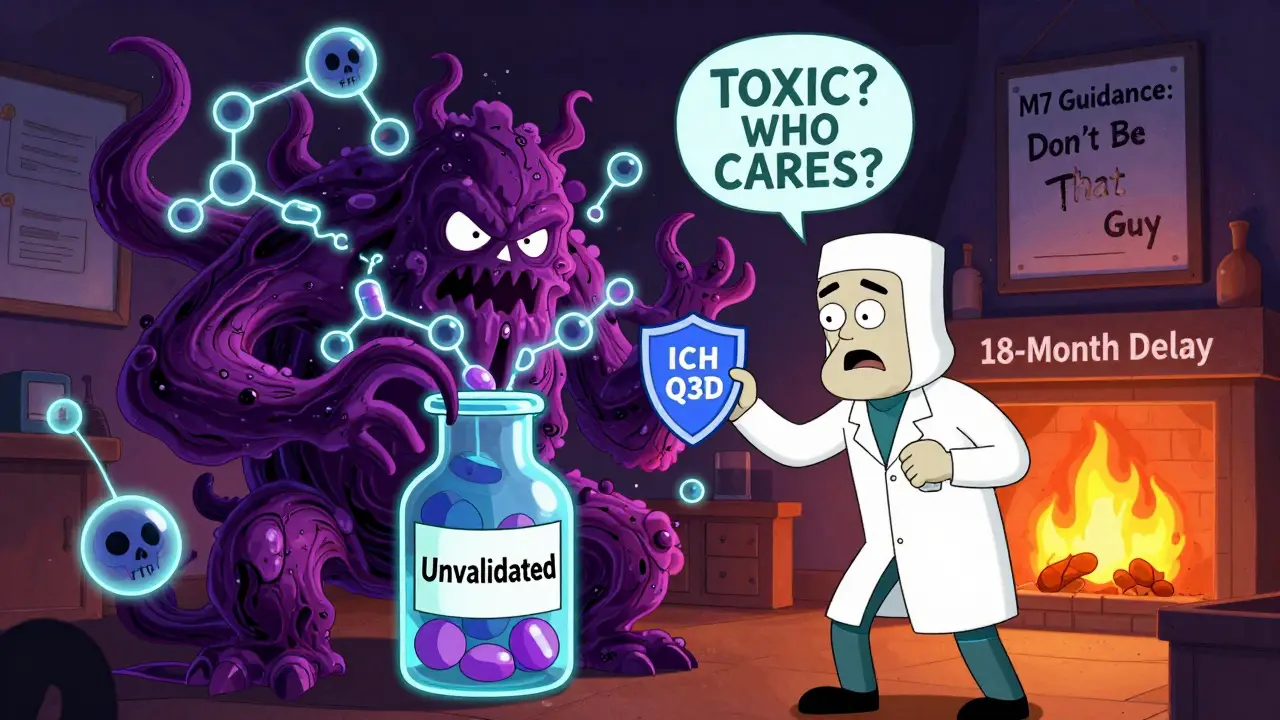
Impurities aren’t dirt. They’re chemical byproducts formed during manufacturing or storage. Some are harmless. Others are carcinogenic. The FDA’s M7 guidance sets strict limits for mutagenic impurities. If your drug has a degradation product that hasn’t been tested for DNA damage, your application is dead.
20% of drug product deficiencies involve unqualified impurities. That means: no toxicology study. No risk assessment. Just a note saying, "We found this chemical, but we didn’t check if it’s dangerous." One applicant submitted a generic version of a blood pressure drug and missed a trace-level impurity formed during sterilization. The FDA rejected it. The company had to run a full 90-day rodent study. Approval was delayed by 18 months.
Elemental impurities are another growing issue. The ICH Q3D guidelines set limits for metals like lead, cadmium, and arsenic. Yet 13% of applications still lack a proper control strategy. Some companies assume their suppliers’ certificates are enough. The FDA says: "We need your own testing data, not theirs."
Manufacturing and Process Control Failures
Generic drugs aren’t copies. They’re re-creations. And if your manufacturing process doesn’t consistently produce the same product, the FDA won’t approve it.
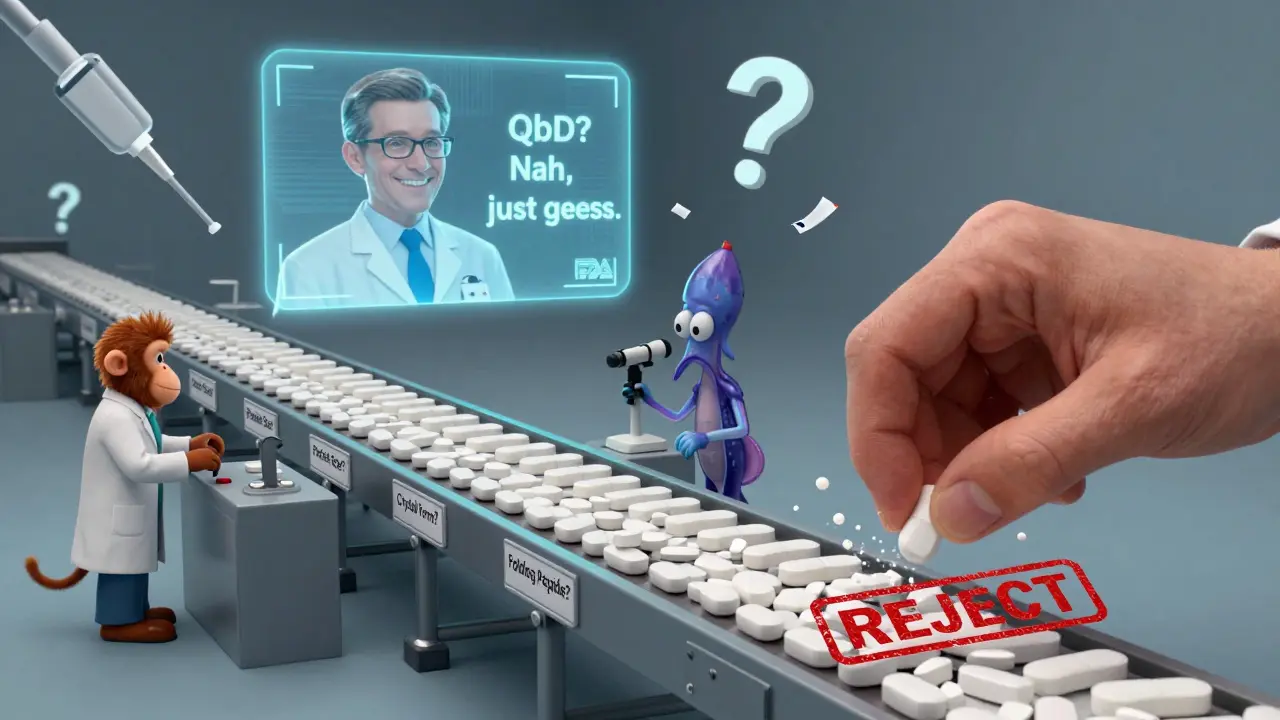
Modified-release tablets are especially vulnerable. These drugs release medicine slowly over hours. Getting that timing right requires precise control of coating thickness, particle size, and compression force. In 2021, the FDA found that most complete response letters for these products came from multiple process failures at once. One company used a different granulation method for their bioequivalence batch than for their commercial batch. The FDA saw it immediately. "You didn’t prove you can make this at scale," they wrote.
Even small changes matter. Switching from a paddle to a basket in dissolution testing? Not allowed without justification. Changing the supplier of a filler? Requires a new comparability study. The FDA expects every step to be documented, controlled, and validated-not just "good enough."
Why Some Companies Keep Failing
It’s not just technical. It’s cultural. Companies with fewer than 10 approved ANDAs have deficiency rates 22% higher than those with 50 or more. Why? Experience. They’ve seen the letters before. They know what the reviewers are looking for.
First-time applicants often treat the FDA like a university committee. They submit a polished report with pretty graphs and assume that’s enough. But the FDA doesn’t care about elegance. They care about evidence. Did you test the drug in real conditions? Did you prove it’s the same? Did you show you can make it reliably?
Another big problem: poor communication. A 2023 survey found that 78% of generic companies felt they didn’t understand what the FDA wanted. One company submitted a 300-page application and got back a one-sentence deficiency: "Clarify the rationale for selecting the reference standard." They had spent $2 million and missed the point entirely.
How to Avoid Deficiency Letters
You can’t eliminate risk-but you can cut it in half.
- Request a pre-ANDA meeting. Companies that do this see deficiency rates 32% lower. Bring your dissolution data, impurity profiles, and manufacturing flow. Ask: "What would make you reject this?" The FDA will tell you.
- Use Quality by Design (QbD). Don’t just test the final product. Design the process to control quality from the start. Map your critical quality attributes (CQAs) and link them to process parameters. The FDA rewards this approach.
- Don’t copy the brand blindly. If the brand uses a 20-year-old dissolution method, don’t use it. The FDA wants modern, biorelevant methods. Test in fasted and fed-state simulated fluids.
- Validate everything. Analytical methods, dissolution, impurity testing-none of it is optional. Document your validation protocols. Include precision, accuracy, linearity, and robustness.
- Invest in documentation. Applications with detailed development reports have 27% fewer deficiencies. Explain why you chose each method. Show your thought process. The FDA appreciates transparency.
The Future: Faster Approvals Are Coming
The FDA knows this system is broken. Too many good drugs get stuck in review. That’s why they launched the First Cycle Generic Drug Approval Initiative in 2023. They’re creating template responses for the 10 most common deficiencies. They’re training reviewers to be more consistent. They’re even testing AI tools that scan submissions before they’re officially filed-flagging missing data, wrong apparatus, or unvalidated methods.
Early results are promising. Among companies using the new templates and pre-submission tools, dissolution-related deficiencies dropped 15%. The FDA’s goal? Raise first-cycle approval rates from 52% to 68% by 2027. That means 15 to 20 more generic drugs hitting the market every year.
For companies willing to invest in quality-not just speed-the future is brighter. The $110 billion generic market depends on it. And patients depend on you to get it right.
What is a deficiency letter from the FDA?
A deficiency letter is a formal notice from the FDA that identifies specific issues in an Abbreviated New Drug Application (ANDA) that prevent approval. It lists required corrections-such as missing data, flawed methods, or inadequate controls-that must be addressed before the drug can be approved. It is not a rejection, but a request for additional information.
What are the most common reasons for FDA deficiency letters in generic drugs?
The top reasons are dissolution method and specification issues (23.3%), unqualified impurities (20%), drug substance sameness problems (19%), inadequate analytical method validation (16.5%), and deficiencies in control strategies for elemental impurities (13%). Most of these stem from poor process design, outdated testing methods, or insufficient characterization of the drug’s physical and chemical properties.
How long does it take to resolve a deficiency letter?
Resolving a deficiency letter typically adds 12 to 18 months to the approval timeline. Complex issues-like needing new toxicology studies for impurities or redeveloping a dissolution method-can extend this to over two years. The time depends on the scope of the issue and how quickly the applicant can generate new data, validate methods, and resubmit.
Can a deficiency letter be avoided entirely?
Yes. About 65% of major deficiencies are preventable with better preparation. Companies that conduct pre-submission meetings with the FDA, use Quality by Design principles, validate all methods thoroughly, and document their development process in detail have significantly lower deficiency rates. First-time applicants who invest in learning FDA expectations before submitting can avoid the most common pitfalls.
Do small generic companies have a harder time getting approval?
Yes. Companies with fewer than 10 approved ANDAs experience deficiency rates 22% higher than established manufacturers with 50 or more approvals. This is largely due to less experience with FDA expectations, limited access to advanced testing equipment, and weaker documentation practices. However, small companies that use pre-submission meetings and partner with experienced consultants can close this gap significantly.
What’s the difference between a deficiency letter and a rejection?
A deficiency letter is not a rejection. It means the application has potential but requires additional information or corrections. A rejection-called a Complete Response Letter (CRL)-means the FDA has determined the application cannot be approved in its current form, often due to fundamental flaws like safety concerns or lack of bioequivalence. Most deficiency letters can be resolved with proper action.
How does the FDA’s new AI tool help reduce deficiencies?
The FDA is testing an AI-assisted pre-submission screening tool scheduled for full rollout by Q3 2026. This tool automatically scans applications for common errors-like missing dissolution pH data, incorrect apparatus selection, or unvalidated methods-before the formal review begins. Early tests show it can reduce preventable deficiencies by up to 35%, helping applicants fix issues before they even submit.
Are complex generics like peptides more likely to get deficiency letters?
Yes. Complex generics-including peptides, modified-release tablets, and topical dermatologicals-face deficiency rates 40-65% higher than standard immediate-release small-molecule drugs. These products require advanced analytical techniques (like circular dichroism or size-exclusion chromatography) to prove structural and functional equivalence, which many applicants lack experience with. The FDA has created specialized review teams for these products to improve consistency, but the bar remains high.
Comments
Konika Choudhury
January 11, 2026 AT 18:43Stop begging for approval. Start making it right and force them to accept it.
Darryl Perry
January 11, 2026 AT 21:27Windie Wilson
January 12, 2026 AT 07:33Next they'll be testing the emotional resonance of the tablet coating.
Jose Mecanico
January 13, 2026 AT 13:32Alex Fortwengler
January 14, 2026 AT 12:08Monica Puglia
January 16, 2026 AT 02:12So many small teams think 'if it works in the lab, it's good enough'-but the FDA isn't your college lab TA. They want proof, not hope. QbD isn't buzzword bingo-it's survival. You got this! 💪
Rebekah Cobbson
January 17, 2026 AT 08:56Audu ikhlas
January 17, 2026 AT 12:06