
Drug Side Effect Causality Calculator
How This Tool Works
This calculator uses the principles of dechallenge (stopping the drug to see if symptoms improve) and rechallenge (restarting to see if symptoms return) to estimate how likely a drug caused your side effects. Based on the timing relationships between your drug use and symptoms, it provides a causality score similar to the Naranjo Scale used by clinicians.
Remember: This tool is for educational purposes only and should not replace medical advice. Always consult with your doctor about any medication concerns.
Enter Your Information
Have you ever been told to stop a medication because you developed a rash, nausea, or dizziness-and then felt better right away? That’s not just coincidence. It’s dechallenge, one of the most powerful tools doctors and pharmacists use to figure out if a drug is actually causing your side effects. And if your symptoms come back when you take the drug again? That’s rechallenge-and it’s the closest thing medicine has to a smoking gun.
What Is Dechallenge?
Dechallenge is simple: you stop the drug and watch what happens. If your side effect fades away, that’s a positive dechallenge. It means the drug was likely the culprit. If your symptoms stick around? That’s a negative dechallenge-and it suggests something else is going on.It sounds basic, but it’s not always easy. People often stop their meds on their own, which messes up the timing. Did the rash disappear because you stopped the antibiotic-or because you changed your soap? Doctors need clear timelines. A good dechallenge means the side effect improves within a timeframe that matches how long the drug stays in your body. For example, if you took a drug with a half-life of 12 hours and your itching went away in 36 hours, that’s a strong clue. If it took three weeks? Maybe not.
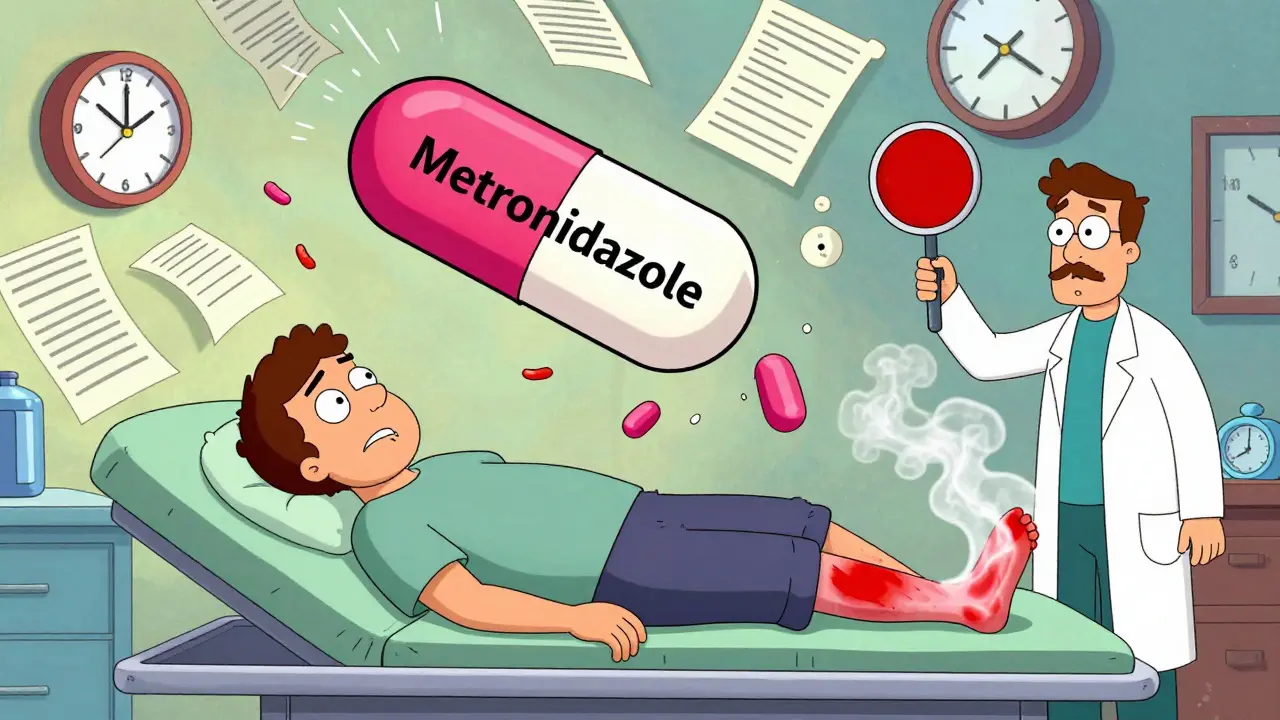
In dermatology, where skin reactions are common, dechallenge is used in about 87% of cases. A patient gets a rash from metronidazole. They stop the pill. The redness fades over five days. The skin starts healing. That’s a textbook positive dechallenge. No fancy lab test needed. Just observation and timing.
What Is Rechallenge?
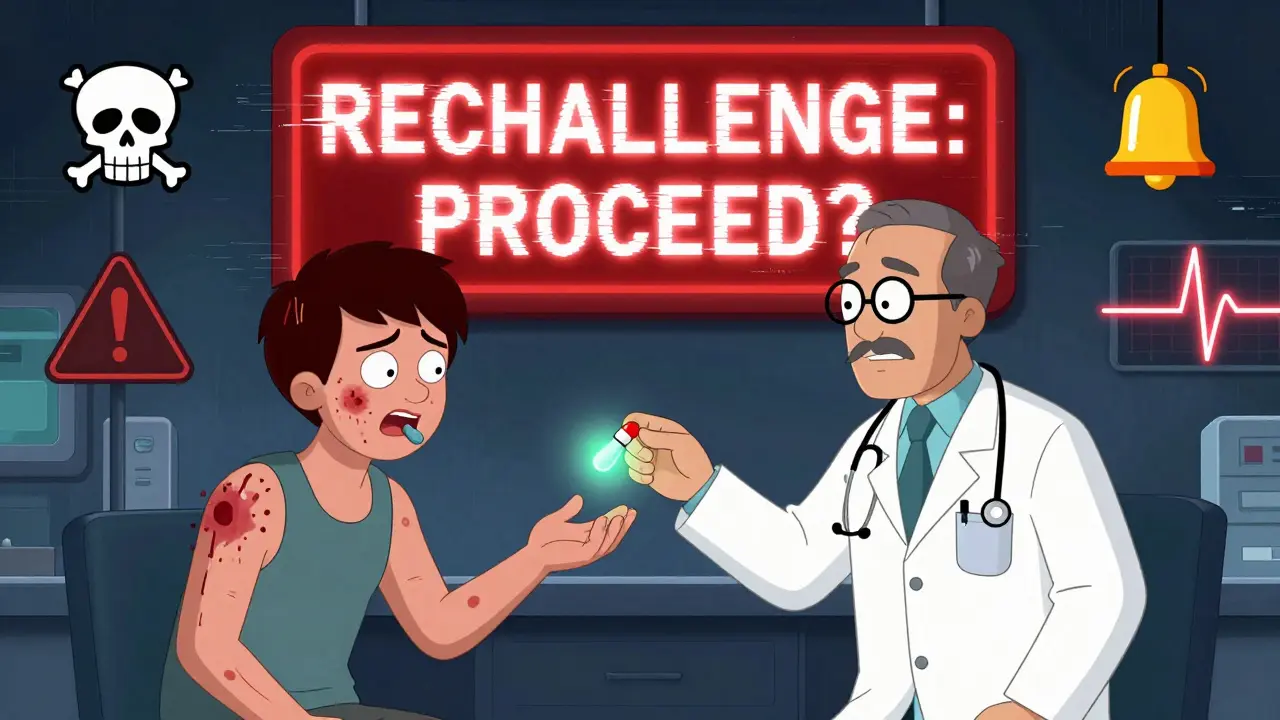
Now imagine this: after the rash is gone, your doctor says, “Let’s try the drug again-just one small dose, under supervision.” If the rash comes back, exactly the same way, within hours or days? That’s rechallenge-and it’s powerful.Rechallenge doesn’t just suggest the drug caused the reaction. It proves it. According to the World Health Organization’s criteria, a successful rechallenge moves the causality rating from “probable” to “definite.” In 97% of cases where rechallenge is done safely and properly, it confirms the drug is responsible.
But here’s the catch: rechallenge is risky. If you had a life-threatening reaction like Stevens-Johnson Syndrome or liver failure, no doctor in their right mind would give you the drug again. Even for milder reactions, it’s not done lightly. In the U.S., fewer than 0.3% of serious adverse drug reaction investigations include rechallenge. It’s only considered when:
- The reaction wasn’t life-threatening
- The drug is essential and has no good alternative
- You give informed consent
- The test is done in a controlled setting with emergency care ready
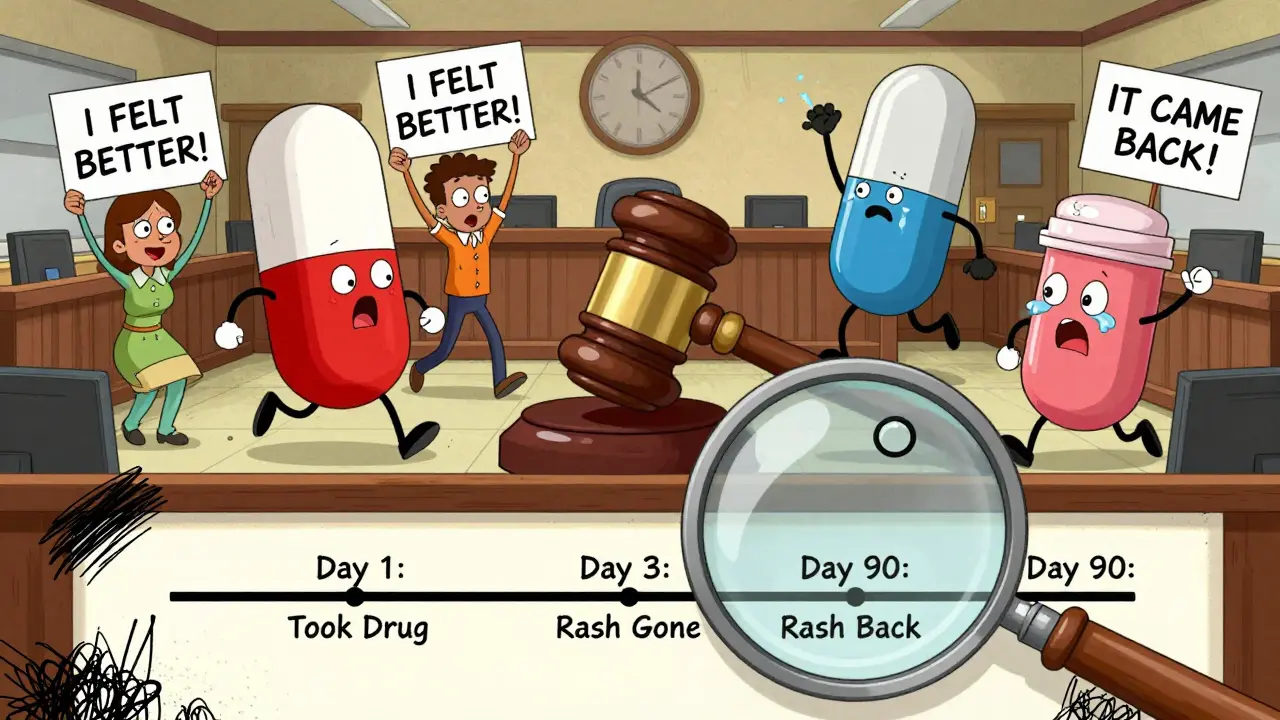
One famous case involved a patient who got a fixed drug reaction-a recurring rash in the same spot-after taking metronidazole. After stopping it, the rash vanished. Months later, under strict medical watch, they took one pill. Within 48 hours, the exact same rash appeared in the exact same spot. That’s rechallenge in action. It’s rare, but when it happens, it’s definitive.
Why These Tests Matter
You might wonder: why not just use a blood test or an allergy scan? The truth is, most drug side effects aren’t allergies. They’re unpredictable, dose-related, or delayed reactions that don’t show up on standard tests. That’s where dechallenge and rechallenge come in.These two steps are part of the four pillars of drug causality assessment:
- Temporal relationship-Did the side effect start after taking the drug?
- Dechallenge-Did it go away when you stopped?
- Rechallenge-Did it come back when you restarted?
- Biological plausibility-Does this reaction make sense for this drug?
Without dechallenge and rechallenge, you’re left guessing. The Naranjo Scale-a common tool doctors use to rate how likely a drug caused a reaction-gives extra points for positive dechallenge and rechallenge. But even the best algorithm can’t replace the real-world evidence of symptoms disappearing and returning with the drug.
When Dechallenge and Rechallenge Don’t Work
These tools aren’t magic. They have limits.Polypharmacy is a big problem. If you’re on ten medications and one causes a side effect, stopping them all at once makes it impossible to know which one was the culprit. That’s why doctors try to stop one drug at a time-when possible.
Delayed reporting also messes things up. If you don’t tell your doctor about your nausea until three weeks after starting the drug, and you’ve already switched to a new pill, rechallenge isn’t an option anymore.
And then there’s irreversible damage. Some drugs cause nerve damage, liver scarring, or permanent skin changes. Even if you stop the drug, the harm stays. A negative dechallenge here doesn’t mean the drug was innocent-it just means the damage is done.
Psychiatric drugs are another tricky area. Stopping an antidepressant can trigger withdrawal or worsen depression. Rechallenge might not be ethical at all. That’s why dechallenge is used less often in psychiatry-only about 43% of cases include it.
How Technology Is Changing the Game
You might think these are old-school methods. But they’re evolving.Wearable sensors now track heart rate, skin temperature, and even subtle inflammation changes when a drug is stopped. In one 2023 study, these devices caught resolution of side effects in 78% of cases-compared to just 52% when patients just reported how they felt. That’s a big jump in accuracy.
Researchers are also developing blood tests that check how your immune cells react to specific drugs in a lab. These in vitro assays can predict if you’re likely to have a bad reaction-with 89% accuracy. If proven reliable, they could replace rechallenge entirely for some reactions.
Machine learning is being used to predict dechallenge outcomes. If you’ve had a rash from amoxicillin before, an algorithm can estimate how long it’ll take to clear after you stop. This helps avoid unnecessary delays in restarting important meds.
But here’s what experts agree on: no tech can replace the real thing. As Dr. Elena Rodriguez from the WHO put it, “No algorithm can substitute for the clinical reality of symptom resolution after drug discontinuation.”
What This Means for You
If you’re on a new medication and notice something off-itching, dizziness, swelling, fatigue-don’t just ignore it. Don’t just stop it cold, either.Write down:
- When you started the drug
- When the side effect started
- How bad it is (on a scale of 1 to 10)
- What you did when it started (did you stop the drug? Did you call your doctor?)
This info is gold. It helps your doctor decide if it’s a real drug reaction. And if they suggest a dechallenge, don’t panic. It’s not about testing you-it’s about finding the truth so you can stay safe.
And if your doctor ever talks about rechallenge? Ask questions. Understand the risks. Know why they think it’s worth it. It’s rare-but when it’s done right, it gives you clarity no lab test ever could.
Bottom Line
Dechallenge and rechallenge aren’t fancy science. They’re simple, direct, and brutally honest. Stop the drug. See if you feel better. Try it again-carefully-and see if it comes back. That’s how we know what’s harming you.They’re not perfect. They’re not always possible. But when they work, they cut through the noise. In a world full of algorithms, guesswork, and conflicting advice, these two steps remain the gold standard. Because sometimes, the best way to find out if a drug is dangerous is to stop it-and see what happens.
Can dechallenge and rechallenge be done at home?
No. Dechallenge should only be done under medical supervision. Stopping certain medications suddenly can be dangerous-for example, antidepressants, blood pressure drugs, or seizure medications. Rechallenge is never done at home. It requires a controlled clinical setting, emergency equipment, and informed consent. Never stop or restart a medication without talking to your doctor first.
If my symptoms go away after stopping a drug, does that mean it definitely caused them?
Not always. A positive dechallenge strongly suggests the drug was responsible, but other factors could be involved-like a virus, stress, or another medication you also stopped. Doctors look at the whole picture: timing, biological plausibility, and whether the reaction matches known side effects of the drug. Dechallenge is a key clue, but not proof on its own.
Why is rechallenge so rarely used?
Because it carries risk. If you had a severe reaction like anaphylaxis, liver failure, or a life-threatening skin condition, re-exposing yourself could kill you. Even for mild reactions, there’s no guarantee it won’t get worse. Ethical review boards and regulatory agencies only approve rechallenge in rare cases where the benefit (knowing for sure which drug caused the issue) outweighs the risk-and only when no alternatives exist.
Do all doctors know how to do dechallenge and rechallenge correctly?
No. Many general practitioners don’t get formal training in pharmacovigilance. Studies show certified pharmacovigilance professionals are 42% more accurate in identifying drug-caused side effects than general providers. That’s why it’s important to see a specialist-like a clinical pharmacologist or an allergist-if you’ve had a serious reaction. They know how to interpret the timing, rule out other causes, and document outcomes properly.
Are dechallenge and rechallenge used in drug approval?
No. These tests are used after a drug is already on the market, during post-marketing surveillance. Clinical trials before approval can’t catch rare or delayed side effects. That’s why regulators require companies to track dechallenge and rechallenge reports from doctors and patients worldwide. This real-world data is what leads to safety warnings, label changes, or even drug withdrawals.
Dechallenge and rechallenge are not just clinical tools-they’re patient safety tools. They turn guesswork into certainty. And in medicine, that’s priceless.
Comments
Jody Kennedy
December 27, 2025 AT 09:34So you're telling me the only way to know if a drug is messing you up is to stop it... and maybe try it again? Sounds like something out of a 1970s medical drama. I mean, we have AI and gene sequencing, but we're still playing guess-the-symptom with human guinea pigs?
christian ebongue
December 28, 2025 AT 19:27dechallenge is just common sense tbh. if your rash disappears when you stop the pill? yeah it was the pill. no lab test needed. just stop being lazy and track your symptoms. also, rechallenge is wild. imagine being like ‘hey doc, wanna see if this kills me again?’ 😅
jesse chen
December 30, 2025 AT 08:30I love how simple this is... and how rarely it's done right. I had a friend who stopped her blood pressure med cold turkey because she thought the dizziness was ‘just stress’... and then she fainted at the grocery store. Dechallenge isn’t a DIY project. Please, please, please talk to your doctor before you stop anything. I’m not saying this to scare you-I’m saying it because I’ve seen the aftermath.
Ryan Cheng
December 30, 2025 AT 10:55For anyone who’s ever been told ‘it’s probably just anxiety’-this is why you should keep a symptom journal. Write down the date, the drug, how you felt, and what you ate that day. I used to think I was being dramatic until I realized my migraines only happened after I took that new fish oil. Stopped it? Gone. Restarted? Back in 48 hours. No magic, just math and patience. You’re not crazy-you’re just paying attention.
Jeanette Jeffrey
December 31, 2025 AT 20:55Oh wow, so we’re still using ‘trial and error’ as a diagnostic tool in 2025? How quaint. The fact that we haven’t replaced this with a simple blood test yet is a crime. And let’s not pretend rechallenge is ‘rare’-it’s just that most doctors are too scared to do it right. Meanwhile, patients are left guessing, misdiagnosed, and medicated into oblivion. This isn’t medicine. It’s medical roulette.
Shreyash Gupta
December 31, 2025 AT 23:20in india we dont even get to stop the drugs... doctors just add another one to ‘fix’ the side effect 😅😂 so dechallenge? nah. we do ‘polypharmacy roulette’ instead. also, rechallenge? my uncle tried it with a statin and ended up in ICU. now he takes 11 pills. and still dizzy. 🤷♂️
Ellie Stretshberry
January 1, 2026 AT 11:41i stopped my antidepressant because i felt weird and then got super tired for weeks. turned out it was the iron pill i started at the same time. i wish i had written stuff down. now i keep a notes app called ‘drug drama’ and it’s saved me twice. just write it down people. it’s not that hard.
Angela Spagnolo
January 3, 2026 AT 04:06I just... I just want to say thank you for writing this. I had a reaction to a new antibiotic last year, and my doctor dismissed it as ‘allergies aren’t real unless you swell up.’ I kept track of everything-timing, food, stress levels-and when I showed him the log, he actually listened. We did a dechallenge. It was the first time I felt like a person, not a symptom. This matters. Thank you.
Sarah Holmes
January 4, 2026 AT 14:47It is deeply concerning, and frankly, unconscionable, that the medical establishment continues to rely upon such archaic, anecdotal methodologies in lieu of rigorous, evidence-based, biochemically verifiable diagnostics. The very notion that a human being’s subjective experience-unquantified, unstandardized, and riddled with cognitive bias-is considered the ‘gold standard’ in pharmacovigilance is not merely outdated; it is an affront to the very principles of scientific integrity. This is not medicine. This is superstition with a stethoscope.
Joanne Smith
January 4, 2026 AT 19:23Rechallenge is the medical equivalent of asking your ex to come back just to prove they were toxic. And yeah, sometimes it works. But sometimes you get burned so bad you need a new skin. I’d rather trust the 89% accurate lab test than gamble my liver on a ‘what if.’ Also, why is no one talking about how these tests are way easier when you’re white and have good insurance? Just saying.
Prasanthi Kontemukkala
January 5, 2026 AT 18:28This is so important, especially for people on multiple meds. I’m on 5 drugs for different things and when I got a rash, I panicked and stopped everything. Big mistake. Took me 3 months to figure out it was just the new blood pressure pill. If I’d known about dechallenge, I could’ve saved myself so much stress. I’m telling all my friends about this now. You’re not alone. We’re all just trying to survive the pill maze.
Alex Ragen
January 5, 2026 AT 23:21Let’s be honest: dechallenge and rechallenge are not ‘science’-they are the last gasp of empiricism in a world increasingly dominated by algorithmic determinism. The fact that we still require a human to ‘feel better’ or ‘get worse’ to validate causality speaks volumes about the epistemological bankruptcy of modern pharmacology. The WHO’s criteria? A quaint relic. We need molecular signatures. We need single-cell proteomics. We need to stop anthropomorphizing drug reactions and start treating them as data points in a vast, interconnected biological network. Until then, we are all just guessing in the dark-with a clipboard.