

Daptomycin Muscle Toxicity Risk Calculator
Patient Risk Assessment
Additional Risk Factors
When you're fighting a serious bacterial infection like MRSA or infective endocarditis, daptomycin can be a lifesaver. But there's a hidden risk many patients and even some doctors overlook: daptomycin muscle toxicity. It doesn't show up in every patient, but when it does, it can be serious - and it's entirely preventable with the right monitoring.
What is daptomycin and why does it cause muscle damage?
Daptomycin is a powerful antibiotic used for tough Gram-positive infections. It works by punching holes in bacterial cell membranes, which kills the bacteria quickly. That same mechanism, however, can also damage human skeletal muscle cells. Studies using cultured muscle cells show daptomycin directly disrupts the cell membrane, leading to cell death. This isn't just a theory - it's been proven in lab settings, especially under low-oxygen conditions. Patients with poor circulation, heart disease, or severe sepsis are at higher risk because their muscles are already stressed.
The FDA approved daptomycin in 2003, and since then, doctors have been using it more often - even at higher doses for bone and joint infections. But with higher doses comes higher risk. Real-world data shows muscle toxicity occurs in 5% to 10% of patients, far higher than the 0.2% reported in early clinical trials. Why? Because those trials were done under strict conditions. Real patients have other health problems, take other meds, and get treated longer - all of which increase the chance of muscle damage.
What are the warning signs of daptomycin-induced muscle toxicity?
Don't wait for muscle breakdown to happen. Watch for these early symptoms:
- Muscle pain or aching, especially in the thighs, shoulders, or back
- Unexplained muscle weakness - struggling to climb stairs or lift objects
- Tenderness when pressing on muscles
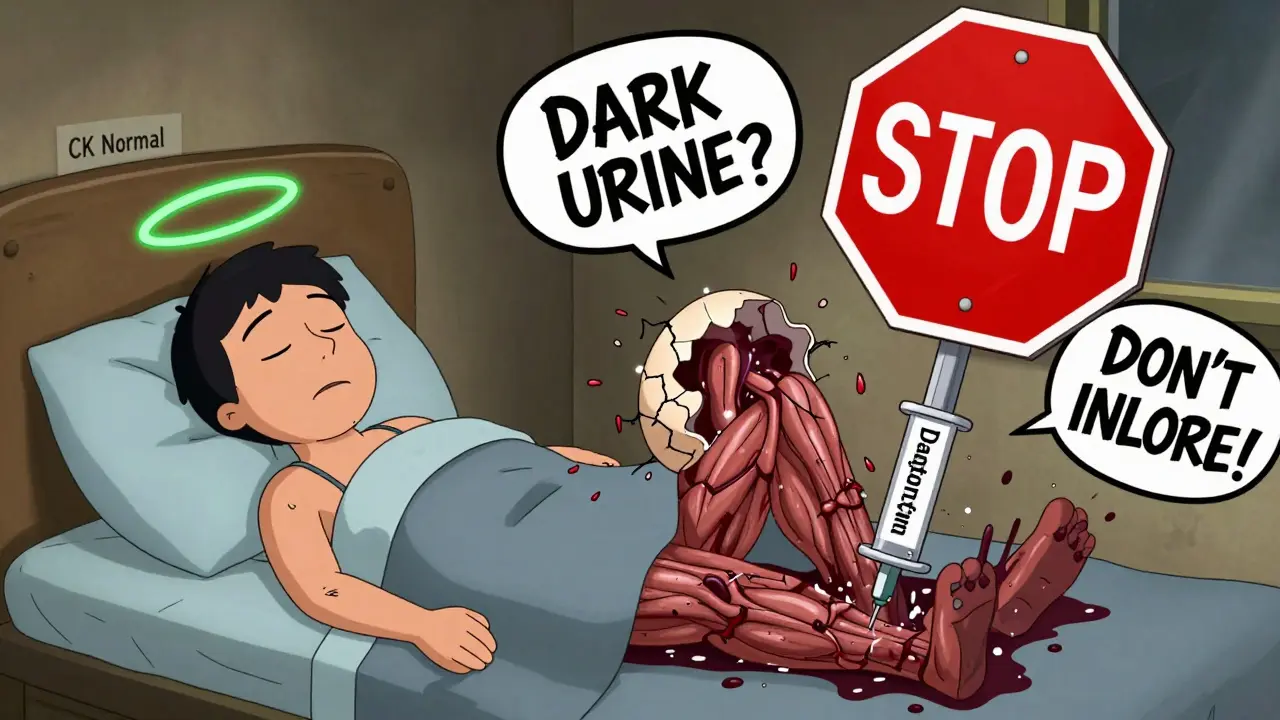
- Dark urine (a sign of muscle breakdown products in the bloodstream)
These symptoms usually start after a few days to a week of treatment. If you're on daptomycin and notice any of this, don't ignore it. Muscle damage from daptomycin is reversible - if caught early. Left unchecked, it can lead to rhabdomyolysis, a life-threatening condition where muscle tissue breaks down and floods the kidneys with harmful proteins.
Why CK monitoring is non-negotiable
CK, or creatine phosphokinase, is a protein found in muscle cells. When muscle cells get damaged, CK leaks into the blood. Measuring CK levels is the most reliable way to catch daptomycin toxicity before symptoms get bad.
Here's what the guidelines say:
- Check CK before starting daptomycin - baseline matters.
- Test weekly during treatment. Some clinics test every 3-4 days for high-risk patients.
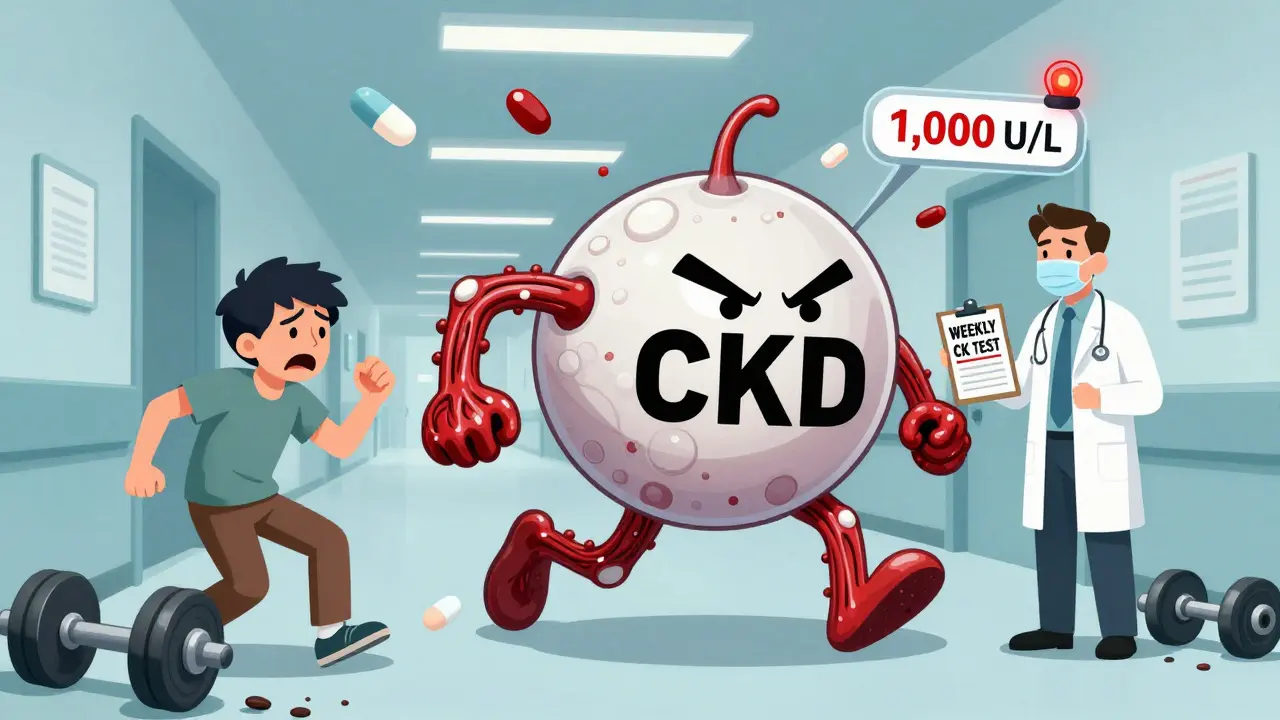
- Stop daptomycin if CK rises above 1,000 U/L in a patient with muscle pain.
- Stop even if the patient feels fine if CK hits 10 times the upper limit of normal (about 1,000-1,500 U/L depending on the lab).
These thresholds aren't arbitrary. They come from years of clinical experience and studies from places like the University of Nebraska Medical Center. One case report described a patient with heart disease whose CK shot up to 6,250 U/L after daptomycin treatment. He didn't have severe pain - but his muscle damage was already advanced. That’s why you can't wait for symptoms.
Who’s at highest risk?
Not everyone on daptomycin will get muscle toxicity. But some groups are far more vulnerable:
- Patients on high-dose daptomycin (8-12 mg/kg/day) for bone or joint infections
- Those with poor circulation, heart failure, or chronic lung disease
- People with low oxygen levels in tissues (hypoxia)
- Patients with pre-existing muscle disorders or recent trauma
- Those taking statins - though the risk isn't as high as once thought
Research from 2014 showed that patients on both daptomycin and statins didn't have significantly more muscle damage than those on daptomycin alone. Still, many hospitals still advise pausing statins during treatment - just to be safe. If you're on a statin, talk to your doctor. Don't stop it on your own, but don't assume it's harmless either.
Daptomycin vs. other antibiotics: How does it compare?
Not all antibiotics hurt muscles the same way. Vancomycin, for example, can damage kidneys, but rarely causes muscle issues. Fluoroquinolones like ciprofloxacin can cause tendon ruptures, especially in older adults. Daptomycin is different - it attacks muscle cells directly. That's why CK monitoring is unique to daptomycin. No other common antibiotic requires this level of muscle-specific tracking.
Cost-wise, daptomycin is expensive - about $1,200 for two weeks of treatment. Vancomycin costs about $120 for the same period. But daptomycin's cost includes only one weekly CK test ($7.50), while vancomycin needs multiple blood draws for drug level checks. So while daptomycin is pricier upfront, the monitoring burden is simpler - if you follow the rules.
What to do if CK rises
If your CK goes above the danger threshold:
- Stop daptomycin immediately.
- Hydrate well - drink water to help your kidneys flush out muscle breakdown products.
- Don't exercise - rest until your CK drops back to normal.
- Follow up with your doctor for repeat CK tests every few days.
Most patients recover fully within 1-2 weeks after stopping the drug. There's no permanent damage if caught early. But if you keep going, you risk kidney failure, which can require dialysis.
Practical tips for patients and caregivers
- Keep a log of muscle pain or weakness - even mild symptoms matter.
- Ask for your CK results after each test. Don't assume "normal" means no risk.
- If you're being treated for a bone infection, expect to be on daptomycin for weeks - that's when toxicity is most likely.
- Don't take NSAIDs like ibuprofen to "relieve" muscle pain. They can mask symptoms and worsen kidney stress.
- Report dark urine, swelling, or sudden weakness right away - don't wait for your next appointment.
Future of daptomycin safety
Doctors are moving beyond just dosing by weight. New research suggests tracking the total drug exposure over time - called AUC (area under the curve) - gives a better picture of risk. Target ranges of 666 to 939 mg·h/L are now being used in specialized centers to balance effectiveness and safety. In the future, we may see personalized dosing based on kidney function, oxygen levels, and even genetic factors.
For now, the simplest rule holds: Monitor CK. Watch for pain. Stop if things look off. That’s how you keep daptomycin working as a lifesaver - not a hidden danger.
Can daptomycin cause permanent muscle damage?
No, daptomycin-induced muscle damage is almost always reversible if caught early. Once the drug is stopped, CK levels drop, and muscle function returns. Permanent damage only occurs if rhabdomyolysis leads to kidney failure and is left untreated.
How often should CK be checked during daptomycin treatment?
CK should be tested before starting daptomycin, then weekly during treatment. For high-risk patients - such as those on high doses, with heart disease, or on long-term therapy - testing every 3-4 days is recommended. Never go longer than 7 days without a test.
Do I need to stop my statin if I'm on daptomycin?
Current evidence doesn't show a strong link between statins and increased daptomycin muscle toxicity. However, many hospitals still recommend temporarily stopping statins as a precaution. Talk to your doctor - don't make this decision on your own. Stopping statins without guidance can increase your risk of heart events.
Is daptomycin safe for older adults?
Older adults are at higher risk because they often have reduced kidney function, lower muscle mass, and more underlying conditions like heart disease or diabetes. Daptomycin can still be used safely, but CK monitoring must be more frequent - ideally every 3-4 days - and dosing should be adjusted based on kidney function.
Can I exercise while taking daptomycin?
Avoid intense exercise while on daptomycin. Physical stress can worsen muscle damage. Light walking is usually fine, but avoid weightlifting, running, or anything that causes muscle fatigue. If you feel sore or weak, stop and rest. Your muscles need to recover - not be pushed.
Comments
Philip Blankenship
February 17, 2026 AT 11:48Man, I’ve been on daptomycin for a staph infection last year and never knew about the CK monitoring. My doc just said "take it and call if you feel weird." I did feel weird-like my thighs were on fire-but I thought it was just the infection. Turns out my CK was at 3,200. They stopped it, I drank a gallon of water a day, and two weeks later I was back to lifting weights. Don’t be like me. Ask for the numbers. Seriously.
Linda Franchock
February 18, 2026 AT 05:50Wow. So basically we’re saying daptomycin is like a ninja-silent until it punches your muscles in the face. And we’re supposed to just check CK like it’s a routine oil change? I love how medicine is moving from "trust your doctor" to "here’s your lab report, go figure it out."
Geoff Forbes
February 19, 2026 AT 00:02As someone who read the original NEJM papers on daptomycin’s mechanism-this is laughably oversimplified. The membrane disruption isn’t "punching holes"-it’s calcium-dependent conformational changes in phospholipid bilayers. And the 5-10% toxicity rate? That’s from retrospective cohort studies with poor confounder control. Real-world data doesn’t mean poorly controlled data.
Also, statins? Please. The 2014 study was underpowered. The real risk is in CYP3A4 polymorphisms and renal clearance kinetics. But of course, you’ll just tell patients to "watch for pain" like it’s a DIY home repair video.
Jonathan Ruth
February 20, 2026 AT 19:55Why are we even using daptomycin when vancomycin costs 10x less? The answer is corporate greed and lazy ID docs who don’t want to wait 72 hours for culture results. Daptomycin is a luxury drug for rich hospitals. And now we’re adding CK tests? That’s another $30 per patient. Who’s paying for that? The uninsured? The system is broken.
Also stop saying "muscle pain"-it’s rhabdo. Use the right word. Or are you afraid to scare people?
Logan Hawker
February 21, 2026 AT 14:45Oh, this is beautiful. A 3000-word treatise on daptomycin, complete with FDA timelines, AUC modeling, and CK thresholds-and yet not a single mention of the elephant in the room: we’re overprescribing antibiotics like they’re Advil. The real toxicity isn’t the drug-it’s the cultural addiction to IV antibiotics for every sniffle. Also, I’m pretty sure the author is a rep for Cubist. Just saying.
Prateek Nalwaya
February 22, 2026 AT 05:17In India, we don’t even have access to weekly CK tests in rural clinics. I’ve seen patients on daptomycin for 3 weeks with no labs, just because the hospital ran out of test strips. The real story isn’t about monitoring-it’s about equity. Who gets the lifesaver? Who gets the hidden danger? This post reads like a luxury manual for a car that most people can’t even afford to own.
Maybe the answer isn’t better monitoring-but better access to alternatives. Or even better, prevention. Stop the MRSA outbreaks in the first place.
Oliver Calvert
February 23, 2026 AT 16:10CK monitoring is non-negotiable. I’ve seen two patients go into renal failure because their CK was ignored. One was 72, on 10mg/kg, had CHF, and was on atorvastatin. They said "he felt fine" so they kept going. He didn’t wake up. Always check. Always stop at 1000. No exceptions. I don’t care if your patient is an athlete. Muscle doesn’t care about your fitness level.
Kancharla Pavan
February 24, 2026 AT 07:44How can you be so naive? You think CK levels are the solution? You think doctors care? In my hospital, the lab techs have to beg for CK orders. Nurses say "he’s fine, he’s walking." And the attending? He’s too busy texting his wife. This isn’t medicine-it’s a lottery. You get lucky if your doctor remembers to check. Otherwise you become a statistic. And no one will apologize.
Stop pretending this is a clinical guideline. It’s a plea for mercy.
PRITAM BIJAPUR
February 25, 2026 AT 14:04🫶 Daptomycin is a double-edged sword. It kills the infection… but sometimes kills the muscle too. Isn’t that the paradox of modern medicine? We weaponize biology to save life, but forget that life is fragile. We measure CK like it’s a stock price, but we forget the person behind the number. That man with the dark urine? He’s not a lab value. He’s someone’s dad. Someone’s brother. Someone who just wanted to go home.
Maybe the real treatment isn’t the test… but the pause. The breath. The moment before we push the next dose.
James Lloyd
February 26, 2026 AT 03:34Just wanted to add: if you’re on daptomycin and your CK is rising, don’t panic-but don’t delay. I had a patient last month whose CK peaked at 8,000. He stopped the drug, hydrated like crazy, and had zero kidney damage. He’s back to hiking. The key? Early recognition. And yes, that means patients need to be educated. Not just handed a script and told "call if something bad happens."
Also-dark urine? Yes. But also: cola-colored. Not just "dark." Be specific. It helps.
Digital Raju Yadav
February 26, 2026 AT 18:05US doctors act like they invented this drug. In India, we’ve been using daptomycin since 2008. And guess what? We didn’t have CK tests. We had clinical judgment. You overtest. You overthink. You turn a simple antibiotic into a bureaucratic nightmare. We lost patients too-but we didn’t need 10 pages of guidelines to do it. Sometimes, less is more.
Adam Short
February 26, 2026 AT 22:59UK guidelines say CK monitoring is optional for low-risk patients. Why are we Americanizing this? We don’t need your $1200 drug and your $7.50 test. We have NICE. We have evidence. We have common sense. Stop exporting your overmedicalized culture. Daptomycin isn’t a miracle. It’s a tool. Use it wisely-or don’t use it at all.
Tony Shuman
February 27, 2026 AT 01:03So… you’re saying we should stop daptomycin if CK is high? What about the MRSA in his heart? What if he dies? What if the infection spreads? You’re prioritizing muscle over life. That’s backwards. If you’re going to risk kidney failure, fine. But don’t call it a safety protocol. Call it a trade-off. And stop pretending this is black and white.
Also-statins? I’ve seen patients have heart attacks after stopping them. You think a CK number is more important than a coronary artery? Wake up.
Dennis Santarinala
February 28, 2026 AT 11:08I just want to say thank you for writing this. I’m a nurse on the med-surg floor, and I’ve seen too many patients get burned by this. One guy? 82, diabetic, on daptomycin for 14 days. His CK was 4,500. He didn’t complain. He was too polite. We didn’t check. He ended up in dialysis. This post? It’s not just info. It’s a lifeline. Please share it. With your family. With your doctor. With your grandma. We need more of this.