
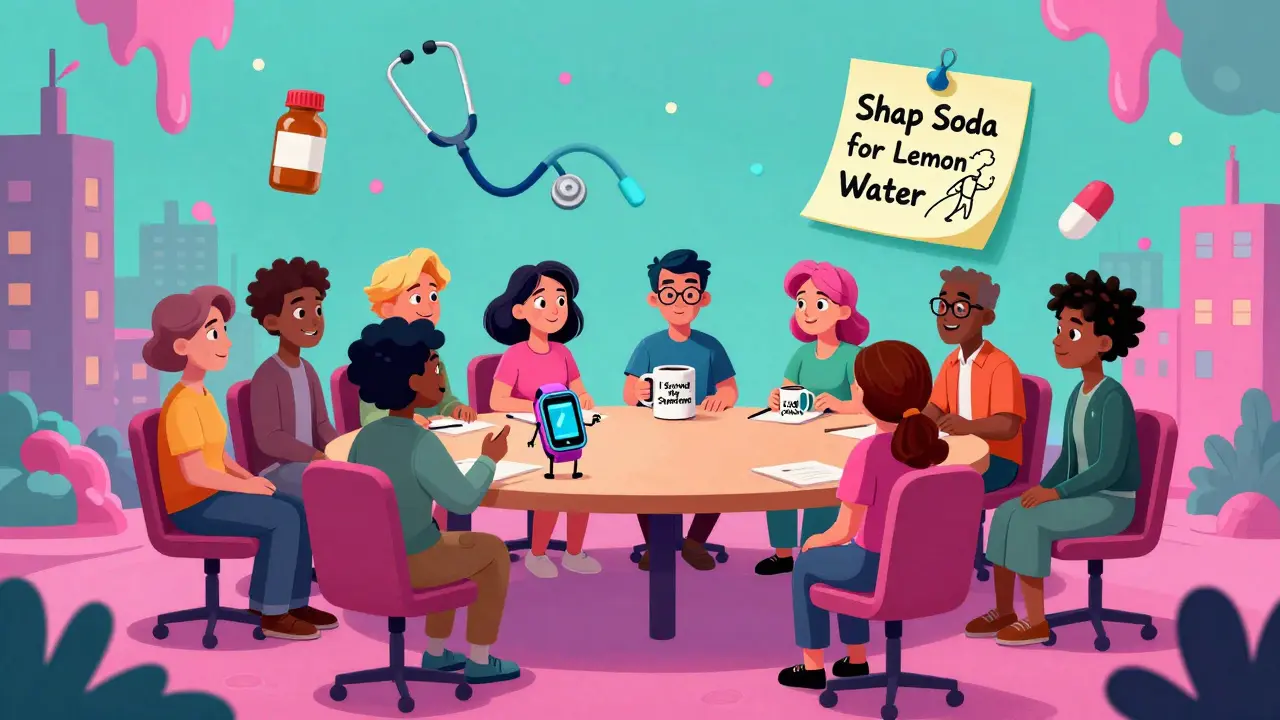
Living with a chronic disease doesn’t mean giving up on daily life. Millions of people with diabetes, arthritis, heart disease, COPD, and other long-term conditions are learning how to take back control-not by fixing their illness, but by changing how they live with it. The key isn’t just medicine. It’s self-management.
What Self-Management Really Means
Self-management isn’t about being a doctor. It’s about becoming the CEO of your own health. That means knowing your symptoms, spotting warning signs, adjusting your routine, talking to your care team, and making small changes that add up. The most proven program for this is the Chronic Disease Self-Management Program (CDSMP), developed at Stanford University in the 1990s by Dr. Kate Lorig. It’s not a cure. It’s a toolkit. And it works.Participants in CDSMP don’t just feel better-they do better. Studies show a 23% improvement in symptom management skills compared to those who only get standard care. People report sleeping better, walking farther, and feeling less anxious. One user in Oregon tracked her steps with a Fitbit: she went from 1,200 steps a day to 5,800 in just eight weeks after learning how to set realistic action plans.
The Six Core Skills You Learn
CDSMP teaches six practical skills that anyone can learn, no matter their diagnosis:- Problem solving: Instead of saying, "I can’t exercise because my knees hurt," you ask, "What kind of movement can I do without pain?" Maybe it’s swimming, chair yoga, or walking in place while watching TV.
- Decision making: You learn how to weigh options. Should you take that painkiller now? Is this fatigue normal or a red flag? You don’t guess-you use data from your own body.
- Using resources: You find out what’s actually available: free community classes, Medicare-covered programs, local support groups, even free apps that track symptoms.
- Partnering with your provider: You stop being passive. You walk into appointments with questions. You say, "This isn’t working for me," and you’re not afraid to ask for help.
- Creating action plans: Instead of "I’ll eat healthier," you write: "I’ll swap soda for sparkling water with lemon at lunch, three days this week."
- Self-tailoring: Your plan doesn’t have to look like someone else’s. If you’re a night person and your meds make you tired in the morning, you adjust your routine. Your health, your rhythm.
In-Person vs. Online: Which One Works for You?
There are two main ways to learn these skills: in person or online.In-person workshops are six weeks long, two and a half hours a week, led by trained peer leaders-people who also live with chronic conditions. These aren’t doctors. They’re your peers. The group setting gives you real talk, real support, and accountability. Completion rates are high: 72% finish the program. People say the biggest win? "I didn’t feel alone anymore." In rural areas, 78% report reduced isolation.
Online programs like Better Choices, Better Health® offer the same content but through a website or app. You log in 2-3 times a week, watch videos, join discussion boards, and complete exercises at your own pace. The upside? No travel. No scheduling conflicts. You can do it in pajamas. But completion rates drop to 58%. And without face-to-face contact, sticking to complex routines-like managing multiple medications-gets harder. One CDC study found adherence to medication schedules was 22% lower in fully digital programs.
Hybrid options are growing. Some clinics now offer online sessions with live check-ins from a coach. Others pair digital tools with monthly phone calls. The best fit depends on your life. If you’re housebound, online wins. If you crave connection, in-person wins.
Digital Tools That Are Actually Helping
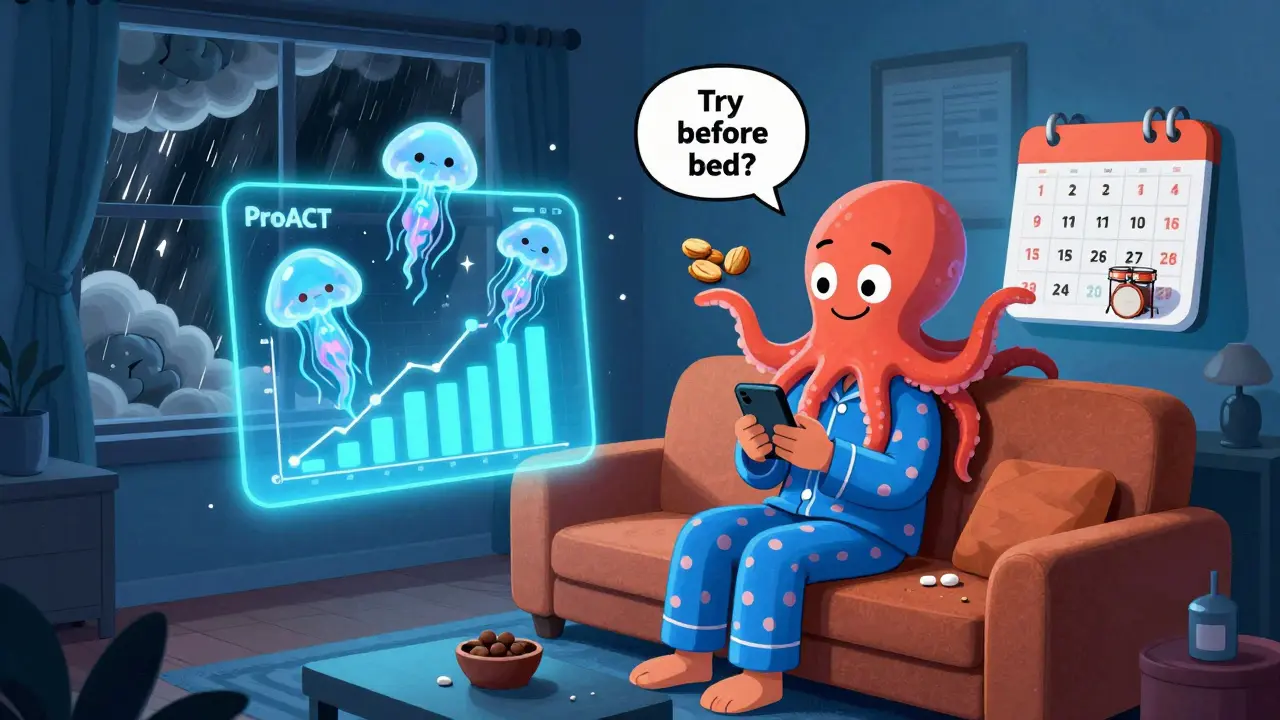
Not all apps are created equal. Some are just fancy diaries. Others are game-changers.ProACT is one of the most advanced. It’s not just an app-it’s a whole system. It connects your wearable device, tracks your symptoms, sends alerts to your care team, and gives you personalized tips. In a 12-month trial, users improved their self-management behaviors by 28%. It’s now used in 12 health systems across the U.S.
Mun Health’s AI companion is newer, but promising. It doesn’t just ask, "How’s your pain?" It notices patterns. If you’ve been skipping meals when your blood sugar drops, it gently reminds you: "Try a handful of nuts before bed." Early pilots show 85% user satisfaction. And it’s being built with cultural context-Spanish-language prompts, visuals for low-literacy users, and options for different family structures.
But here’s the catch: 41% of people with chronic conditions struggle to understand basic health info. If an app uses medical jargon or assumes you know how to interpret glucose readings, it’s useless. Look for tools that explain things simply. The best ones use language at a 6th-8th grade reading level, as recommended by national health literacy standards.
Getting Started: No Experience Needed
You don’t need to be tech-savvy or super organized to begin. Start small.- Take a quick self-check: What’s the one thing that’s hardest right now? Is it remembering meds? Feeling tired all the time? Avoiding social events because you’re in pain?
- Choose one thing to focus on. Not five. Not ten. One.
- Write a tiny action plan. "I will take my blood pressure pill after brushing my teeth every morning." That’s it.
- Track it for a week. Use a notebook, a sticky note, or a free app like Glucose Buddy or MyTherapy.
- At the end of the week, ask: Did it work? What got in the way? Adjust next week.
Many people feel overwhelmed at first. One participant in Tennessee said, "Checking my sugar, adjusting meds, foot care-it felt impossible." But she didn’t do it all at once. She did one step. Then another. That’s how progress happens.
What Gets in the Way-and How to Fix It
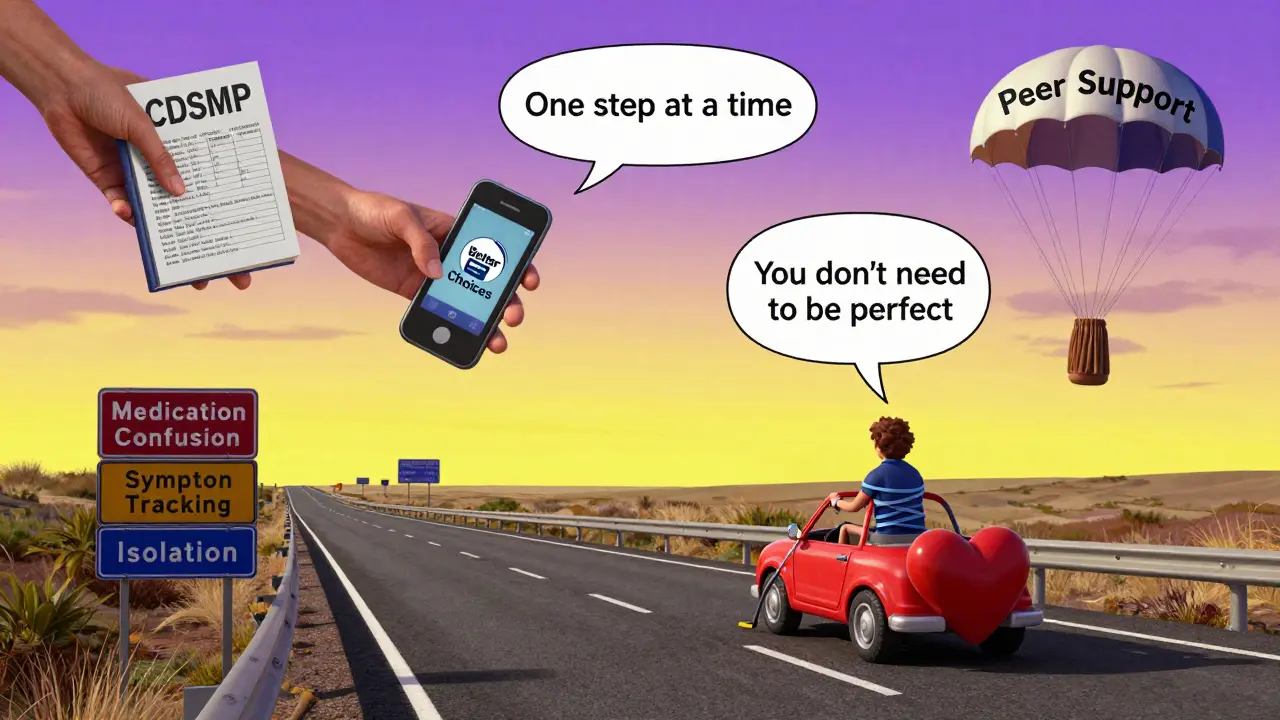
There are three big roadblocks:- Time: 32% of people miss sessions because symptoms flare up. Solution: Talk to your facilitator. Most programs let you make up missed sessions or offer one-on-one calls.
- Medication confusion: 28% of users struggle with complex regimens. Solution: Ask for a medication coach. The Sarah Bush Lincoln Health Center reduced errors by 31% just by adding 15-minute weekly check-ins with a nurse.
- Symptom tracking: 45% of new users stop tracking after the first month. Solution: Use a simple system. Color-code your pain on a calendar. Or set a phone reminder: "Rate your energy: 1-10."
Don’t aim for perfection. Aim for consistency. Even tracking once a week is better than nothing.
Who Pays for This?
Good news: Medicare covers several evidence-based self-management programs, including Diabetes Self-Management Training (DSMT). In 2022, over 1.2 million Medicare beneficiaries used these services-a 19% jump from the year before. Many Medicaid programs and private insurers now cover them too. Some community centers offer CDSMP for free. Check with your local health department, hospital, or Area Agency on Aging. You don’t need a referral to join a workshop.It’s Not About Fixing-It’s About Living
Chronic disease doesn’t go away. But your life doesn’t have to shrink around it. The goal isn’t to eliminate pain or fatigue. It’s to live well despite them. To play with your grandkids. To take a walk without dreading the next step. To talk to your doctor without feeling like a burden.People who stick with self-management programs don’t just manage their disease. They reclaim their days. They learn that small choices-drinking water instead of soda, calling a friend when they feel down, writing down their symptoms-add up to real change. And that change? It lasts. Studies show the benefits stick for at least a year, often longer.
You don’t need to be strong. You don’t need to be perfect. You just need to start.
Can I do self-management if I have more than one chronic condition?
Yes. In fact, programs like ProACT and CDSMP were designed for people with multiple conditions-like diabetes and heart disease, or arthritis and depression. The tools focus on skills that apply across conditions: setting goals, communicating with doctors, managing symptoms, and reducing stress. You don’t need a separate plan for each illness. You build one plan that works for your whole life.
Do I need to be tech-savvy to use digital tools?
No. Many digital programs are designed for people who aren’t comfortable with technology. Apps like Better Choices, Better Health® use simple menus, large buttons, and voice-guided instructions. Some even offer phone-based support-you can call in and get help without using a screen. Look for tools labeled "low-tech friendly" or those that offer a phone option.
What if I can’t leave my house?
You don’t need to go anywhere. Online versions of CDSMP, like Better Choices, Better Health®, work from any device with internet access-phone, tablet, or computer. Many programs also offer phone coaching or video calls with peer leaders. If you don’t have internet, some community organizations will mail you workbooks and call you weekly. Your mobility level doesn’t disqualify you-it just changes the format.
Is self-management just for older adults?
No. While many participants are seniors, the tools work for anyone with a chronic condition-whether you’re 30 with Crohn’s disease, 45 with multiple sclerosis, or 60 with COPD. The skills are the same: problem solving, action planning, communication. Programs are adapted for different ages and needs. Some even have youth-focused versions for teens managing asthma or diabetes.
How long before I see results?
Most people notice small changes within two to four weeks-like feeling more confident talking to their doctor, or being able to walk a little farther. Big changes-like fewer hospital visits or improved mood-usually show up after three to six months. The key is consistency. One step, every day, builds momentum. You don’t need to fix everything at once.
Are these programs free?
Many are. Medicare and Medicaid cover several evidence-based programs, including CDSMP and Diabetes Self-Management Training. Community centers, hospitals, and nonprofits often offer free workshops. Online versions like Better Choices, Better Health® are free to join. Some digital apps have free tiers. Always ask: "Is this covered by insurance?" or "Is there a cost?" You’d be surprised how many options are no-cost.
What if I’m not motivated?
Motivation comes after action, not before. You don’t wait to feel like doing it-you do it anyway, even a little. Start with something so easy it feels silly: "I will drink one glass of water when I wake up." Do that for a week. Then add one more. The act of doing creates momentum. Group programs help, too-just showing up to a class, even if you’re tired, can spark motivation because you’re not alone.
Can self-management replace my doctor?
No. Self-management helps you work better with your doctor-it doesn’t replace them. You still need regular check-ups, prescriptions, and tests. But when you’re skilled at managing your symptoms, you make better use of your appointments. You come prepared. You ask the right questions. You know when to call and when to wait. That’s how you get better care, not less.
Next Steps: Where to Go From Here
If you’re ready to try:- Visit selfmanagementresourcecenter.org to find a CDSMP workshop near you.
- Try Better Choices, Better Health® at betterchoicesbetterhealth.org (free, no sign-up required).
- Call your local Area Agency on Aging-they often host free programs.
- Ask your doctor: "Do you refer patients to self-management programs?"
You don’t have to do it all today. Pick one tool. Try one skill. See how it feels. That’s how lasting change begins.
Comments
Tiffany Channell
January 3, 2026 AT 16:26This 'self-management' crap is just corporate wellness theater dressed up as empowerment. People with chronic illness aren't lazy-they're exhausted. Telling them to 'set tiny action plans' while ignoring systemic barriers like healthcare costs, food deserts, and disability discrimination is tone-deaf. The real problem isn't their lack of discipline-it's a system that abandons them after diagnosis.
And don't get me started on 'peer leaders.' If your 'expert' is someone who also has arthritis, then we're just swapping one confused patient for another. Where are the actual clinicians in this? Where's the accountability?
These programs work for people who already have stable housing, reliable transportation, and social support. For everyone else? It's just another guilt trip wrapped in a glittery app.
Stop romanticizing survival as 'self-management.' It's not a skill-it's a survival tactic forced on people by a broken system.
veronica guillen giles
January 5, 2026 AT 12:05Oh sweet mercy, another ‘you just need to drink more water and write a sticky note’ guide to surviving chronic illness.
Let me guess-the author has never missed a meal because their pain meds made them nauseous, or tried to track blood sugar while juggling three kids and a part-time job.
‘Small changes add up’? Sure, if you have the mental bandwidth to care. For those of us who spend 14 hours a day just staying upright, ‘action plans’ feel like a punchline.
And yet… somehow, this is the version of care that gets funded. Meanwhile, real support-home nursing, adaptive equipment, mental health services-gets cut. So yes, I’m sarcastic. I’ve been told to ‘be more proactive’ while waiting six months for a specialist appointment.
Maybe next time, tell us how to manage our disease while also managing the bureaucracy that’s supposed to help us.
Ian Ring
January 5, 2026 AT 12:05While I appreciate the practical framework outlined here, I must emphasize that the real challenge lies in implementation-not theory. The six core skills are sound, yes-but they assume a baseline of cognitive reserve, digital literacy, and emotional resilience that many simply don’t possess.
I’ve seen patients in rural England attempt to use ProACT, only to abandon it after two days because the interface required a password reset they couldn’t navigate, and their Wi-Fi cut out during a critical symptom log.
Hybrid models are promising, but they need funding, not just pilot studies. And the cultural adaptation in Mun Health’s AI? That’s the future. But it’s not scalable yet.
Let’s stop praising the tool and start fixing the infrastructure that makes it usable for the people who need it most.
Also: thank you for mentioning Medicare coverage. Too many assume these are out-of-pocket expenses.
Shanahan Crowell
January 6, 2026 AT 01:41THIS. THIS RIGHT HERE. I’ve been living with lupus for 12 years and I’ve tried every app, every program, every ‘motivational’ podcast-and THIS is the first thing that actually made me feel like I could breathe again.
I started with ONE thing: taking my pill after brushing my teeth. Just that. No tracking. No pressure. Just… done.
Three weeks later, I started walking around the block. Then two blocks. Then I joined a Zoom group-and I cried the first time someone said, ‘Me too.’
You don’t need to be perfect. You don’t need to be strong. You just need to start. And if you’re reading this and you’re tired? I see you. And you’re not alone.
Go grab that one tiny step. Do it. Then come back and tell us how it went. I’ll be here cheering you on.
❤️
Angela Fisher
January 6, 2026 AT 07:57Okay, but what if the whole self-management movement is a cover-up? What if the real reason they push these programs is because insurance companies don’t want to pay for real treatment? What if they’re training us to be our own nurses so they can cut costs? I looked up Stanford’s funding sources-guess who’s on the board? Big Pharma. And the Fitbit study? Sponsored by a wearable company.
They don’t want to cure us. They want us to manage quietly. To track our pain so their algorithms can predict when we’ll need more meds-and then bill us for it.
And don’t tell me about ‘low-literacy’ apps. If your app needs a 6th-grade reading level, why is it still full of words like ‘adherence’ and ‘compliance’? That’s not accessibility-that’s condescension.
I’ve been told to ‘eat better’ while living in a food desert. I’ve been told to ‘exercise’ while on disability. I’ve been told to ‘be proactive’ while my doctor won’t return my calls for three weeks.
They’re not helping us. They’re training us to accept less.
And the ‘peer leaders’? Are they really peers-or are they unpaid laborers for a broken system?
I’m not buying it. Not anymore.
They want you to think you’re in control. But you’re not. You’re just the new unpaid caregiver for your own body.
Wake up.
And if you think I’m paranoid? Look up the 2018 CDC audit on CDSMP funding. I’ll wait.
Neela Sharma
January 6, 2026 AT 12:31Life with chronic illness is like dancing in a storm-no one hands you the music, no one clears the floor, and yet you learn to move anyway.
These tools? They’re not magic. They’re mirrors. They reflect back what you already know: you are stronger than your pain, even when your body forgets.
I once sat on my porch for an hour, just breathing, because walking hurt too much. That was my action plan. No app. No tracker. Just me, the wind, and the quiet courage of showing up for myself.
It’s not about fixing. It’s about remembering-you are still here. Still worthy. Still whole.
And that? That is the most revolutionary act of all.
One breath. One step. One day.
You are not broken. You are becoming.
Shruti Badhwar
January 7, 2026 AT 16:42While the emotional appeal of this article is understandable, the lack of empirical rigor in its claims is concerning. The cited 23% improvement in symptom management skills lacks a clear control variable definition. The Fitbit anecdote is compelling but not statistically representative. Moreover, the assertion that hybrid models are 'growing' is unsupported by peer-reviewed longitudinal data.
Furthermore, the recommendation to use apps at a 6th–8th grade reading level is appropriate for health literacy, yet the article itself employs complex syntax and academic terminology inconsistent with its own guidelines.
While the intent is commendable, the presentation risks undermining credibility among clinicians and policymakers who require evidence-based, replicable models-not inspirational narratives.
Recommendation: Publish methodology, sample sizes, and longitudinal follow-up data before promoting as 'proven.' Otherwise, this risks becoming another well-intentioned but unvalidated intervention.
Brittany Wallace
January 8, 2026 AT 16:48I’m a Filipina-American with fibromyalgia and I’ve been in both in-person and online programs.
What no one talks about is how culture shapes this. In my family, we don’t talk about pain-we endure it. Saying ‘I need help’ felt like betrayal.
But in the CDSMP group, someone said, ‘My mom called my fatigue laziness. I cried for a week.’ And suddenly, I wasn’t the weird one.
That’s the real magic-not the app, not the steps, not the tracking. It’s realizing you’re not broken for needing help.
And if you’re scared to start? I get it. I waited 8 years.
But you don’t have to fix everything today. Just say ‘I’m here.’ That’s enough.
❤️
Michael Burgess
January 9, 2026 AT 16:06Man, I used to think self-management was just another buzzword until I started using MyTherapy to track my meds after my heart surgery.
Turns out, I was missing doses because I’d get distracted by my kids. So I set a dumb little alarm: ‘Pills + coffee.’ Now I never forget.
And yeah, the app is simple. No fancy AI. Just a checklist. But it gave me back control.
Also, the part about ‘motivation comes after action’? 100% true. I didn’t feel like doing it. I did it anyway. And now? I’m not just surviving-I’m actually planning a trip to the coast next summer.
Small steps. Big life.
Also-shoutout to the nurse who told me ‘your pain is valid, even if it doesn’t show up on a scan.’ That changed everything.
🙏
Liam Tanner
January 10, 2026 AT 05:49Start with one thing.