
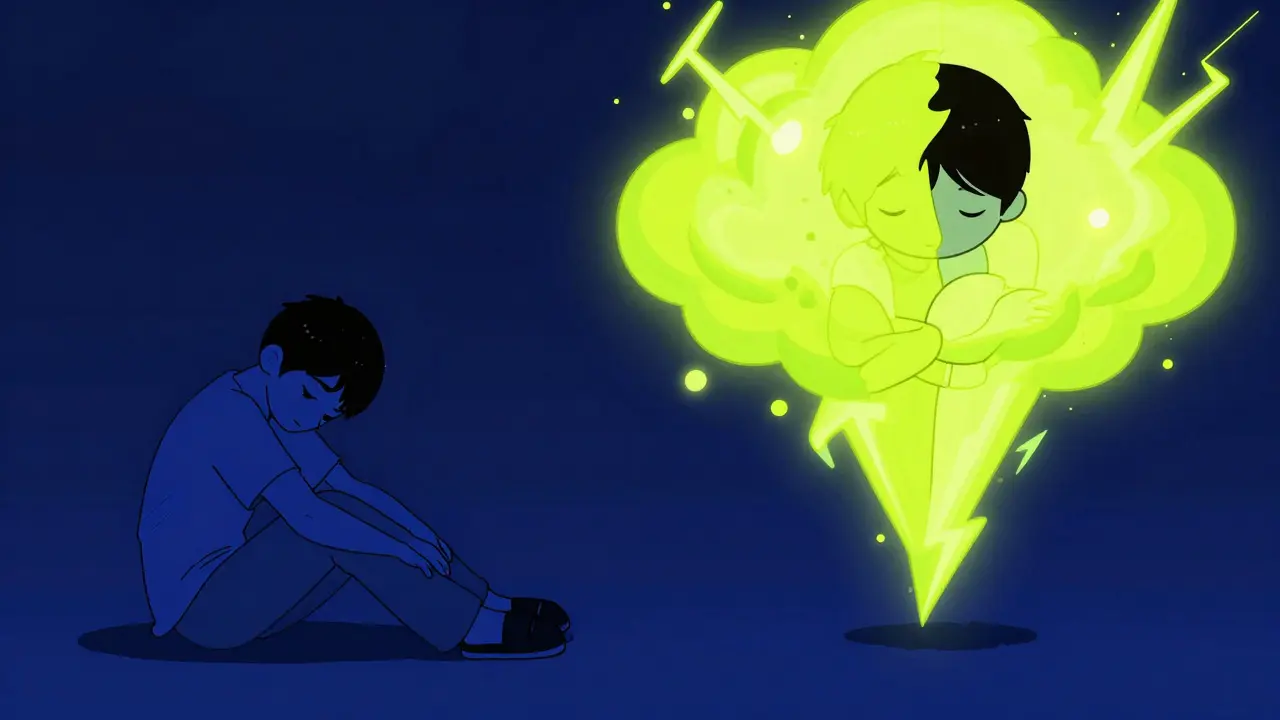
Imagine spending seven years on an antidepressant, only to find out that the medication was actually making your mood swings worse. This isn't a rare story; it's a common reality for people misdiagnosed with unipolar depression when they actually have bipolar disorder. While both conditions involve crushing lows, treating them the same way is a dangerous mistake. Getting the right diagnosis isn't just about a label-it's about avoiding a potential trip to the hospital due to medication-induced mania.
The Core Difference: One Pole vs. Two
At its simplest, the difference comes down to the "poles" of mood. Unipolar Depression is formally known as Major Depressive Disorder (MDD), where a person only experiences the "down" pole of mood . If you have unipolar depression, you deal with sadness, lethargy, and loss of interest, but you've never had a period of abnormally high energy or euphoria.
On the other hand, Bipolar Depression is a phase of bipolar disorder where the person cycles between depressive lows and manic or hypomanic highs . The "bipolar" name literally refers to these two opposite poles. Even if you are currently in a deep depression, the fact that you've had at least one manic episode in your life changes the entire diagnosis and the way you need to be treated.
Spotting the Red Flags: Bipolar vs. Unipolar Symptoms
If you're looking at your own symptoms or helping a loved one, it's easy to see only the depression. However, bipolar depression often leaves specific clues that unipolar depression doesn't. Research shows that people with bipolar depression are more likely to experience psychomotor retardation-that feeling where your body and thoughts move in slow motion-at a rate of 68%, compared to 42% in unipolar cases.
Keep an eye out for these specific "bipolar markers":
- Sleep patterns: Waking up very early in the morning (57% of bipolar cases) rather than oversleeping.
- Morning mood: Feeling significantly worse the moment you wake up, which often improves slightly as the day goes on.
- Cognitive fog: Greater difficulty with complex mental tasks and slower processing speeds.
- Psychosis: A higher incidence of hallucinations or delusions during depressive episodes (22% vs 8%).
- Atypical features: Things like "leaden paralysis" (limbs feeling heavy like lead) or excessive sleeping (hypersomnia) often point toward Bipolar II.

The Danger of the Wrong Medication
This is where the distinction becomes critical. For someone with unipolar depression, SSRIs (Selective Serotonin Reuptake Inhibitors) like sertraline or escitalopram are often the first line of defense. They work by boosting serotonin to lift the mood. For most, this is exactly what's needed.
But for someone with bipolar disorder, taking an antidepressant without a mood stabilizer is like adding fuel to a fire. It can trigger a "switch" into mania or lead to rapid cycling, where you swing through four or more mood episodes a year. In fact, a study known as STEP-BD found that over 76% of bipolar patients treated with antidepressants alone experienced mood destabilization.
| Feature | Unipolar Depression (MDD) | Bipolar Depression |
|---|---|---|
| Primary Goal | Lift mood from depression | Stabilize mood and prevent swings |
| First-Line Meds | SSRIs or SNRIs | Mood Stabilizers or Atypical Antipsychotics |
| Key Medications | Sertraline, Escitalopram | Lithium, Quetiapine, Lurasidone |
| Antidepressant Use | Standard first-line therapy | Used only as add-on to stabilizers |
| Therapy Focus | Cognitive restructuring (CBT) | Daily routines and rhythm (IPSRT) |
How Doctors Actually Diagnose the Difference
Because so many people only seek help when they are depressed, doctors have to be detectives. They can't just look at your current mood; they have to look at your entire history. The DSM-5 is the guidebook they use to ensure you meet the specific criteria for either disorder.
Clinicians often use screening tools to dig deeper. For instance, the Mood Disorders Questionnaire (MDQ) asks about past periods of high energy or decreased need for sleep. If you have a family history of bipolar disorder, the risk is significantly higher-first-degree relatives have a 5-10% risk compared to just 1-2% for the general public.
Another huge red flag is treatment resistance. If you've tried two different antidepressants and neither worked, there's a 3.7 times higher chance that the diagnosis is actually bipolar disorder rather than unipolar depression. The "failure" of the medication is often a clue that the brain chemistry requires a stabilizer, not just a booster.

Therapy and Long-Term Management
Medication is only half the battle. The type of therapy you need depends entirely on the diagnosis. For unipolar depression, Cognitive Behavioral Therapy (CBT) is the gold standard. It focuses on breaking the loop of negative thoughts that keep you stuck in a depressive hole.
Bipolar disorder requires a different approach called Interpersonal and Social Rhythm Therapy (IPSRT). Instead of just focusing on thoughts, IPSRT focuses on stability. It emphasizes keeping a strict daily routine-eating, sleeping, and exercising at the same time every day. Why? Because disruptions in your biological clock can trigger a manic or depressive episode. When patients use IPSRT, remission rates jump to 68% compared to just 42% for standard care.
Long-term management also differs. Someone with a single episode of unipolar depression might be able to stop medication after a year of feeling well. For bipolar disorder, however, the relapse rate is staggering-around 73% within five years if mood stabilizers are stopped. For most, this means lifelong maintenance to keep the "poles" from swinging.
Can unipolar depression turn into bipolar disorder?
It's not so much that it "turns into" it, but rather that it was misdiagnosed from the start. Around 30-40% of people initially diagnosed with unipolar depression eventually show manic symptoms, leading to a corrected diagnosis of bipolar disorder. This often happens because people rarely report their "highs" to doctors, as they usually feel great during those periods.
What is "rapid cycling" in bipolar disorder?
Rapid cycling is when a person experiences four or more mood episodes (mania, hypomania, or depression) within a single year. This is often exacerbated by the use of antidepressants without a mood stabilizer, which can push the brain into an unstable state of constant switching.
Is lithium still used for bipolar depression?
Yes, Lithium remains a cornerstone of treatment. While newer drugs like lurasidone or quetiapine are very effective for the depressive phase, lithium is highly valued for its ability to prevent future manic episodes and reduce suicide risk.
Why are antidepressants dangerous for some people with bipolar?
In a bipolar brain, an antidepressant can act as a trigger that pushes the person out of depression and straight into mania or a "mixed state" (where you have energy and agitation but still feel depressed). This switch can lead to impulsive behavior, severe insomnia, and in some cases, hospitalization.
What are the best screening tools for bipolar disorder?
The Mood Disorders Questionnaire (MDQ) and the Hypomania Checklist-32 (HCL-32) are widely used. While the MDQ is very specific, the HCL-32 is generally more sensitive, meaning it's better at catching potential bipolar cases that might otherwise be missed.
Next Steps: What to Do Now
If you suspect your diagnosis might be wrong, don't just stop your medication-that can cause a severe crash. Instead, start a mood journal. Track your sleep hours, your energy levels, and any periods where you felt "too good" or abnormally productive. Take this data to your psychiatrist and specifically ask about the possibility of a bipolar spectrum disorder.
For those already diagnosed, focus on the rhythm. Whether it's unipolar or bipolar, stability comes from the basics: consistent sleep, a steady diet, and a reliable therapy schedule. If you're struggling with treatment-resistant depression, ask your doctor about newer options like esketamine or specific mood stabilizers that might be a better fit for your unique brain chemistry.
Comments
Srikanth Makineni
April 5, 2026 AT 12:36been there. meds are a gamble sometimes
Toby Sirois
April 6, 2026 AT 00:59most people just dont understand how the brain works but i do. you cant just take a pill and think you're fixed. the real issue is that people are too weak to handle their own minds and rely on these doctors who just want your money. i've seen this a thousand times and it's always the same story. you think you're depressed but you're actually just lacking discipline. the whole system is a joke and you're all just pawns in a game of big pharma. if you actually looked at the data you'd see that the're just guessing. it's basic biology and most of you are too lazy to read a book about it. stop whining about your mood swings and start taking control of your life. it's not that hard if you actually have some grit. honestly the way society treats mental health now is just pathetic. everyone has a label now and it's just an excuse to not work hard. just get up and move and you'll see the difference. trust me i know exactly how this works because i've studied it more than any of the people in this thread. the industry is just selling you a lie to keep you dependent on chemicals. it's honestly sad to see how many people just give up and let a doctor tell them who they are. you are what you make of yourself not what some DSM book says.
Timothy Burroughs
April 7, 2026 AT 09:32typical west coast medicine logic lol. we do it better here in the states and you can tell just by looking at the results. stop trying to act like this is some mystery when its just basic science
Daniel Trezub
April 9, 2026 AT 03:26actually the distinction is often way more blurred than this makes it seem. like a lot of people with cyclothymia get lumped into both and it just creates more confusion. honestly the whole 'poles' analogy is a bit oversimplified but whatever
Brady Davis
April 11, 2026 AT 02:09oh wow a chart! i feel so much better now that i have a table to look at while my life falls apart. truly a miracle of modern medicine
Dhriti Chhabra
April 11, 2026 AT 08:13It is truly heartwarming to see such detailed information being shared to help others find the correct path toward healing and stability.
Christopher Cooper
April 12, 2026 AT 19:04The point about the biological clock is fascinating. It makes so much sense that anchoring your day with routine could mitigate the intensity of the swings. I've always found that a strict sleep schedule helps my own focus, so seeing the 68% remission rate for IPSRT is really encouraging for anyone struggling with this.
Sarabjeet Singh
April 14, 2026 AT 08:42keep pushing forward guys. the right diagnosis is just the first step to winning the battle
Alexander Idle
April 14, 2026 AT 12:38I am absolutely devastated by the fact that people spend seven years on the wrong meds. It is simply a tragedy of epic proportions. Like, imagine the sheer audacity of the medical field to just miss a manic episode. Truly an absolute circus
Srikanth Makineni
April 14, 2026 AT 19:03agree. circus is the right word