
When you pick up a generic prescription, you might wonder: is this really the same as the brand-name drug you’ve been taking? It’s a fair question. After all, the price is lower, the pill looks different, and the name isn’t familiar. But here’s the truth: if the FDA says it’s bioequivalent, it works the same way in your body. No guesswork. No compromise. Just science-backed certainty.
What Bioequivalence Actually Means
Bioequivalence isn’t about matching the color, shape, or brand name. It’s about matching what happens inside your body. The FDA defines it simply: there must be no significant difference in how fast and how much of the active drug gets into your bloodstream compared to the brand-name version. That’s it. No need to retest safety or effectiveness from scratch. If the drug reaches your system the same way, it will act the same way. This isn’t just theory. It’s the backbone of the entire generic drug system in the U.S., created by the Hatch-Waxman Act of 1984. Before that, companies had to run full clinical trials for every generic - a costly, time-consuming process that kept prices high and options low. The bioequivalence standard changed everything. It let generic manufacturers skip the expensive trials and prove equivalence through precise, measurable science.How the FDA Tests for Bioequivalence
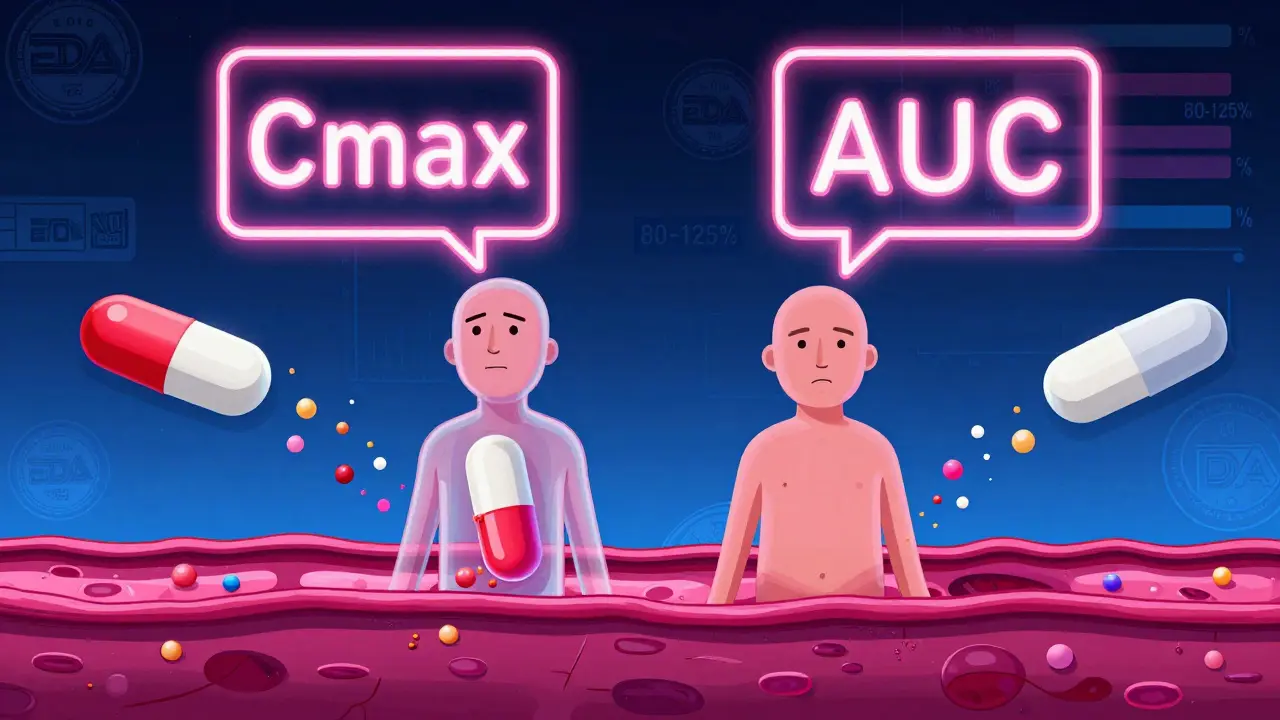
The FDA doesn’t rely on patient outcomes alone. Instead, they use pharmacokinetic (PK) studies - usually with 24 to 36 healthy volunteers. These aren’t patients with the disease. They’re healthy people who take the brand-name drug and the generic version in a controlled, randomized order, often with a washout period in between. Blood samples are taken over time to track how the drug moves through the body. Two numbers matter most:- Cmax: the highest concentration of the drug in the blood
- AUC: the total amount of drug absorbed over time (area under the curve)
Common Misconceptions
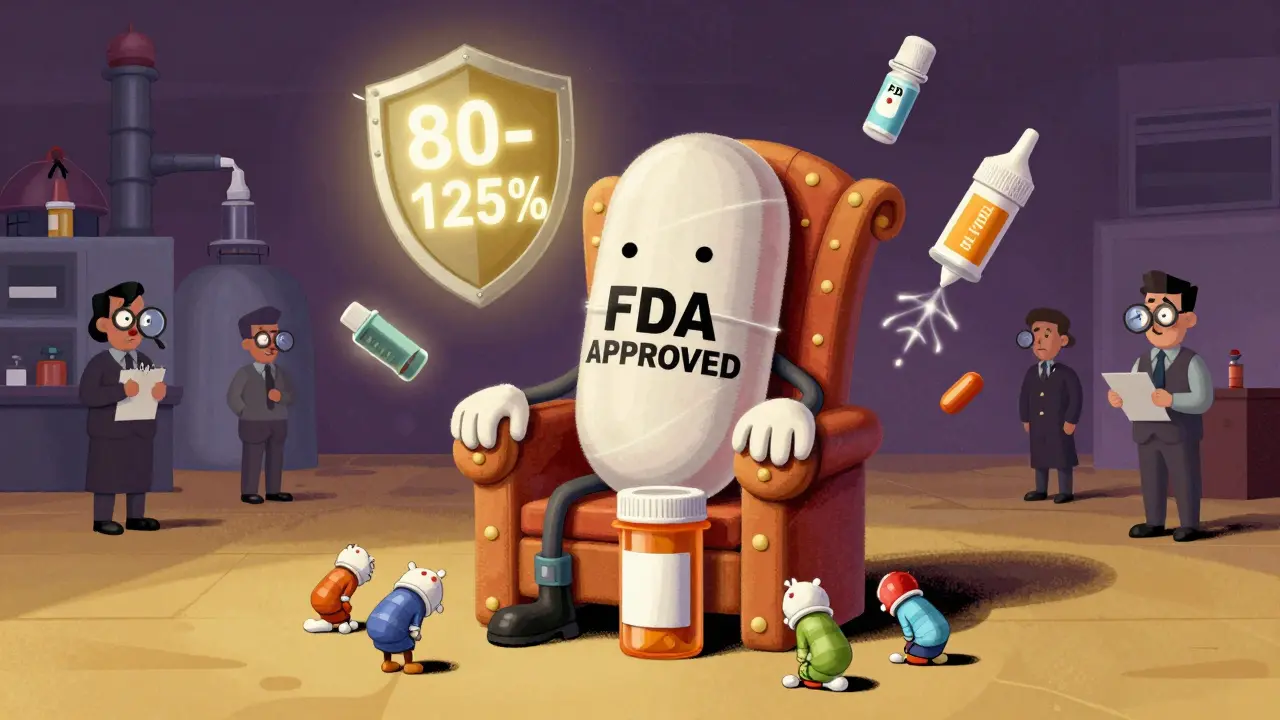
A lot of people think the 80-125% rule means the generic can have 80% to 125% of the active ingredient. That’s wrong. The active ingredient amount is tightly controlled. Both versions must contain the exact same amount - within tight manufacturing tolerances. The 80-125% range applies only to how the drug behaves in your body, not how much is in the pill. Another myth: if a generic passes bioequivalence, it’s “good enough.” But that’s not the full story. The FDA also requires pharmaceutical equivalence. That means:- Same active ingredient
- Same strength
- Same dosage form (tablet, capsule, etc.)
- Same route of administration (oral, injectable, etc.)
- Same quality standards
What About Drugs That Don’t Get Absorbed?
Not all drugs need to enter the bloodstream to work. Take inhalers for asthma, topical creams for eczema, or eye drops for glaucoma. These act locally. For those, the FDA often allows in vitro testing - meaning lab tests on how the drug releases from the product, how it dissolves, or how it spreads on the skin or in the eye. For example, a generic asthma inhaler doesn’t need a blood test. Instead, manufacturers prove it delivers the same amount of drug to the lungs as the brand name, using specialized machines that mimic human breathing. The same goes for complex topical products like creams and gels. The FDA has specific guidance for each type, with over 2,000 product-specific documents available to guide developers.Why Some Generics Still Raise Concerns
You’ve probably heard stories about generics not working as well. Sometimes, that’s true - but rarely because of bioequivalence failure. More often, it’s because of:- **Narrow therapeutic index (NTI) drugs**: These are medications where even tiny changes in blood levels can cause harm or treatment failure. Think warfarin, lithium, or certain seizure drugs. For these, the FDA still uses the 80-125% standard, but prescribers often monitor levels closely.
- **Formulation differences**: A generic might use a different filler or coating that changes how fast the pill breaks down. This can affect absorption, especially if the drug is sensitive to stomach pH or food.
- **Manufacturing inconsistency**: Rare, but possible. The FDA inspects factories and requires strict quality control. Still, small batches or supply chain issues can occasionally lead to variability.
The Bigger Picture: Why This Matters
Generic drugs make up about 90% of all prescriptions filled in the U.S. But they cost only about 20% of what brand-name drugs do. Over the past decade, generics saved the U.S. healthcare system nearly $1.7 trillion. That’s not just money. It’s access. It’s people who can afford their insulin, their blood pressure meds, their antidepressants. The FDA approves around 1,000 generic applications each year. About 65% get approved on the first try. The rest? Often because of bioequivalence issues - formulation problems, poor dissolution profiles, or incomplete data. The agency gives feedback, and companies fix it. It’s a system designed to be rigorous, but fair. New technologies are coming. Modeling and simulation tools are being used to predict how a drug will behave without running full human trials. This could speed up approvals for complex generics like patches, inhalers, or injectables. But the core rule stays the same: if it doesn’t behave the same in the body, it doesn’t get approved.What You Should Know as a Patient
If your doctor prescribes a brand-name drug and your pharmacy gives you a generic, you can trust it. The FDA doesn’t approve generics lightly. The science behind bioequivalence is solid, transparent, and constantly monitored. Still, if you notice a change in how you feel after switching - dizziness, nausea, lack of effect - talk to your doctor or pharmacist. It’s rare, but not impossible. Sometimes, switching between different generic brands can cause minor differences due to inactive ingredients. That’s why some patients stick with one generic manufacturer. You don’t need to understand Cmax or AUC to benefit from this system. But knowing that the FDA requires proof - not promises - can give you confidence. The generic you’re taking isn’t a cheaper version. It’s an equivalent. And that’s the whole point.Is a generic drug really the same as the brand-name version?
Yes, if it’s FDA-approved. The FDA requires that a generic drug must be pharmaceutically equivalent (same active ingredient, strength, dosage form) and bioequivalent (same rate and extent of absorption) to the brand-name drug. This means it works the same way in your body. The only differences are in inactive ingredients, packaging, or price.
Does the 80-125% bioequivalence range mean generics can have 20% less or 25% more active ingredient?
No. The 80-125% range applies only to pharmacokinetic measurements - how much of the drug enters your bloodstream and how fast (Cmax and AUC). The actual amount of active ingredient in the pill must be identical to the brand-name drug, within strict manufacturing limits. The range is about absorption, not content.
Why do some people say generic drugs don’t work as well?
In rare cases, switching between different generic versions - or from brand to generic - can cause minor differences in how you feel, especially with narrow therapeutic index drugs like warfarin or thyroid medication. These aren’t due to bioequivalence failure, but to slight differences in inactive ingredients or how the pill breaks down in your stomach. Always report changes to your doctor.
Are all generic drugs tested the same way?
No. For drugs that need to enter the bloodstream (like pills or injections), the FDA requires human bioequivalence studies. For drugs that act locally - like inhalers, eye drops, or topical creams - in vitro (lab) tests are used instead. The method depends on how the drug works, not just what it is.
How does the FDA ensure quality across different generic manufacturers?
The FDA inspects every manufacturing facility - domestic and foreign - before approving a generic. They check for consistency, cleanliness, and proper testing methods. Companies must submit data from all bioequivalence studies they run, not just the successful ones. This transparency helps catch problems early. The FDA also monitors post-market reports for any unexpected side effects or failures.
Can a generic drug be pulled from the market after approval?
Yes. If post-market data shows a generic drug isn’t performing as expected - for example, if patients report unexpected side effects or lack of effectiveness - the FDA can investigate. If bioequivalence is compromised due to manufacturing changes or quality issues, the drug can be recalled or its approval revoked. The FDA doesn’t approve a drug and forget about it.
Comments
Jan Hess
January 16, 2026 AT 12:22Stop overthinking it.
Frank Geurts
January 16, 2026 AT 15:04Arjun Seth
January 17, 2026 AT 14:02Mike Berrange
January 18, 2026 AT 17:21Ayush Pareek
January 20, 2026 AT 07:37Sarah Mailloux
January 21, 2026 AT 18:32Nilesh Khedekar
January 22, 2026 AT 01:36Jami Reynolds
January 23, 2026 AT 00:37RUTH DE OLIVEIRA ALVES
January 24, 2026 AT 13:14Nat Young
January 25, 2026 AT 22:26Jaspreet Kaur Chana
January 27, 2026 AT 13:55Haley Graves
January 28, 2026 AT 03:24Gloria Montero Puertas
January 28, 2026 AT 17:48Tom Doan
January 29, 2026 AT 21:32