
Antidepressant Tapering Calculator
This tool calculates a safe tapering schedule based on your antidepressant type, current dose, and duration of use. Always consult your healthcare provider before adjusting medication.
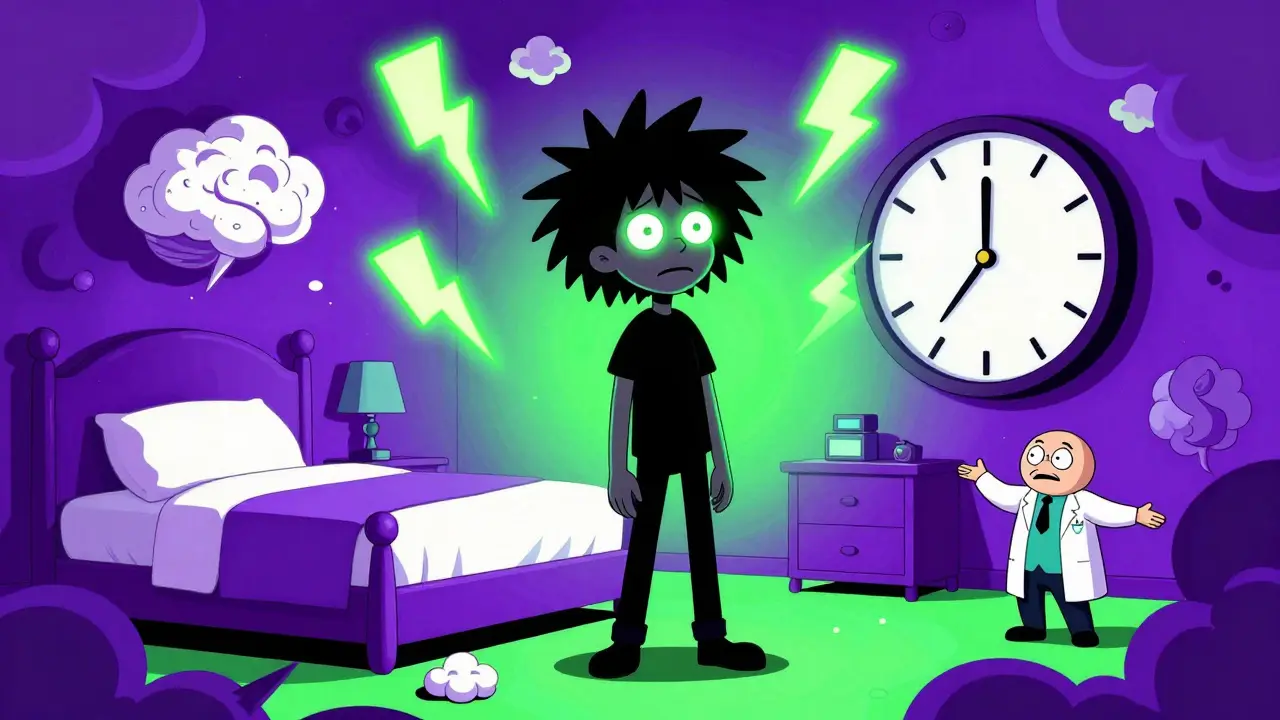
Stopping antidepressants isn’t as simple as just skipping a pill. For many people, it’s not a clean break-it’s a physical and mental shake-up that can feel like a sudden illness. You might wake up dizzy, get electric-shock sensations in your head, feel nauseous, or be hit with intense anxiety out of nowhere. These aren’t signs your depression is coming back. They’re symptoms of antidepressant discontinuation syndrome, a very real and often misunderstood reaction to stopping or reducing your medication too quickly.
What Exactly Is Antidepressant Discontinuation Syndrome?
This isn’t addiction. You’re not craving the drug. You don’t get high from it. But your body has adapted to having it around. When you take an antidepressant-whether it’s an SSRI like sertraline or an SNRI like venlafaxine-your brain adjusts its chemistry to work with the extra serotonin or norepinephrine. Over time, it stops producing as much on its own. When you stop the medication, your brain is suddenly out of sync. That mismatch triggers withdrawal symptoms. It’s not rare. Studies show up to 80% of people who stop an antidepressant abruptly will experience some form of discontinuation syndrome. The symptoms can be mild or severe, and they show up fast-sometimes within hours of missing a dose, especially with short-acting drugs like paroxetine or venlafaxine.Common Symptoms: The FINISH Mnemonic
Doctors use the acronym FINISH to remember the most typical signs:- Flu-like symptoms: Fatigue, muscle aches, chills, sweating, nausea, diarrhea
- Insomnia: Trouble falling or staying asleep, vivid or disturbing dreams
- Nausea: Feeling sick to your stomach, sometimes vomiting
- Imbalance: Dizziness, vertigo, feeling off-balance or like you’re swaying
- Sensory disturbances: Tingling, numbness, or those infamous “brain zaps”-sudden, brief electric-shock feelings in the head, often triggered by eye movement
- Hyperarousal: Anxiety, irritability, agitation, panic attacks, restlessness
Not All Antidepressants Are the Same
The risk and severity of withdrawal depend heavily on the drug’s half-life-how long it stays active in your body.- Short half-life (high risk): Paroxetine (Paxil), venlafaxine (Effexor), and fluvoxamine (Luvox) leave your system quickly. Withdrawal hits harder and faster. Up to 47% of people stopping venlafaxine experience moderate to severe symptoms.
- Long half-life (lower risk): Fluoxetine (Prozac) sticks around for days. People switching off Prozac often have milder or no symptoms because the drug tapers itself naturally.
How to Tell It’s Withdrawal, Not Relapse
This is critical. Many people think their returning sadness means their depression is back. But there’s a key difference. Withdrawal symptoms appear within days-sometimes hours-after stopping. They’re physical, strange, and unlike your original depression. Relapse takes weeks to develop. If you feel worse slowly, over time, with low mood, hopelessness, and loss of interest, that’s likely relapse. If you feel dizzy, zapped, nauseous, and anxious right after missing a dose, that’s discontinuation syndrome. And here’s the proof: if you take your medication again, withdrawal symptoms vanish within 24 to 72 hours. Relapse doesn’t. That’s how doctors confirm the diagnosis.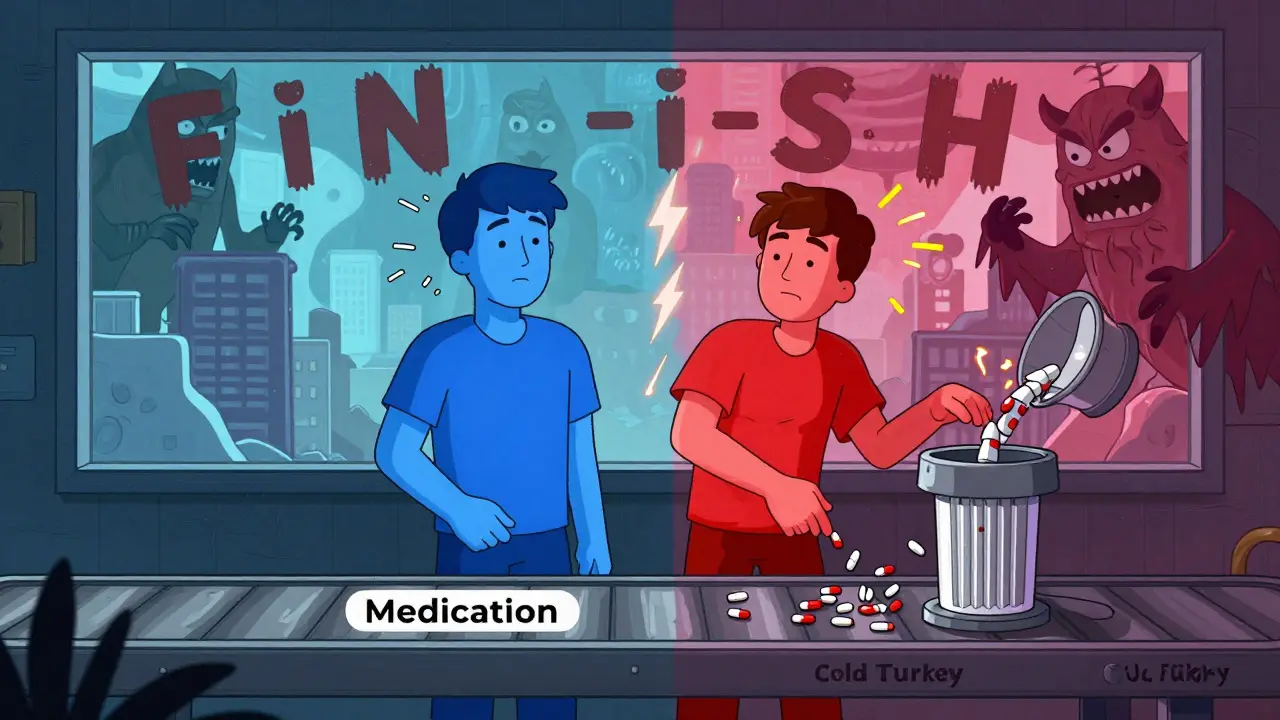
Why So Many People Are Misdiagnosed
A 2022 Reddit thread with over 1,200 comments showed 87% of people felt their doctors dismissed their symptoms. One woman was told she was “just anxious” after stopping sertraline-then spent three weeks vomiting and dizzy. Another man was sent to the ER for “possible stroke” after brain zaps and balance loss. He’d just quit paroxetine. Doctors aren’t always trained to recognize this. Many still believe antidepressants aren’t addictive, so withdrawal can’t be real. But the science says otherwise. The American Academy of Family Physicians confirmed it in 2006. The National Institutes of Health published detailed guidelines in 2017. The Royal College of Psychiatrists updated their advice in 2022. And then there’s the generic switch problem. Switching from brand-name to generic fluoxetine? Sounds harmless. But not all generics are bioequivalent. A tiny drop in blood concentration can trigger withdrawal-even if you didn’t reduce your dose. That’s why 22% of cases happen during formulation changes, not when people stop cold turkey.How to Stop Safely: The Right Way to Taper
The best way to avoid this mess? Don’t stop suddenly. Ever. The standard advice: taper slowly over six to eight weeks. But that’s not one-size-fits-all.- For SSRIs like sertraline or escitalopram: a 4-week taper is usually enough if you’ve been on them less than a year.
- For venlafaxine or paroxetine: go slower. An 8-week taper is safer. Some people need to taper over 3-6 months.
- For fluoxetine: you might not even need a taper. Its long half-life acts as a natural buffer.
What to Do If Symptoms Start
If you’ve already stopped and symptoms hit:- Don’t panic. Most cases resolve in 1-2 weeks.
- Contact your prescriber immediately. They may recommend restarting your original dose at the previous level.
- Once symptoms ease, restart the taper-slower this time.
Protracted Withdrawal: When It Doesn’t Go Away
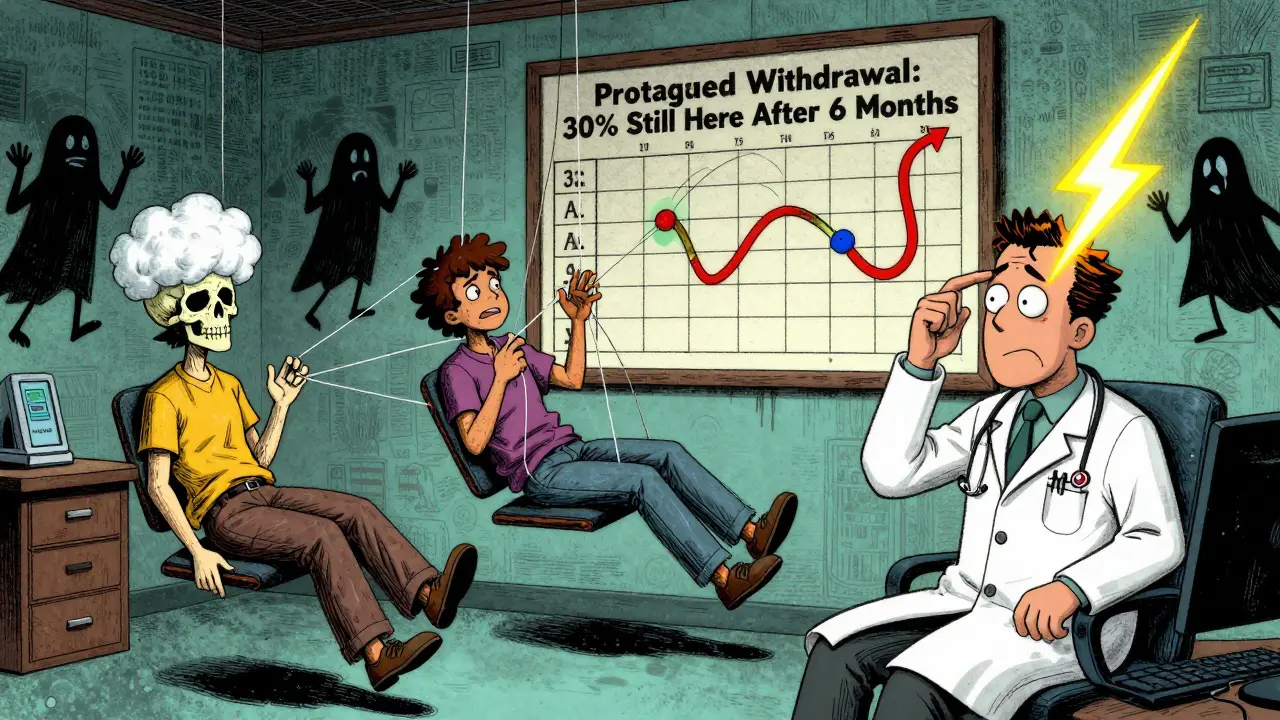
The medical literature says symptoms usually fade in weeks. But patient communities tell a different story. The Surviving Antidepressants forum, with over 15,000 members, reports that 73% of people had symptoms lasting longer than two weeks. Nearly 30% said symptoms dragged on for six months or more. Some report brain zaps, dizziness, or anxiety for over a year. A 2022 study in the Journal of Clinical Psychiatry found 18.7% of people still had symptoms after three months. That’s not rare. It’s not “in their head.” It’s a real, documented phenomenon called protracted withdrawal. There’s no FDA-approved treatment for it. But many find relief with slow reintroduction of low-dose antidepressants, supportive therapy, or lifestyle changes-sleep hygiene, stress reduction, gentle exercise. Research is ongoing. Clinical trials are now looking for biomarkers to predict who’s at risk.Special Situations: Pregnancy, Switching, and More
Pregnancy is a major trigger. Over 40% of pregnant women stop antidepressants without medical advice-often out of fear. But stopping cold can be riskier than continuing. Talk to your OB-GYN and psychiatrist. There are safer options. Never switch brands or generics without checking with your pharmacist. Even small changes in absorption can trigger symptoms. If you’re on multiple psychiatric meds, tapering gets more complex. Work with a psychopharmacologist-not your GP.Bottom Line: Don’t Go It Alone
Antidepressants aren’t addictive. But your body gets used to them. Stopping suddenly isn’t a choice-it’s a gamble with your nervous system. The symptoms are real, measurable, and avoidable. If you’re thinking about stopping, talk to your doctor. Ask about your drug’s half-life. Ask for a taper plan. Ask what to do if symptoms start. Bring this article. Bring the FINISH checklist. Bring your own experience. You’re not weak for needing help. You’re smart for asking for it.Can antidepressants cause withdrawal symptoms even if I’ve only taken them for a few weeks?
Yes. Even short-term use-four to six weeks or more-can lead to physical dependence. Your brain adapts to the drug’s presence, and when it’s removed, withdrawal can occur. The risk increases with longer use, but it’s not limited to people who’ve been on medication for years.
Are brain zaps dangerous?
Brain zaps aren’t life-threatening, but they can be extremely unsettling. They’re believed to be caused by rapid changes in serotonin levels affecting nerve signaling. While they’re not a sign of brain damage, they can interfere with daily life-especially if they happen when you move your eyes or stand up. Slowing your taper usually reduces or eliminates them.
Is it safe to stop antidepressants on my own?
No. Stopping without medical supervision increases your risk of severe symptoms by over three times. You could trigger protracted withdrawal, misdiagnose relapse, or even worsen your mental health. Always work with your prescriber to create a safe tapering plan.
Why do some people have mild symptoms and others have severe ones?
It depends on the drug’s half-life, how long you took it, your genetics, your metabolism, and whether you tapered slowly. People on paroxetine or venlafaxine are more likely to have severe symptoms. Those with a history of anxiety or previous withdrawal reactions are also at higher risk. There’s no single predictor, but slow tapering helps everyone.
Can I switch to a different antidepressant instead of quitting?
Yes, but it must be done carefully. Switching directly from one antidepressant to another can cause serotonin syndrome or worsen withdrawal. The safest approach is to taper off the first drug, wait a few days for it to clear, then start the new one. This should always be done under medical supervision.
How long should I wait before trying to stop again if I had bad withdrawal symptoms?
Wait until your symptoms have fully resolved-this could take weeks or months. Rushing another attempt increases the chance of repeating the same experience. Use that time to work with your doctor on a better taper plan. Some people need to taper over six months or longer for a safe outcome.
Comments
Usha Sundar
December 23, 2025 AT 21:14Brain zaps feel like your skull’s got a faulty WiFi signal.
claire davies
December 25, 2025 AT 19:16I remember when I tried to quit sertraline after six months-thought I was fine until I woke up at 3 a.m. feeling like I’d been dipped in static electricity. My cat stared at me like I was haunted. Turned out I’d missed one dose and my nervous system threw a full-on rave. Took me three weeks to taper down with liquid drops and a whole lot of tea. Don’t let anyone tell you it’s ‘all in your head’-your body remembers what your mind wants to forget.
Joe Jeter
December 26, 2025 AT 19:24Everyone’s acting like this is some new revelation. My grandma took tricyclics in the ‘70s and they warned her about withdrawal. This isn’t science-it’s corporate laziness. Pharma doesn’t want you knowing how hard it is to quit because then people wouldn’t take them in the first place.
Jeffrey Frye
December 28, 2025 AT 04:49lol so paroxetine is the devil? funny how every time someone says ‘brain zaps’ they act like it’s a supernatural event. it’s just serotonin receptors doing the cha-cha. also, who the hell uses liquid formulations? that’s not medicine, that’s a science fair project.
Isaac Bonillo Alcaina
December 29, 2025 AT 12:42You people are romanticizing withdrawal like it’s some spiritual awakening. You didn’t ‘heal’-you just got unlucky with your neurochemistry. If you can’t handle a simple taper, maybe you shouldn’t have started the drug in the first place. This isn’t a support group for the neurologically fragile.
Rachel Cericola
December 31, 2025 AT 08:16Let me tell you about Maria-she was on venlafaxine for 18 months, tried to quit cold turkey after a bad breakup, and ended up in the ER with vertigo and panic attacks. Her doctor didn’t even know what FINISH stood for. We switched her to fluoxetine, did a 12-week taper with 5% reductions every two weeks, and now she’s off meds and hiking in the Rockies. It’s not magic-it’s patience, precision, and a damn good prescriber. If you’re reading this and thinking ‘I’ll just wing it,’ please, for your own sake, talk to someone who’s seen this before.
Raja P
January 1, 2026 AT 18:32My cousin stopped citalopram after 4 months and thought she was having a stroke. Turns out it was just the zaps and dizziness. Took her 3 weeks to feel normal again. I’m glad this article exists-so many people don’t know this is real. Just… please, if you’re thinking of quitting, don’t do it alone. Text your doctor. Bring this page. They’ll thank you later.
Katie Taylor
January 3, 2026 AT 15:09STOP LISTENING TO DOCTORS WHO THINK ANTIDEPRESSANTS ARE ‘NOT ADDICTIVE.’ THEY’RE WRONG. YOUR BRAIN ISN’T A LIGHT SWITCH. IT’S A DAMNED TUNING FORK. AND WHEN YOU HIT IT AND THEN YANK THE HAMMER OUT? IT RINGS. FOR WEEKS. DON’T BE A HERO. TAPER.
Charles Barry
January 4, 2026 AT 16:41They don’t want you to know this, but the FDA buried studies in 2015 showing SSRIs cause permanent synaptic rewiring in 12% of users. That’s why symptoms last for years. They’re not ‘protracted withdrawal’-they’re neurological damage. And the doctors? They’re paid by Big Pharma to call it ‘psychosomatic.’ Wake up. This isn’t medicine-it’s chemical manipulation disguised as care.
Joseph Manuel
January 6, 2026 AT 07:53While the article provides a comprehensive overview of antidepressant discontinuation syndrome, it lacks a critical discussion of confounding variables such as comorbid anxiety disorders, concurrent substance use, and the potential for placebo effects during tapering. The reliance on anecdotal forums like Surviving Antidepressants introduces significant selection bias. A more rigorous approach would contextualize these symptoms within the broader framework of neuroadaptive plasticity and differential pharmacokinetics across populations. Further, the assertion that ‘brain zaps’ are non-pathological requires neuroimaging validation, which is notably absent from the cited literature.